Captain William Douglas was born on January 22, 1848, at Hinxton near Cambridge, England. He was the first child of Thomas and Phoebe Douglas and emigrated to Western Australia with his parents on the vessel Sabrina, arriving in Fremantle on June 19, 1852. His parents settled on the south side of the Swan River and became the third family to settle in South Perth. Douglas Avenue carries the family name, and Thomas Street runs close to Douglas Avenue; it would be interesting to discover if this street was named after Thomas Douglas.
Thomas held a large area of land extending along the river, where he planted orchards and gardens. He rowed his produce along the river and established a shop on about the site of the Town Hall. In later years, his gardens were worked by the Chinese. As late as 1914, one of his sons, Arthur, held 20 acres of land, which now forms most of "The Sir James Mitchell Park." William was educated at Bishop Hale's Perth Boys School, which he attended by rowing across the river from his home in South Perth.
On July 5, 1868, William married Emma Matilda Barratt in Perth. They were to have eight children, six of whom survived: William, Edward, Bert, Clemence, Thomas, and Percy. The couple were living in Albany when their first child, William, was born in October 1869.
Since William likely spent his early days working with his father in the orchard and gardens, this may explain why, when he went to Albany in 1882, he selected land at Nanarup, 11 miles east of Albany, and built his first home. I remember my father, Clemence, pointing out the land around the house that he and his elder brothers cleared. He sought better opportunities around the Port, losing interest in Nanarup, and moved into Albany.
William's first recorded employment was as a co-driver on a Perth to Albany mail coach. In 1870, he was believed to be part of the crew of the vessel Adur, which carried John Forrest's supplies to Esperance from Perth for his overland trip to Adelaide.
In 1872, William and a Mr. Alcock founded the first Rechabite Tent [Lodge] in W.A. at Albany. Mr. Alcock was on his way to Perth from Adelaide to open the first Tent in Perth. However, he had to stay in Albany for a few days while his ship sheltered from bad weather and, disliking hotel life (the Order is a teetotal one), he joined Captain William Douglas, who was also a total abstainer. Together, they founded the Plantagenet Tent.
In 1873, William, along with his brother Frederick, was a member of the victorious Christmas rowing regatta team in Albany on Boxing Day that year.
In 1873, he was recorded as the owner of a one-masted cutter, the Victory, which was wrecked off West Cape Howe in June 1875. This seems to have been the first recorded vessel owned by him.
In about 1876, he moved to South Australia with his family, where he served from February 2, 1876, to September 5, 1879, as a second-class constable with the Adelaide Metropolitan Police Force.
William and his family returned to Albany in 1879, and he is supposed to have operated the first privately owned steam launch in Albany. He is recorded as the owner of the Perseverance, a small steam tug used for harbour duties in competition with Alex Armstrong's Loch Lomond.
In May 1885, William, in the Perseverance, rescued a drowning sailor from HMS Opal during a squall in Albany Harbour. William was to use the name Perseverance for two more vessels; it reflects his character that after his initial Victory was wrecked, its successor should be called Perseverance.
In November 1890, William Douglas took the newly built ketch Perseverance on a sealing expedition to the islands between Albany and Eucla. This journey had to return early after one of the members, Mr. John Hayes, was accidentally killed.
In 1889, William was a member of the Albany Town Council; a bronze plaque fastened to the clockwork in the Old Town Hall bears the names of nine serving councillors, including William Douglas.
In 1894, along with his son Bert and others, he participated in a gold prospecting trip to the Dundas and Coolgardie goldfields. They may have been employed by the Douglas Prospecting Company, a South Australian registered company with offices in Albany at the time.
Several letters from William and his son Bert to William’s son Ted survive, graphically depicting the rigours endured by the company during 1894 and 1895. The trip does not seem to have been very successful.
In 1886, William sailed as assistant engineer on the vessel Jessie on a voyage from Melbourne to Albany.
Discharge papers for that voyage, between August 14 and September 27, still survive.
William had purchased the Jessie for use as a steam tug in the Port of Albany. In the same year, he received his Master's Certificate for the Port of Albany.
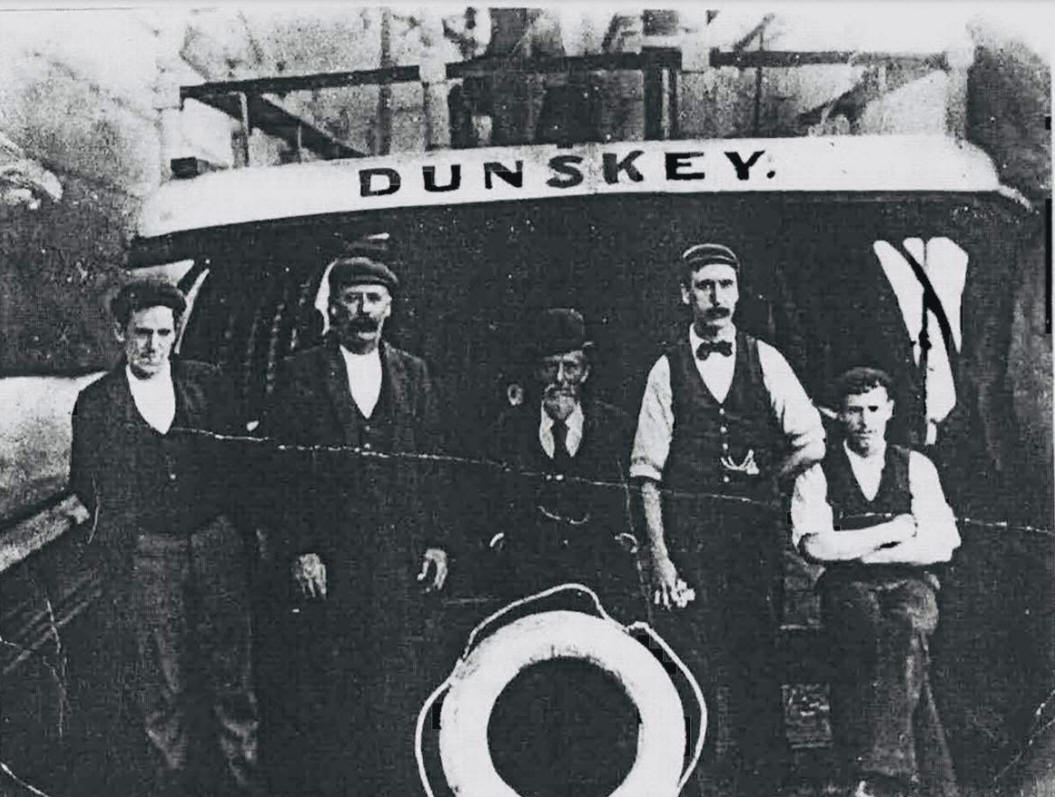
In 1896, he purchased the steam tug Dunskey in Sydney and sailed it to Albany, arriving at 11:30 PM on December 24, 1896. The vessel was floated in the P&O Company's floating dock when necessary, and a photo of the Dunskey in that dock in 1897 still exists. The tug was used for carrying passengers as well as performing its normal duties as a tug and tender.
A photo taken in 1897 shows a sign on her bridge railings offering return journeys for one shilling.
On Thursday, September 1, 1898, the small steamer Gertie ran aground in the entrance to Wilson's Inlet following a south-easterly gale. Already engaged to tow the Gertie to Albany, that vessel signaled she had run out of coal. Captain William immediately set off in the Dunskey to rescue her. Bad weather forced a postponement of the attempt, but by Sunday the 4th, conditions had cleared sufficiently for another attempt. The stranded vessel was reached at 5 PM, and preparations commenced the next day to haul her free. The Gertie was floated off at 12:00 PM on the 5th and towed back undamaged to Albany, arriving there at 2:20 PM. Captain William received £1,000 for the salvage.
In July 1899, Captain William Douglas and the Dunskey were operating out of Fremantle, with his son Clem in the crew. On July 12, 1899, following a terrible gale, the sailing ship City of York ran onto Rottnest Island's northern shore to become a total wreck.
The next day, in the Dunskey, William carried out a daring rescue of the eight crew still aboard the wreck. While his son Clem and a young assistant named Bill Riley manned the Dunskey beyond the rolling surf, he made several perilous journeys with his dinghy under the stern of the City of York to rescue the men.
While some accounts say he made eight journeys, others claim it was three. He was recommended to the Royal Humane Society for his bravery but received little more than the acclaim of his contemporaries for a courageous and dangerous rescue.
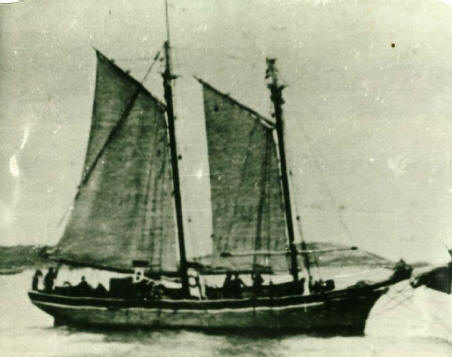
In about 1904, William purchased the three-masted barquentine Iris from J & W Bateman of Fremantle and chartered this vessel between South Australia and southern coastal ports.
Lacking a seagoing Master's Ticket, but holding a coastal Master's Ticket, William could not command the vessel but remained "close to their action" by sailing as Purser. A discharge paper for the voyage from January 21 to August 24, 1904, survives.
During one of these voyages, the Iris was dismasted in bad weather, and a photo of her at Port Adelaide shows her with her foremast broken at the topsail yard and hanging over her starboard side.
In 1906, William was back at the Kalgan River in Albany, where he built the 5-ton timber steam launch Perseverance, the third vessel of that name. Surveyed on January 11, 1907, as a "propelling" launch equipped with one oil engine burning naptha and producing 6 hp, the Perseverance was licensed to carry up to 40 passengers in the Port of Albany.
In 1910, William and his son Clem sailed in the motor launch E M D (Emma Matilda Douglas) to the Leeuwin looking for salvage from the RMS Pericles. The ship had struck a rock and sunk a few miles off the Leeuwin. The launch E M D had been built for William by an Albany boat builder, Bill Geary, around 1908-1909. It measured 30 ft long, 9 ft wide, and had a 3 ft draught, powered by a 14 hp, 4-cylinder Wolverene petrol engine. Fitted with a mast and sail, the mast could be lowered to pass under the lower Kalgan Bridge.
In December 1912, along with many other residents of the district, many of whom were his descendants, William and his wife Emma attended the opening of the (Upper) Kalgan Hall as guests of the Kalgan River Settlers Association. Between 1915 and 1916, William commenced building a home high on the bank of the river at the Top Kalgan Bridge. The house was built of stone and still stands today. The writer, as a young boy, helped him build it.
From July 1916 to 1918, William was again attempting to salvage a vessel on the South Coast, this time at Fanny's Cove east of Albany. However, this attempt to pull the stranded vessel, the Dunster Castle, from the beach ended in failure, and she eventually became a total wreck.
In 1919-1920, William built a lighter on the bank of the river just below his home. The lighter was constructed for his son, Captain Clem Douglas, to "lighter" or carry fruit from the river to Albany. It was built of Jarrah planking and bush timber, with planking sourced from the old whaling station at Frenchman's Bay. Its dimensions were 40 ft long, 12 ft wide, with a 12-inch draught and a depth of hold of 7 ft. The same year, William dismantled the Frenchman's Bay Whaling Station.
The housing, sheds, and workshop were purchased by William Douglas, his son Bert Douglas, and a Mr. Johnson. The lighter was used to ferry the material from Albany. The writer, Les Douglas, helped his grandfather throughout this period. William built many small craft, including the lighter, of up to 40 ft during his years on the Kalgan River, first while living at Killarney and then at Maitland. This property belonged to his son, Captain Bert Douglas, who at this time was employed by the State Steamship Company as the master of their first vessel, the SS Una, and then the SS Eucla.
While living at Maitland, William built his last home at the Top Kalgan Bridge. Here he built the lighter and several other small boats. It seemed that if William wasn’t on a boat, he had to be building one. He was also very happy at the Kalgan, as five of his sons had land and orchards there. Three of them and their families lived within a mile, providing him with plenty of river access and always a boat.
Late in 1924, William and Emma's sons, Percy and Thomas, sold the Kalgan River property. Thomas had bought a 20-acre orchard property at Bedfordale, while Percy bought a house in Leederville and was on the State Ship Kybra. William and his wife moved to Perth to be near many of their old family friends, living in Percy’s house. It was there that they celebrated their Diamond Wedding.
William's wife Emma died in 1929.
At the age of 80, William moved to Bedfordale to live with his son Thomas and daughter-in-law Irene. In early 1932, he suffered a severe stroke that left him incapable of many activities, making his last days sad and frustrating.
On November 11, 1932, while tended by Percy’s wife Eunice at 4 Thomas Road, Armadale, William suffered a final fatal stroke and passed away that day. William Douglas was buried in the family plot at Karakatta, in the Wesleyan section, BA, #254.
Some idea of how intrepid William Douglas was may be gained from the fact that he obtained his first driving licence at the age of 80, promptly bought a car, and proceeded to drive it down to Albany”
This biographical sketch of William Douglas was written by his grandson, Les Douglas
See also:
• His brother, Fred
Douglas
•
Descendants of Thomas and Phoebe Douglas (William's parents) [16mb;
pdf]
Contributions
Do you have an ancestor whose
story should be told here? Can you add to this article? Please let us have the details.
|