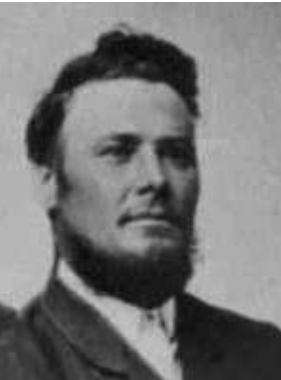
Frederick Douglas was born on the 8th July 1850 in Hinxton, Cambridgeshire, England, and was the second son of Thomas Douglas and Phoebe Wisbey. He came to Fremantle, Western Australia in 1852 on the sailing ship “Sabrina” with the rest of the family and was renown as a coastal sea captain operating on the south coast of Australia between 1873 and 1910. Frederick was the owner of the vessels “Agnes” and “Grace Darling”. Master of the tub called “Bruce” and a Master Mariner, holding the certificate of competency #121, Western Australia.
Captain Frederick Douglas will be longest remembered on the south coast in connection with his schooner The Grace Darling, which he rescued the 196 passengers and crew of the Steamer “Rodonds”, which sunk after striking a reef in
1894.
Frederick Douglas was a pupil of Perth’s Government School when William Adkinson was its headmaster. Here he won a poetry reading prize awarded by the Colonial Secretary. His
first job was with the Fremantle Post Office. It is believed he went to Albany at about the same time as his brother William in 1869. He took part in the Albany rowing regatta on Boxing Day 1873. It is also believed he spent time sailing vessels along the south coast, as well as spending time on William Douglas vessels “Victory” (built at Albany in 1873, official number 01.119.11 of 1874, single masted cutter dimensions 46’x6’, wreaked
West Cape Howe 25th June 1875) and “Perseverance” between 1873 and 1881.
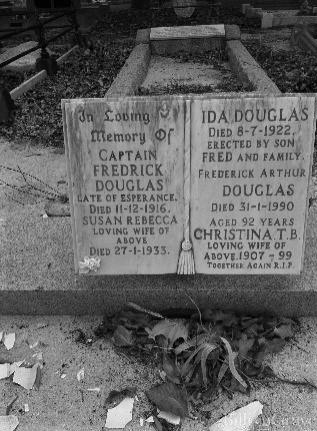
In 1879, Frederick married Priscilla Elizabeth Archie and she bore him 4 children-Ida, Archie, Carl and Grace before she died in 1889. Frederick remarried in 1890, to Susan Rebecca Wellstead who was the children’s Governess, and she bore a further six children; Faith, Evelyn, Robert known as Bob, Mona, Frederick and Coral.
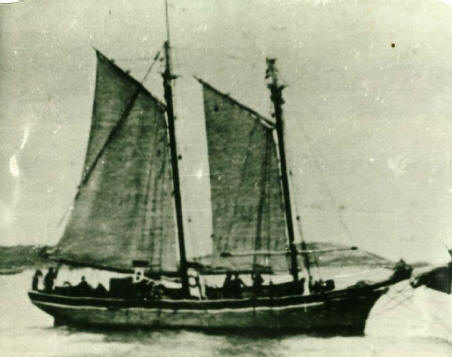
Les Douglas states in the Maritime Albany Remembered that “Frederick must have gained some Knowledge of the south coast” as her purchased the schooner Agnes in 1881. The photo on the left is the schooner Agnes of 45 tons was built in Brisbane Water NSW in 1874. Initially owned by J. Freeman in 1877, sailing out of South Australian ports; ownership transferred to W.H. Jelly in 1878 and purchased by Captain Frederick Douglas in 1881. Used extensively in south western coastal trade of Western Australia, including
delivering mail to Esperance. An advertisement in the Albany Advertiser dated February 11th, 1888, lists her owners as “F & A Douglas”; this probably Alfred Douglas. Agnes was wreaked at Bremer Bay 24th April 1892.
In April 30th 1878, the then collector of customs Mr L. W. Clifton, was concerned about the prevalence of smuggling in the south east of the state, and wrote to the Colonial Secretary; “Persons must be employed as Customs Offers at Eucla, Israelite Bay and Esperance Bay for now that I knew that smuggling is going on at these outports preventative measures must be taken to remedy those evils as soon as possible”. It is quite likely that Frederick and Alfred may have been a party to these entrepreneurial endeavours? for over 29 years, on the Agnes first and then on the Grace Darling.
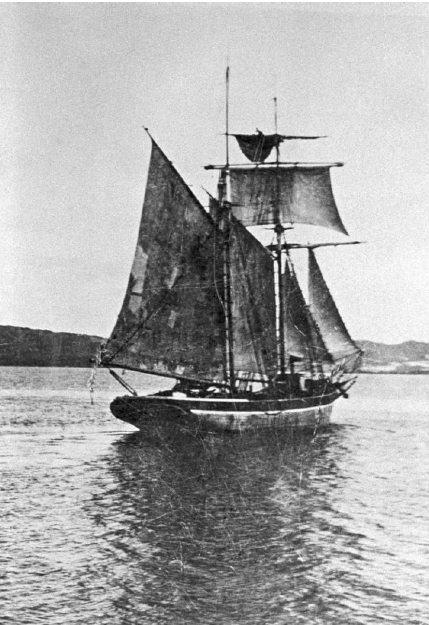
Frederick Douglas served the remote communities of the south-east coast. His ship the Grace Darling (Built Battery Point, Hobert, Tasmania in 1869, official number 57502. W.A. registration 3/1892, Fremantle 21/6/1892; wreaked Edward Island Lancelin 4/2/1914) Virtually became a training ship, as many notable mariners of the south
coast-Captain Harris, Chief Harbour Master Western Australia; Captain Winzar, Chief Harbour Master Western Australia, Captain Bent Douglas, first captain W.A. State shipping service; Captain Carl Douglas,
Photo of the Grace Darling.
Skipper of the Wyola in the Mediterranean during World War one. Captain Archie Douglas, last Harbour Master Braselton and Captain Clem Douglas – all served their “Apprenticeships” on her.
In October 1894 in Grace Darling, Frederick Douglas rescued 197 passengers and crew from the steamer Rodondo, wrecked on Pollock Reef in that month. A boat containing members of the crew, then sailed towards Esperance to seek help. In the fresh north-east wind, they reached the south-west corner of Middle Island by 8.30pm and, in order to check their course, lit a kerosene flare using a lamp thrown into the boat at the last minute. The wind blowing out the light almost immediately but with brief flash was just sufficient to be glimpsed by Captain Frederick Douglas on the schooner Grace Darling, on route from Esperance to Israelite Bay. He investigated and took the crew of the boat on board and, towing their boat, sailed for South East Island, arriving there about midnight.
The Grace Darling anchored about three miles off the island until dawn, when its dinghy and the boat from the Rodondo were used to make contact with those on shore. Heavy seas prevented any landing and the Grace Darling sailed to the other side of the island and made another attempt to land at 9.00am, but again without success. An hour and a quarter later the first survivors were taken on board the Grace Darling and by 12.15pm all 36 crew and
160 passengers had been rescued. The schooner landed them at Point Malcolm, when they were cared for by the people at the sheep station which belonged to Messer’s Ponton Bros and Sharp.
Three of the passengers, Mrs Corston and her two daughters were taken by the Grace Darling to Israelite Bay where they were looked after by Mrs Ryan, the Telegraph Station-master wife.
He retired in 1910, due to ill health. Frederick Douglas was recognized at a function at the Albany Town Hall by the Mayor of Albany, Mr A. Armstrong. It was said at of him at that function “Generous, Kind and considerate in every way and along the south coast his name was a household word. No man knew the coast between Fremantle and Eucla better than he did and no matter how unpleasant the circumstances, he had always done his duty, ever mindful of the needs of those among whom he traded”.
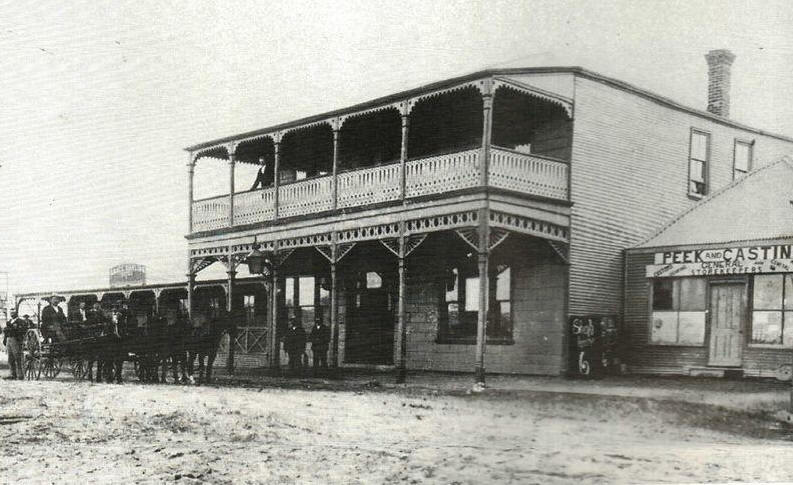
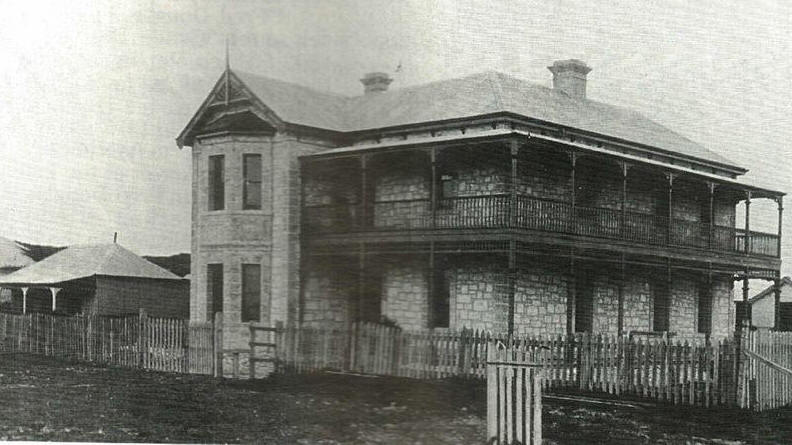
Frederick died 11th December 1917. Frederick and Priscilla first lived in Albany on a home that is still standing on the corner of Brunswick Road and Lawly Park. In 1890, he moved to Esperance where he built the two-storey house “Fairhaven” in Dempster Street. Frederick also built the old Grace Darling Hotel in Esperance and several other buildings.
Captain Frederick Douglas brought his family then consisting of 4 girls and 2 boys to Esperance in 1898, arriving on his ship the “Grace Darling”. He lived in an eight-room house for ten years, where the Esperance Land Development Company was situated, north side of present Esperance post office.
Captain Frederick Douglas built the big house “Bayview” in Dempster Street, his niece Agnes
helped a lot.
There is additional information (1) about Frederick Douglas on the cairn at Bremer Bay, which marks the site of the primitive signalling station used by the Wellstead family to signal Captain Douglas to pick up cargo. The rock cairn had an important role to play in the early days of coastal trade and transportation in Bremer
Bay. First built in the 1880’s by the pioneering Wellstead family, the cairn was used to signal passing vessel’s that there was cargo to pick up from John’s Cove.
The original cairn consisted of a long pole held upright by a
large pile of rocks. A lantern hung on the pole at night and a white
flag by day were used as signals. The first seafaring vessel dedicated
to coastal trade and communication
between Albany and Eucla began operating in 1881 and this was the Agnes, a 19 metre 44-ton schooner skippered by Captain Frederick Douglas a “Crack Mariner” who exploits over more than 30 years of sailing the south coast became the staff of legends. Travelling by sea dramatically reduced the time it took to reach Albany from Bremer Bay-about eight hours of sailing time compared with four to ten days by bullock dray. For John and Anne Wellstead, sea transportation meant they could move produce, including livestock, skins, wool, sandalwood, vegetables and dairy produce much more quickly in large quantities and more to markets than ever before.
The Agnes was Douglas’s first vessel and they would sail together for 11 years before she met her end in Bremer Bay. On the night of the 24th April 1892 the Agnes was moored in John’s Cove. Heavy seas sent huge rollers into the bay, breaking her anchorage and carrying her high up onto the bar at Wellstead Estuary and wrecking
her. Frederick Douglas had a mere six weeks in which to replace the Agnes before his (Mail) contract would be forfeited. In this time, he rode 107 miles to Albany then sailed to Adelaide and returned on the Grace Darling, a 25-metre schooner, almost twice the tonnage of the Agnes.
Frederick Douglas who was the husband of John and Ann Wellstead’s fourth child, Susan, would captain the Grace Darling for 18 years. Together they became a household name between Fremantle and Eucla. By the time Frederick Douglas retired, aged 60, in 1910 overland transportation was overtaking shipping as a more viable option.
Notes:
1. I have tried to find a quality
photograph of the cairn and its sign. Has anyone got a copy?
See
also:
• William Douglas,
his brother
•
Descendants of Thomas and Phoebe Douglas (Frederick's parents)
[16mb; pdf]
The above article is a contribution by Derek Glover
Supplementary Article
Captain Frederick Douglas (1850–1916): Pioneer Mariner and
Builder of Western Australia’s South Coast
Born on July
8, 1850, in Hinxton, England, Frederick Douglas migrated to Western
Australia with his parents, Thomas and Phoebe Douglas, aboard the
*Sabrina*, arriving in Fremantle in June 1852. After a brief stay at Mr
Hardy’s Peninsular Farm (now Tranby House), the family settled in South
Perth, becoming the third family in the area. Frederick attended the
local government school, where he showed early promise in poetry, and
began his working life at the Fremantle Post Office.
In 1869,
Frederick and his brothers William and Alfred moved to Albany, where he
would spend the next 25 years. He quickly developed a strong connection
to the sea, joining the Albany Rowing Regatta team and working aboard
his brother’s boats, Victory and Perseverance. His maritime skills
flourished, and he became known for his seamanship and deep knowledge of
the south coast.
Frederick married Priscilla Elizabeth Keyser in
Albany in 1879, and they had four children: Ida, Carl, Archie, and
Grace. The family lived at the corner of Brunswick Road and Lawley Park,
in a house that still stands today. Priscilla passed away in 1889 and is
buried in the Albany Pioneer Cemetery. In 1890, Frederick married Susan
Rebecca Wellstead of the Bremer Bay family, who had been governess to
his children. Together, they had six more children: Faith, Evelyn,
Robert (Bob), Mona, Frederick, and Coral.
As an early trader,
Frederick purchased the 43-tonne schooner Agnes in 1881, using it to
deliver mail and supplies along the rugged south coast from Albany to
Esperance. Susan often accompanied him on these voyages. After the Agnes
was wrecked in a storm at Bremer Bay in April 1892, Frederick swiftly
acquired the topsail schooner Grace Darling in Adelaide to maintain his
mail contract.
The Grace Darling became legendary for its service
to isolated coastal communities. In October 1894, Frederick played a
heroic role in rescuing 196 passengers and crew from the wreck of the
steamer Rodondo on Pollock Reef. He transported the survivors from
Middle Island to Israelite Bay, beating the government steamer thanks to
his expert navigation of the “inside passages.” His actions likely saved
many lives and cemented his reputation as a master mariner.
Frederick’s maritime ventures also supported his building projects. In
1898, he moved to Esperance, where - assisted by his brother James - he
constructed the Grace Darling Hotel, the Esplanade Hotel, and in 1902,
the residence known as Bay View (possibly Fairhaven) on Dempster Street.
Much of the stone came from offshore islands, carried as ballast aboard
the Grace Darling, while limestone was quarried near Pink Lake. He also
re-erected the Corner Hotel as a residence and owned land at Monganup.
Frederick served as Captain of the tug Bruce, operated by Armstrong
and Waters in Albany, and contributed to major infrastructure projects
including the Overland Telegraph and the rabbit-proof fence, even
causing a two-month mail delay while transporting materials.
In
1910, Frederick retired to Claremont due to ill health. His service was
honoured at the Albany Town Hall, where Mayor A. Armstrong presented him
with a gold Waltham watch and 50 sovereigns - a testament to his
enduring legacy. The watch remains in the family.
Frederick
Douglas died on December 11, 1916, in Claremont. His legacy lives on in
the buildings he constructed, the lives he saved, and the mariners he
mentored. A pioneer of Western Australia’s south coast, his story is one
of resilience, ingenuity, and quiet heroism.
|