This contributed article forms part of the
Douglas of
Cavers collection
END OF AN ERA – THE LAST OF THE DOUGLASES OF CAVERS
This story is derived from three larger ones which you can find elsewhere on this site via the following links:
• Douglas of Cavers
• Cavers House
• Douglas of Cavers family tree
Life nowadays is quite different from the world that our grandparents grew up in, as it was also for them in comparison to their own grandparents,
writes James Ninian Douglas. Indeed, that’s very much been the case since the start of the Industrial Revolution in the mid-18th century, but prior to that, change was measured in centuries rather than decades, and family traditions were respected and adhered to.
Society was far more gender and class dominated then than today’s improved if still imperfect equilibrium and nowhere were those distinctions more evident than in the world of the landed gentry. Entitled privilege brought increased burdens of responsibility though, especially for first-born males who were expected to not only follow in their father’s footsteps but also sire male heirs with wives who were not necessarily their preferred choice of potential mate.
 |
|
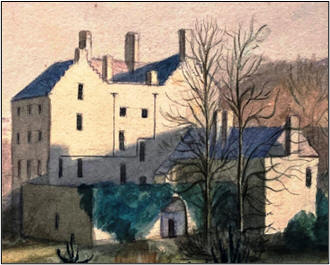
PPainting
of the NW aspect (1854)
|
The history of Cavers is pretty much unknown prior to the late Middle Ages, and it wasn’t until 1320 that a charter provides evidence of the first Douglas ‘ownership’. However, in those days ‘The Crown’ legally still owned the land, so a charter was the monarch’s means of bestowing property to a faithful ally, with subsequent inheritance requiring royal approval. In special cases though, the sovereign might grant a right of ‘entailment’, which under Scots law was a mechanism to restrict the ownership and inheritance of land, ensuring it remained within a specific family line for generations. Essentially, it involved creating a deed that dictated how property would be passed down, preventing the current owner from selling or bequeathing it to anyone outside the designated line of heirs, who by law were designated as male. Thus, when King David II entailed the estate of Cavers amongst others to William 8th Lord of Douglas in 1333, it meant that the family had a greater confidence that the land would remain theirs for generations to come.
But rules had to be followed, and when Isabella, the Countess of Mar, moved into Cavers in 1388 upon the death of her young brother Sir James Douglas, the 2nd Earl, and declared it her own, aided by the fact that her nephew Archibald, the natural successor, was only aged 10 at the time, she was effectively doing so illegally. As time passed by and Archibald entered adulthood, Isabella decided that Cavers was actually a nice place to live and resisted all attempts by him to vacate her from the property. Simply by virtue of her gender though she had no right to remain there without royal sanction, so King Robert III decided to make an example of her and conferred the entire estate to Sir David Fleming of Biggar, thereby reinforcing the unwritten law that what the King giveth he can also taketh away. If for no other reason than there would be no need for this story to be written, it was fortunate that Sir David didn’t survive long enough to take possession, and Archibald was quick to replace Isabella in situ. Technically Archibald didn’t become 1st Laird until 30 November 1412 when King James I of Scotland ratified his ownership, but thereafter the family enjoyed eleven consecutive generations of successful inheritance.
 |
|
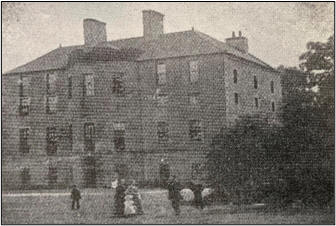
A A very
early photo of Cavers House
showing NE aspect (1860)
|
By having more than one son, a Laird could ensure a greater likelihood of succession, so large families were often created. That would prove to be a wise investment in the case of Sir William 11th Laird and his wife Katherine Rigg. Their eldest son William 12th Laird died without leaving an heir, so the barony passed to his younger brother Archibald 13th Laird. Together with his wife Anna Scott, they conceived an impressive tally of 14 children, but it is at this point that the family’s run of good fortune came to an end. This was the early 18th century; a time when smallpox was particularly prevalent, and two of their eleven sons would succumb to the disease at a young age. Of the other nine, the first four died in age order without issue, whilst the remaining five had also all preceded the fourth-born, leaving him as last in line. Thus Lairds 14 – 17 were all brothers, and when John 17th Laird passed the family had something of a crisis on their hands with it seeming that a “judgement to heaven that the cradle should never rock again in Cavers House" curse had indeed come to pass.
However, a first cousin-once-removed was alive and well, so George 18th Laird was able to fill the void and successfully continued the lineage through his son James 19th Laird. The family had originally experienced a narrow escape following Isabella Countess of Mar’s selfishness, and more recently when nine sons had failed to produce heirs, so the very last thing they needed was someone who would wilfully choose to end the male line.
 |
|
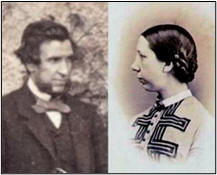
James (20th)
& Mary Agnew circa 1853.
There are no known photos of them
together, even from their 1858 wedding.
|
James the 20th Laird and eldest son of his namesake 19th Laird was an intelligent and well-educated man having been privately tutored at home under his father’s direction, possessing strong religious beliefs and having a love of literature. However, he had a very
different side to his personality too, and when his parents threatened to disinherit him if he continued his relationship with a Swiss lady whom they felt was beneath his social standing, he undertook to gain an exacting and damaging revenge. Playing the role of the dutiful son, he married his parent’s first choice, his cousin Mary Graham Agnew, but he then calculatingly failed to consummate the marriage and spent their remaining years living apart from her in full knowledge of the likely consequences of his lifestyle choice. For her part, Mary chose to accept her fate rather than expose the scandal, let alone seek divorce on entirely legal grounds.
James had a younger sister Mary who had married and given birth to a daughter, also called Mary, in 1859 before dying a few days later from complications arising from the birth of her daughter. Therefore, when her uncle James died in 1878 Mary Douglas Malcolm inherited Cavers and became its 21st Laird. The following year she married Captain Edward Palmer, thereby creating the secondary Palmer Douglas line.
Mary was succeeded by her elder son Archibald, who became 22nd Laird when he attained the rightful age in 1905, before his elder son James became the 23rd and final Laird in 1949. Whilst succession had been problematic at times, solutions had always been found, but now an entirely new threat was on the horizon, and one which would deal a fatal blow to the dynasty. Duty was a word that 23 Lairds had been accustomed to repeatedly hearing as they grew up and was nothing to fear…. until now.
In the aftermath of the Second World War the British political landscape had dramatically changed, and the Labour government of the time were determined to squeeze every possible penny from the country’s more affluent citizens in order to fund its spending plans. Large estates were an easy target so, when James 23rd Laird came to succeed, his inheritance came with a very large bill…. Estate Duty, which had recently increased to a crippling 75%. Also known as death duty’, that was a one-off payment, but there would also be ongoing annual Land Tax to be paid. First introduced in 1692, it was originally a tax on real estate and personal property, but from the 1730s it was mainly levied on land value based on rental assessments.
The estate’s main asset was Cavers House itself, but high Land Tax rates were off-putting to potential buyers, to such an extent that James was unable to even give it away to The National Trust for Scotland which was founded in 1931 to conserve Scotland’s heritage.
 |
|
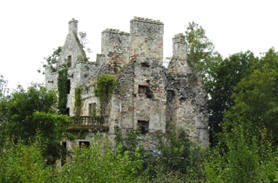
NE view of
remaining ruins (August 2025)
|
His only viable option was to decant the family to a nearby smaller property and empty the house of anything that had a value, even the glass in the windows. High-end items were auctioned at Christies in London to cover the death duty, and the British Army was brought in to reduce the building to rubble so that the stone could also be recycled. However, the walls of the main tower were so thick that most of it remained unscathed, but at least the building was no longer habitable, and thus the Land Tax could be avoided.
There was still a large estate to be run though. Originally stretching to 10,000 acres, a series of sales that began in 1913 had halved its size by the time that James inherited it, but it was no longer a viable proposition and further disposals during the next 60 years reduced it to less than 1,000 acres. A messy divorce in 1975 necessitated the sale of most of the balance to cover the settlement, but James still clung onto the main house ruins and the land upon which they stood in the forlorn hope that he might somehow experience a dramatic upturn in fortunes. This was pre-National Lottery times though, and no magic Premium Bond fix was forthcoming either, so at the age of 58 he decided enough was enough and in 1980 finally relinquished his hold on that too.
All that now remains in family ownership is a single acre behind Cavers Auld Kirk which comprises a consecrated family burial plot in which James was interred in 2013. His five children were spread far and wide across the UK, with only his youngest son Stephen domiciled in the locality. Stephen was a regular visitor to Cavers and a blurred photo exists of him salvaging a large stone lintel
(above) from the estate in July 1995.
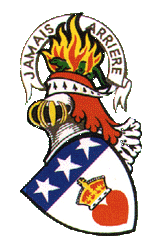
The Douglas of Cavers motto ‘Doe Or Die’ is inscribed on it, and whilst it’s suspected to date from circa 1885 and was possibly above the N entrance door, nobody knows its origins for certain. Sadly, Stephen died in 2024 aged 62, and whilst his ashes were scattered elsewhere his name was added to the gravestone of his father’s double plot. In Stephen’s memory, his elder brother and eldest sister spent Easter 2025 renovating the site making it easier to maintain but also to make it a bit more welcoming to visitors, some of whom even make the pilgrimage from North America to plant their feet on the earth of their ancestors.
However, it’s unlikely that this small parcel of land will be maintained by future generations, as James’ three sons will leave no issue, whilst the children of his two daughters show little interest in their heritage, preferring to leave the past as the past. So, although a candle still flickers, even that will extinguish once James’ offspring depart this world, and they effectively become the last of the Douglases of Cavers.
James Ninian Douglas – September 2025
Stories from the Sennachie
Our storyteller has two tales connected with the end of the Douglas
of Cavers era:
•
The Cavers curse
•
The Hassendean curse
Contributions
Do you have an ancestor whose
story should be told here? Can you add to this article? Please let us have the details.
|