This page is a stub.
You can help improve it.
For three generations, the Palmer-Douglas family made their home at
Cavers. By the time young James Palmer-Douglas, grandson of Mary and
Edward, was born in 1922, the estate had already begun to shrink. When he
eventually inherited it, Cavers extended to some 5,000 acres, the result
of earlier sales of the farms at Denholm and Spital.
Cavers itself was an entailed estate, a legal arrangement that
ensured the property would pass securely down the family line but made
selling land notoriously difficult. Only later changes in the law
allowed the Palmer-Douglases to release portions of it. James would
later reflect on those years with characteristic frankness: he had gone
to war at twenty with the Royal Air Force, and when he returned, he
admitted he had little appetite for university or the formal study of
estate management.
During the Second World War, the great house at Cavers had been
turned over to the Women's Land Army, its rooms filled with the energy
and labour of those who kept the countryside working through the
conflict. By the early 1950s, James chose to move his own family to a
smaller property nearby, Midgard, beginning a new chapter just a short
distance from the ancestral home. He lived a long life, passing away in
Hawick in 2013.
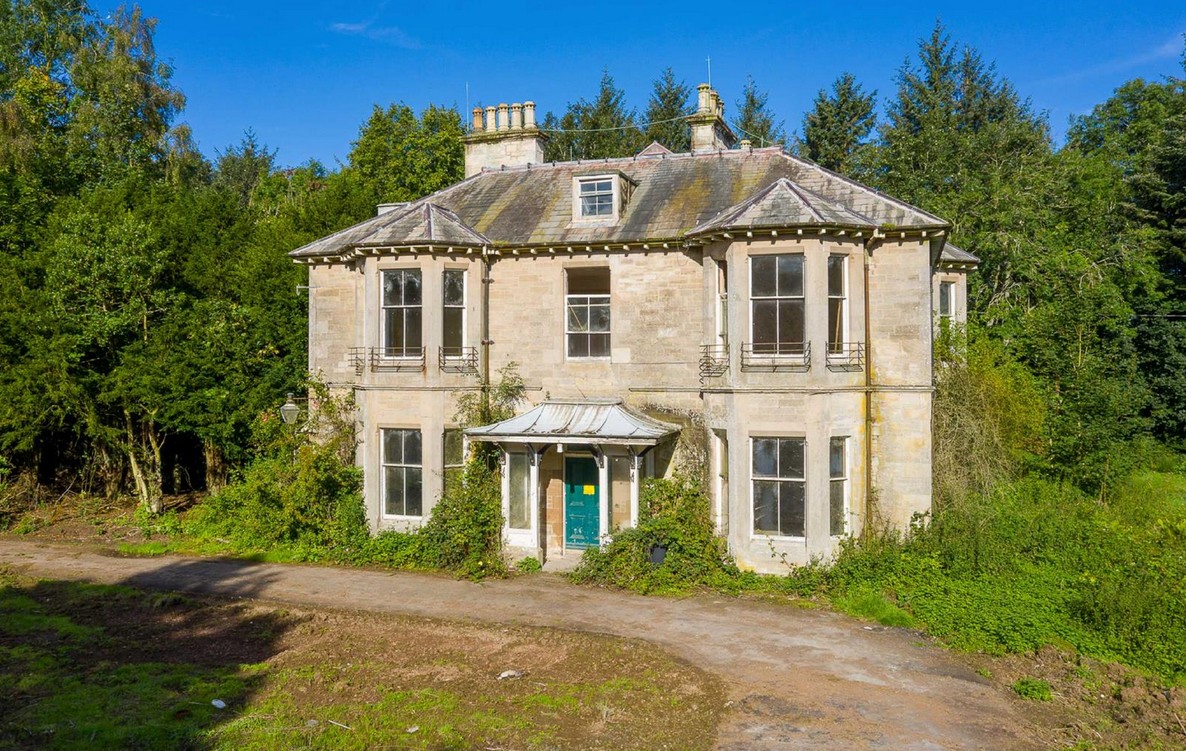
Midgard itself has a quieter, more elusive history. It does not
appear on the first edition of the six-inch Ordnance Survey map of the
1850s, yet it is firmly in place by the second edition of the 1890s. Its
first appearance in the Valuation Rolls in 1895 suggests it was built in
the intervening decades, quite possibly as a dower house for Cavers.
Approached through large iron gates, Midgard sits at the end of a
sweeping driveway that curves around the front of the house before
returning to the entrance. To one side stands a substantial L-shaped
outbuilding containing a garage, workshop, utility rooms and
stabling - practical spaces that once supported the rhythms of estate
life.
The house itself lies within roughly eight acres of mixed ground: gardens, woodland and grazing. A further nine-acre field, used for grazing, stretches out beside the road leading to the property.
By the time Midgard was sold in 2024, it was in need of full
restoration. Yet even in its worn state, the structure, setting and
surviving features hinted at the life it once held—and the possibilities
it still offered for those willing to bring it back to its former
character.
For further reading on the Douglas of Cavers
family, visit the Cavers
Collection.
Contributions
Do you have an ancestor whose
story should be told here? Can you add to this article? Please let us have the details.
|