This page is a stub.
You can help improve it.
Cornelius Marinus Douglas. Born 's-Hertogenbosch (North-Brabant) 9,
baptised Wallon church 17 April 1791. Witness: Cornelie Marie, Baroness
van Borselen, nee de Brauw,
He was the son of Archibald and
grandson of Lt Gen Robert Douglas and Helena de Brauw
1807-1810 Educated Royal
Military School at Hondsholredijk (South-Holland) and the Artillery and
Genie School at Amersfoort (Utrecht).
1811-1812 employed by s'Lands
index.
1813, 30 November, 1st Lieutenant of 1st company of
volunteers under BarorVan Heemstra and present at the siege of the
bastions of Delfzijl (Groningen) and Coevorden (Drenthe).
1814, 3
December, 2nd Lieutenant, 4th Batallion, 1st Company Artillery 0= the
National Milition at Dordrecht (South-Holland), Maastricht (Limburg) and
's-Hertogenbosch (North-Brabant). Promoted to 1st Lieutenant, at
Maastricht and Venlo (Limburg).
1815 1st Lieutenant and Adjudant 6th
Batallion Artillery of the Nationa: Milition at Dordrecht.
1816-1817
obtaining a military leave for 9 months to visit his plantations,
"Mannheim" and "Elk het Zijne" on the Cottica river and the deserted
plantation "New Java" in Dutch Guyana (now Suriname) . in which he
participated for resp. 1/2 and 1/4 part. "New Java" was a coffee and
cocoa plantation while the other 2 had coffee and banana trees.
1822, 22 July, 2nd Captain, 2nd Batallion Field Artillery at Mons
(Hainault), Belgium.
1825 Captain, 2nd Batallion Field Artillery.
1830 transferred to the Staff of the Artillery a la suite.
1830-1831 Prisoner of War at Tournaix.
1831 6th Batallion National
Milition (?Milita) at Bergen op Zoom.
1832 Metal Cross
for the defence of the bastions during the "10 daagse veldtocht" (10
days of action).
1841 Captain 2nd regiment Artillery being attached
to the Genieschool Amersfoort, (Utrecht).
1843, 24 October, Major and Provincial Adjudant
North-Holland
1844 Medal for 35 years of service.
1848 Knight in
the Order of the Oak Crown of Luxemburg. (1841) N.B. The Kings of the
Netherlands were also Grandduke of Luxemburg. The flags of the 2
countries are still the same. only the Luxemburgian blue is of a lighter
shade.
1865 Hon. Medal for the restoration of the Dutch
independence, 1813-1815.
1865 Retired as Major of the Artillery.
Cornelius died in Nijmegen (Guelders) 4 June 1872.
Cornelius
Married firstly Bergen op Zoom 26 August 1820, Agnieta Petronella
Geertruyd, born Maastricht, (Limburg), 26, baptised 28 August 1793,
died Mons, (Hainault), Belgium, 11 January 1829. daughter of Antony
van den Heuvel and Christina Adriana Stuten.
They had issue :
a. Alexander Justus Robert,
Born Bergen/Mons (Hainault), Belgium, 25 August 1821,
died Palembang, South-Sumatra, D.E.I. 30 September 1853. Unmarried
1835, 11 September, Cannoneer 2nd class. (4)
1836, 26 November, Corporal 6th Batallion Artillery, National
Militia.
1837, 27 November, Sergeant same Batallion.
1841, 7 July, transferred to the Dutch East-Indian army and arrived
20 July at the general depot.
29 October, embarked on board the "Europa" at Hellevoetsluis
(South-Holland) .
6 May, disembarked at Batavia, Java (D.E.I.).
2nd Lieutenant Artillery at Batavia, D.E.I.
21 December, transferred from the personal to the material
department of the artillery.
1849, 9 May, to the personal department of the same.
1850, 24 March, 1st Lieutenant Royal Dutch Indies Army.
b. Anthony, Born Mons, (Hainault), Belgium 28 March 1823, died Nijmegen (Guelders),
25 August 1897.
c. Burchard Joan,
Born Mons, (Hainault), Belgium, 6 July 1827, died Epe, (Guelders),
17 August 1865. Unmarried
1861-1864 Archivist of the Mining corporation at Buitenzorg (now
Bogor) on the island of Java, D.E.I.
1842,
1842
1845,
Married secondly, Mons, (Hainault), Belgium 29 April 1830, Anna Maria
Hendrica, daughter of Lodewijk Karel van Dijk and Maria Anna Elisabeth
Barre, born Nieuweschans, (Groningen), 25 November 1798, died Haarlem
(North-Holland) 15, buried Heemstede, (North-Holland), 19 May 1853.
They had issue :
d. Lodewijk Carel Archibald,
Born Brielle, (South-Holland), 6 June/July 1831, died Capetown,
South Africa 26 October 1870. Unmarried
Private teacher.
e. Robbert, Born December 10, 1832, Birthplace: Bergen Op Zoom, Netherlands;
Died February 07, 1897
f. Maria Cornelia Anna,
Born Bergen op Zoom, 26 January 1839, died Nijmegen, (Guelders) ~
8 May 1861. Unmarried.
g. Jan Daniel Josias,
Born Bergen op Zoom, (North-Brabant), 19 February 1842,
died Nijmegen, (Guelders), 4 January 1901.
Married Antoinette Marguerite, born Amsterdam 4 May 1840,
died Nijmegen, 24 April 1900. daughter of Jortathan Baak and
Antoinette Marguerite van Barneveld. They had no issue.
Married thirdly, Schoondijke, (Zeeland), 2 April 1855, Petronella Hendrica,
daughter of Johannes van Dijk and Geertruy Kruseman, born Schoondijke,
15 August 1801, died Nijmegen (Guelders), 8 November 1897.
Lt. Col. Cornelius Marinus Douglas (1791–1872): A Narrative
Biography
Cornelius Marinus Douglas was born in 's‑Hertogenbosch on 9 April
1791, baptised shortly afterwards in the Walloon Church, where a
baroness of the old Borselen family stood as witness. He belonged to a
distinguished military lineage: his father was Archibald Douglas, and
his grandfather was Lieutenant‑General Robert Douglas, whose marriage to
Helena de Brauw linked the family to the Dutch patriciate. Cornelius
grew up in a world where military service was both tradition and
expectation.
As a young man he entered the Royal Military School
at Hondsholredijk between 1807 and 1810, followed by further training at
the Artillery and Genie School in Amersfoort. These institutions were at
the heart of the Netherlands’ effort to rebuild its armed forces after
the turbulence of the French period, and Cornelius emerged from them as
a technically trained artillery officer at a time when artillery science
was becoming increasingly professionalised.
His early career
unfolded during the Napoleonic Wars. In 1811 and 1812 he served with the
Lands Index, and in November 1813 - as the Netherlands rose against
French rule - he was appointed First Lieutenant in the 1st Company of
Volunteers under Baron Van Heemstra. He took part in the sieges of
Delfzijl and Coevorden, two of the last French‑held bastions in the
north. These were bitter, cold campaigns, fought in the winter
marshlands of Groningen and Drenthe, and they marked Cornelius’s baptism
of fire.
After the restoration of Dutch independence, he
continued to rise steadily. In 1814 he became Second Lieutenant in the
4th Battalion of the National Militia, serving in Dordrecht, Maastricht,
and his native ’'s‑Hertogenbosch. Promotion followed quickly: First
Lieutenant at Maastricht and Venlo, then Adjutant of the 6th Battalion
of Artillery in 1815. His career was already marked by reliability,
technical competence, and the quiet steadiness valued in artillery
officers.
In 1816–17, Cornelius took an unusual leave of nine
months to travel to Suriname, where he held shares in three plantations
along the Cottica River: Mannheim, Elk het Zijne, and
New Java. The
first two produced coffee and bananas; New Java produced coffee and
cocoa. His participation - half in one plantation, a quarter in another
- reflects the common practice of Dutch officers investing in colonial
agriculture. It also shows that the Douglas family, though military in
tradition, was woven into the wider economic networks of the Dutch
empire.
Returning to Europe, Cornelius resumed his military
duties. In 1822 he became Second Captain of the 2nd Battalion of Field
Artillery at Mons in Hainault, and by 1825 he was Captain. The Belgian
Revolt of 1830 interrupted his career dramatically: he was taken
prisoner of war at Tournai during the conflict that ultimately separated
Belgium from the Netherlands. After his release, he served with the 6th
Battalion of the National Militia at Bergen op Zoom.
For his role
in the “Ten Days Campaign” - King William I’s attempt to reassert
control over Belgium - Cornelius received the Metal Cross of 1832, a
decoration awarded to those who defended the Dutch positions during the
fighting. It was one of several honours he accumulated over his long
service.
By the 1840s, Cornelius had become a senior figure in
the artillery establishment. In 1841 he was Captain of the 2nd Regiment
of Artillery and attached to the Genie School at Amersfoort, returning
to the institution where he had once trained. In 1843 he was promoted to
Major and appointed Provincial Adjutant of North Holland. A medal for 35
years of service followed in 1844, and in 1848 he was made a Knight of
the Order of the Oak Crown of Luxembourg - a reminder of the personal
union between the Dutch crown and the Grand Duchy.
His final
honour came in 1865: the commemorative medal for the restoration of
Dutch independence in 1813-15, awarded half a century after the events
in which he had taken part as a young lieutenant. That same year he
retired as Major of Artillery, closing a career that had spanned the
fall of Napoleon, the birth of the modern Netherlands, and the reshaping
of Europe’s borders.
Cornelius lived out his last years in
Nijmegen, where he died on 4 June 1872. His personal life had been
marked by both marriage and loss. In 1820 he married Agnieta Petronella
Geertruyd van den Heuvel in Bergen op Zoom. She died in Mons in 1829,
leaving him with children - including Alexander Justus Robert Douglas,
who would later die in Palembang in the Dutch East Indies, linking the
family once more to the wider colonial world.
Cornelius Marinus
Douglas’s life was one of steady, loyal service: a career officer shaped
by the upheavals of the Napoleonic era, the conflicts of the Belgian
Revolt, and the long, quiet decades of mid‑nineteenth‑century military
administration. He belonged to a generation of Dutch officers who
bridged the old world and the new, carrying the traditions of their
families into a rapidly changing Europe and a global empire.
Published:
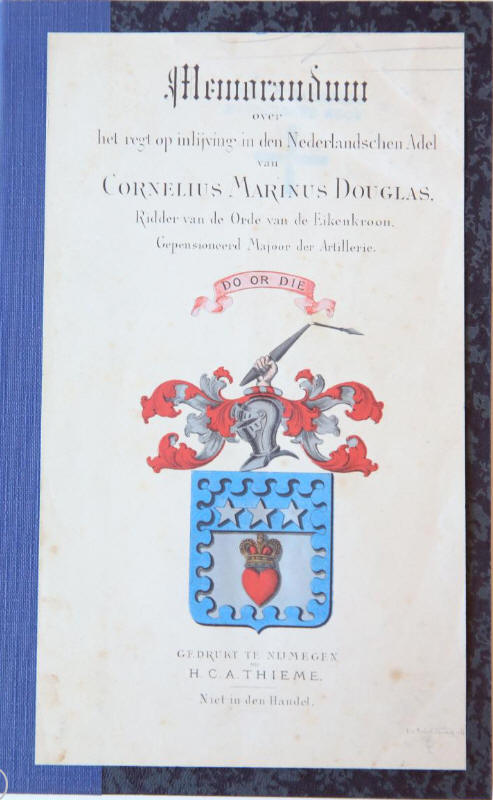
1. Memorandum over het regt op inlijving in den Nederlandschen Adel"
("The right of enlistment in the Dutch nObility"). Printed Nijmegen by
H. C. A. Thieme, 2 April 1869.
Comment:
Cornelius Marinus
Douglas is a descendant of the
Douglas of Friarshaw
family.
|