Douglas of Friarshaw
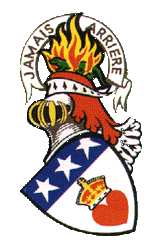
Crest of Douglas of Cavers
With a variation
In Roxburghshire, between the Teviot and Ale rivers, the lands of
Friarshaw formed a stable holding upon which a cadet branch of the Douglas
family established itself. From the mid-sixteenth century onward, the
Douglases of Friarshaw carried forward the Border traditions of service,
landholding, and loyalty, shaping a lineage that would eventually extend far
beyond Scotland's marches into the courts and regiments of continental
Europe, and beyond.
Origins in the House of Cavers
The Friarshaw line descends from the venerable Douglases of Cavers,
hereditary sheriffs of Teviotdale and among the most stable families of the
Borders. Their story begins with William Douglas, 1st of Friarshaw, younger
son of Sir James Douglas, 5th of Cavers, and his wife Eufame Davidson. In an
age marked by shifting allegiances and the turbulence of the Reformation,
William's establishment at Friarshaw represented both continuity and
expansion - a younger son carving out his own patrimony while remaining
firmly within the orbit of the Cavers estate.
William's sons, John
and George, carried the line forward, though it was George, the 3rd of Friarshaw, whose marriage to Margaret Myddilmest secured the estate's
stability into the seventeenth century. Their son Andrew Douglas, 4th of Friarshaw, presided during the unsettled years leading to the Covenanting
era, a time when Border families were often drawn into the wider religious
and political currents of the kingdom.
Consolidation and
Alliance
The next generation, Andrew Douglas, 5th of
Friarshaw, strengthened the family's standing through his marriage in 1640
to Jean Hume of Polwarth, linking Friarshaw to one of the most influential
Lowland houses. Their son Henry Douglas, later 6th of Friarshaw, inherited
not only Friarshaw but also Belches/Belses, expanding the family's
territorial footprint. Henry's marriage to Martha Lockhart of Castlehill in
1672 brought yet another distinguished alliance, weaving the Friarshaw
Douglases into the fabric of Scotland's landed and professional classes.
Henry's children formed a large and capable generation, but it was
George Douglas, born around 1673, who emerged as the 7th of Friarshaw. His
marriage to Elizabeth Scott, daughter of Sir Patrick Scott of Ancrum, added
a final, powerful stitch to the tapestry of alliances that defined the
family's seventeenth-century ascent.
From Borders to Europe:
The Friarshaw Diaspora
The eighteenth century saw the
Friarshaw Douglases step beyond the Borders. George and Elizabeth's sons
included two men whose careers would carry the family name into new realms:
- Sir James Douglas, later 1st Baronet of Springwood, who maintained the
family's Scottish presence and reputation.
- Lieutenant-General Robert
Douglas (1727-1809), whose military service in the Netherlands marked the
beginning of the family's continental chapter.
Robert Douglas rose to
become Governor of 's'Hertogenbosch in 1784, a position of considerable
prestige within the Dutch Republic. His marriage to Helena de Brauw founded
the Douglas van Breugel line, embedding Scottish Douglas blood into Dutch
civic and military life. From this union sprang descendants who would later
appear in Germany, Sweden, and Estonia, often as officers, diplomats, or
members of the landed gentry.
Through these continental branches, the
Friarshaw Douglases contributed to the broader Douglas diaspora - a
phenomenon in which younger sons of Scottish houses found opportunity
abroad, carrying with them the heraldic heart and crown that symbolised
their ancient lineage.
Heraldry and Identity
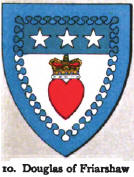
The Friarshaw arms, borne by Lieutenant General Robert Douglas, preserved
the unmistakable Douglas symbolism:
- Argent, a heart gules ensigned
with a royal crown or,
- On a chief azure, three mullets argent,
-
All within a bordure nebuly azure celeste.
The crest, a dexter
forearm grasping a broken lance, and the motto 'Do or Die' speak to the
martial spirit that animated the family's later generations. These arms,
though cadet in form, remain a proud testament to the Friarshaw branch's
place within the greater Douglas story.
Legacy
Today, the Douglas family of Friarshaw stands as a compelling example of
how a Border cadet line could evolve: rooted in the sheriffdom of Teviotdale,
strengthened through prudent marriages, and ultimately carried abroad by the
ambitions of its sons. Their narrative enriches the Douglas Archives not
merely as a genealogical record but as a testament to the adaptability and
endurance of the Douglas name.
From the quiet fields of Lilliesleaf
to the fortresses of the Low Countries, the Friarshaw Douglases embody the
long arc of Scottish history - local in origin, international in reach, and
always marked by the steadfast heart of Douglas.
The family
This Douglas line descended from the Douglas of Cavers branch of the family, and were lawyers and
merchants. They took the title Douglas of Friarshaw from the original
seat of the family in the parish of Lilliesleaf.
William Douglas, 1st of
Friarshaw,
d 1575
Son of Sir James DOUGLAS, 5th of
Cavers
m. Eufame Davidson
Children of William and Uefame DOUGLAS:
1. John Douglas, 2nd of Friarshaw (dsp before 1623)
2. George {below}
George Douglas, 3rd of Friarshaw, d 1623
m. Margaret Myddilmest
Children of George and Margaret DOUGLAS:
1. Andrew {below}
Andrew Douglas, 4th of Friarshaw
d before 10.01.1645
Children of Andrew DOUGLAS:
1. Andrew {below}
2. William
Andrew Douglas, 5th of Friarshaw, d 1698
m. (1640 Jean Hume (of family of Polwarth)
Children of Andrew and Jean DOUGLAS:
1. Henry {below}
2. Thomas Douglas, M.D., married a daughter of the Lord Mayor of
London, and died in Dublin without issue 1686.
Henry Douglas, 6th of Friarshaw, Laird of Belches
(or Belses)(4), d 03.1701
m. (1672) Martha Lockhart (dau of Samuel Lockhart of Castlehill)
Children of Henry and Matha DOUGLAS:
1. George {below}
2. James
3. [Several more children]
George Douglas, 7th of Friarshaw, d 1753 (3) Possibly his
arms below.
m. (1702) Elizabeth Scott (dau of Sir Patrick Scott, Bart of Ancrum)
Children of George and Elixabeth DOUGLAS:
1. Sir James Douglas, 1st Bart of Springwood (d 02.11.1787,
2. (Rear Admiral) Lieutenant-General Robert Douglas, 1727 - 1809

 |
|
 |
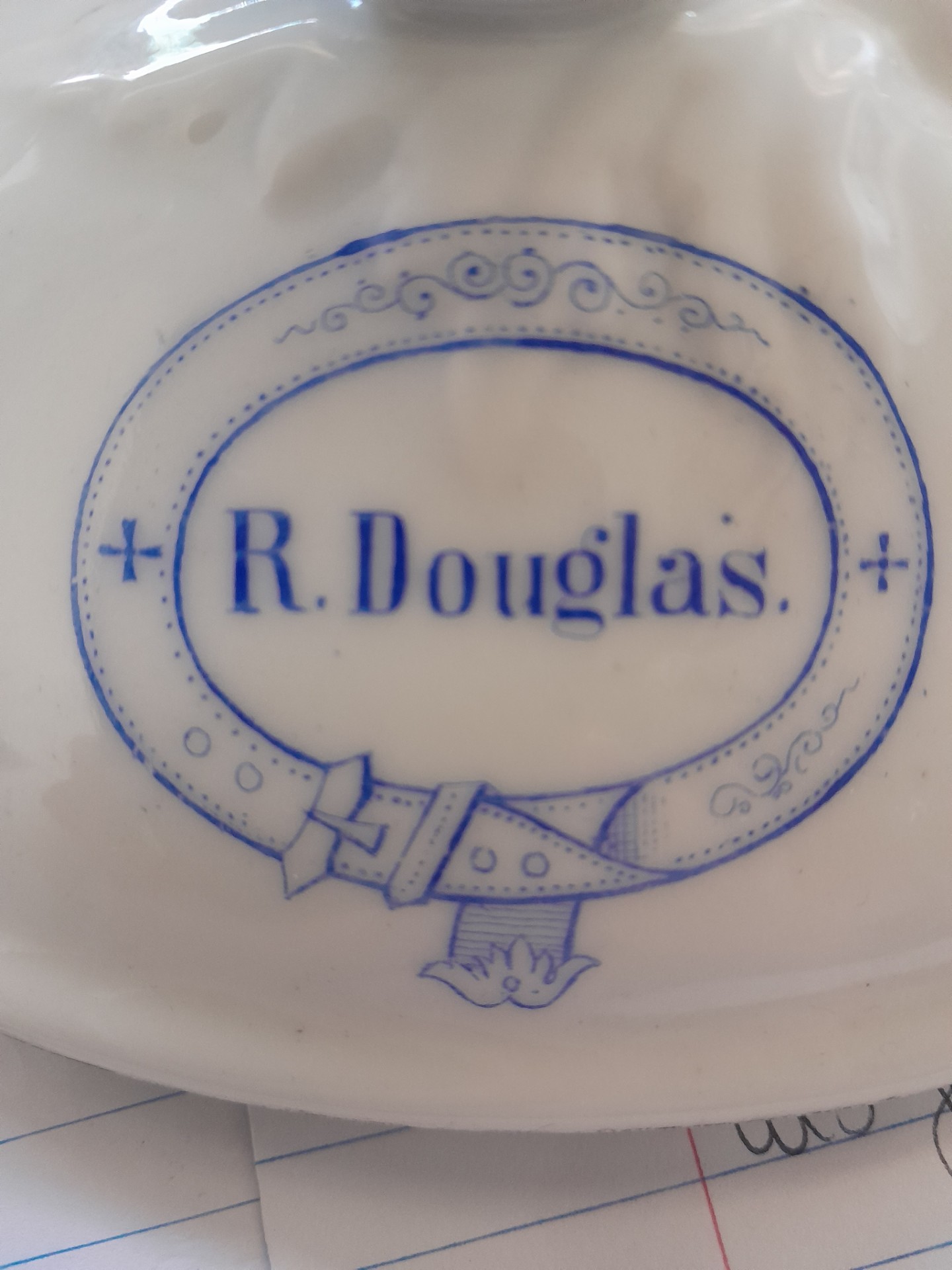
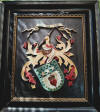
| Armorial from Java |
|
Plate from Java |
| |
|
|
Douglas of Springwood
Admiral Sir James Douglas, 1st Baronet
Sir George Douglas, 2nd Baronet
Sir John James, 3rd Baronet
Sir George Henry
Scott Douglas, 4th Baronet
Sir George Brisbane Douglas,
5th Baronet
Sir James Louis Fitzroy Scott Douglas, 6th
Baronet
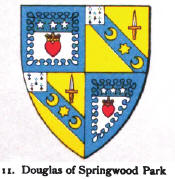
The arms of Robert, son of George Douglas of Friarshaw and Elizabeth
Scott are:
Argent, a heart Gules ensigned by a royal crown Or lined
Gules, on a chief azure three molets argent, with a bordure nebuly Azure
Celeste.
Wreath and mantling; Argens and Gules
Crest: A dexter forearm
and hand proper holding a lance sinister bendwise Or the upper half broken
dexter bendwise proper the point argent.
Motto: Do or Die
Research note:
1. He sold the old estate of Friarshaw in 1788 and
became MP for Roxburgh. Who?
2. The Riddells of Glenriddell, Dumfries-shire, were descended from
Sir Walter Riddell, second baronet of that ilk, through William, his second
son, an advocate at the Scottish bar. This William acquired the lands of
Friarshaw in Teviotdale, and afterwards Glenriddell, and married Elizabeth,
daughter of Captain Francis Wauchope of the Niddry family. His son, Walter,
married Catharine, eldest daughter of Sir Robert Lawrie of Maxwellton,
baronet, and had, with two daughters, two sons, Robert, who succeeded him,
and John, who married Helen, daughter of Sir Michael Balfour of Denmilne,
with issue. The elder son, Robert, married Jane, daughter of Alexander
Fergusson of Craigdarroch, by whom he had several daughters.
3. Possibly the George Douglas who was Sheriff Substitute
of Inverness, 1752, at the time of the murder of Colin Campbell of Glenure
on 14 May (the ‘Appin murder’) This George Douglas was the first
secretary of the Quatuor Coronati Lodge, which position he held for about
five years. But see this entry>>>
4. Belses is a village on the Ale Water, in the Scottish Borders area of Scotland the former Selkirkshire.
See also:
•
Douglas of
Friarshaw pedigree
• Family tree - Descendants of Andrew Douglas, 4th Lord of Friarshaw

• Family seal
|
|