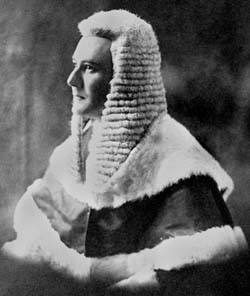
EDWARD ARCHIBALD DOUGLAS (1877-1947) and ROBERT JOHNSTONE DOUGLAS (1883-1972),
brothers and judges, were born on 2 November 1877 at Fortitude Valley, Brisbane, and on
13 April 1883 at Sandgate, first and fourth sons of London-born
John
Douglas, premier (1877-79) of Queensland, and his second wife Sarah, née
Hickey, from Ireland. Educated at various Queensland schools, in 1892
Edward and Robert journeyed with their brothers to Scotland to attend St
Benedict's College, Fort Augustus. On his return in 1895, Edward entered
the pearling industry based on Thursday Island where his father was
government resident. In December 1901 Edward was admitted to the
Queensland Bar, having been an associate from 1897 to Sir Samuel Griffith
and then to Justice Virgil Power whose daughter Annette Eileen he married
on 9 January 1907 at St Joseph's Catholic Church, Rockhampton. In Brisbane
his practice grew steadily. Specializing in taxation and company law, he
appeared as counsel in leading commercial, revenue and constitutional
cases.
After returning from Scotland, Robert completed his schooling at St
Ignatius' College, Riverview, and graduated from the University of Sydney
(B.A., 1905). Admitted to the Queensland Bar in September 1906, he served
briefly as an associate of Justice Real, commenced practice in 1907 at
Townsville, and soon acquired a reputation as a persuasive and successful
advocate. On 15 January 1912 he married Annie Alice May Ball (d.1952) at
St Joseph's Catholic Church, Townsville. He made a special study of
arbitration and in 1915 T. J. Ryan's Labor government appointed him a
judge of the Industrial Court of Queensland. His duties entailed extensive
travel in the north where he sometimes worked in shanties. Prominent in
civic and social activities, he was also an alderman (1907) of the City of
Townsville. He was tall and upright, with a resonant voice, and precise,
factual and direct in the courtroom. In 1923, when 'R.J.' became a judge
of the Supreme Court, sitting at Townsville, northerners hailed his
elevation as a triumph for the region. His reciprocated loyalty later led
him to decline an invitation to join the court in Brisbane.
In 1929 Edward was appointed to the Supreme Court in Brisbane. A
hard-working, scholarly and erudite judge, with an 'impressively austere'
manner, he attracted little public attention until 1938. That year a
campaign for the seat of Ithaca was marred on both sides by sectarian
bitterness. Sitting as Elections Tribunal judge, Edward found
irregularities sufficient to justify setting aside the return of Labor
minister E. M. Hanlon to the Legislative Assembly. The decision against
Hanlon (who did not give evidence at the hearing) was reversed on appeal
by a majority of the Full Court—one of whom was Edward's brother Robert.
Following the resolution of the Ithaca case, 'E.A.' found himself being
passed over for offices or honours which he might reasonably have
expected. In 1944 another disagreement between Edward and the government
over failure to restore judicial pensions, abolished in 1921, attracted
further publicity in the press and parliament. Survived by his wife, two
of his three daughters and five of his eight sons, Edward Douglas died of
a coronary occlusion on 27 August 1947 at Ascot and was buried in Toowong
cemetery after a requiem Mass presided over by Archbishop (Sir) James
Duhig. Speaking on behalf of the profession, A. D. McGill—who had
represented Hanlon in the Ithaca case—stressed the esteem and admiration
which the judge's conduct in that matter had earned for him among all
those who 'look for a fearless and independent Judiciary'. Two of Edward's
sons, (Sir) Edward Sholto and Andrew Brice, became active members of the
Queensland Law Society.
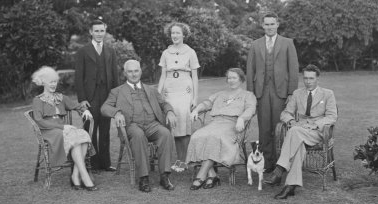 |
| Robert Douglas with his family, c. 1940 |
Robert Douglas retired in 1953. Survived by his three sons and two
daughters, he died on 24 December 1972 at Townsville and was buried in
Belgian Gardens cemetery. One son, James Archibald, was also a Supreme
Court judge.
Source: Australian Dictionary of Biography
Further reading:
•
A detailed account, which includes Edward and Robert, of Henry Alexander Douglas, the prominent
19th-century British merchant banker, has been written by his
descendant, Francis Douglas KC, detailing his commercial career,
familial legacy, and contributions to the judicial system in Australia.
[pdf]
|
|