This page is a stub.
You can help improve it.
Born in Earls Court, London, on April 22, 1892, Quentin Douglas was baptized at Holy Trinity Church in Barnes. His father,
John Douglas, was listed as a carpenter at the time, though a surveyor and estate agent in the 1891 census. Quentin attended Marlborough College from 1905 to 1909, showing an early military interest as a Private in the Officers Training Corps. After school, he apprenticed in his father's building business and studied at Chelsea Polytechnic (then Chelsea College of Science and Technology).
Before the Great War, Douglas worked for architect F.K. Williams and later as a surveyor for Parry, Black and Parry, before establishing his own building, surveying, and estate development firm, following in his family's footsteps.
When World War I erupted in August 1914, Douglas, eager to serve, enlisted as a Driver in the 4th London Field Ambulance, Royal Army Medical Corps, on September 1. This choice was somewhat unusual given his technical background, but perhaps reflected an immediate need for service within the 47th (2nd London) Division, which had just mobilized from its summer camp. As a driver, he would have operated horse-drawn vehicles.
In February 1915, Douglas sought a commission in the Royal Engineers, a move likely driven by his civilian expertise. After further medical examinations, he was commissioned as a 2nd Lieutenant on February 27, 1915. He was initially assigned to the 2/4th London Field Company with the 60th Division but soon transferred to the 4th London Field Company, part of the 47th (London) Division. Although the 47th Division departed for France in March 1915, Douglas remained in England for a short period before joining the 2/3rd London Field Company in May, finally deploying to France on June 23, 1915.
In France, Douglas's company was heavily involved in trench construction and supervision of infantry in building defensive positions, particularly during the
Battle of Loos in August and September 1915. His No. 3 Section played a crucial role in clearing and establishing new defensive flanks. The company spent the winter in the Loos Salient, engaged in vital fortification work, including consolidating craters.
In February 1916, Douglas's company moved to support operations around Vimy Ridge. During a significant crater consolidation effort in May, 2nd Lieutenant Douglas, temporarily commanding No. 2 Section, was tasked with establishing forward supply dumps for the troops consolidating newly blown craters. His efficient delivery of supplies was critical to the operation. He was promoted to Temporary Captain on May 9, 1916, and substantive Lieutenant on June 1, 1916. By June 20, he was acting as Captain and Second-in-Command of the 2/3rd Field Company.
The 2/3rd Field Company then saw extensive involvement in the Battle of the
Somme from July to October 1916. In November, Douglas went on leave and was reportedly posted to command a field company of the 55th Division Engineers. His service papers, however, show him assigned to the 419th Field Company with the rank of Acting Major in December 1916. Despite this acting rank, he was sent to a Company Commanders Course, suggesting a need for further training.
In November 1917, Douglas's wartime role shifted significantly when he was appointed Corps Light Railway Officer within the Royal Engineers Transportation Establishment, initially with III Corps. This critical role involved managing the vital light railway systems that transported supplies and evacuated wounded from the front lines, a military adaptation of early 20th-century railway technology essential to trench warfare. He continued in this specialized capacity, moving between various Corps, including the British Cavalry Corps and VII Corps, and briefly worked on defence systems. In June 1918, he was re-appointed Acting Major. He continued as a Corps Light Railway Officer with X Corps and then III Corps before returning home shortly after the Armistice and was demobilized in January 1919.
After the war, Douglas rejoined the Territorial Army in 1919 and married Edith Dorothy Ingram. His financial situation appears to have improved significantly, allowing him to reside in a prestigious London address and engage in local Kensington politics. In 1921, he resigned his commission to focus on managing his property.
In the interwar years, Douglas managed his estate, travelled abroad to places like New York and Gibraltar, and continued to list his occupation as a surveyor. His son,
Alexander "Sandy" Shafto Douglas, born in 1921, also attended Marlborough College.
With the outbreak of World War II in 1939, the then 48-year-old Douglas volunteered, rejoining the Royal Engineers as a 2nd Lieutenant (acting Major) in November. He was attached to the 6th Training Battalion before proceeding to France in March 1940 with the 104th Army Troops Company, part of the British Expeditionary Force. He was among the last to be evacuated from Dunkirk in June 1940.
After Dunkirk, Douglas continued his service in various staff positions within the Royal Engineers' Works Establishment in the UK, holding temporary ranks from Captain to Acting Major. In May 1943, at 51, he embarked for service in India with the Eastern Army in Bengal, for which he was awarded the Burma Star. He served as a Field Engineer and later as a Staff Officer Royal Engineers, Grade II, in Delhi.
In October 1944, Douglas returned to the UK on medical grounds, being admitted to hospital. After recuperating, he was posted to various roles within the Scottish Command, including Deputy CRE and Acting CRE. His later military career was marked by frequent reassignments, a testament to his continued service despite his age and the demands of wartime.
Major Douglas appears to have lived out the remaining years of
his life in retirement at his London address. He died on the 3rd of May
1974 at St. George’s Hospital, Westminster, London at the age of 82.
Notes:
• John Douglas (1862-1928), father of Quentin Douglas
was born in 1862 and in 1889 he got into the building business in London much like his father William.
William Douglas died in 1893 but the family connection with Kensington continued. John took over the builder’s yard in Chelsea and set up an office in 1888 at No. 12 Exhibition Road where a builder’s and estate agent’s business was carried on under his name until 1939. He built some of the last residences in Queen’s Gate and was, in fact, the contractor employed to reface and alter some of his father’s houses. In his later years he lived with his family at 12 Woodville Gardens in Barnes, Surrey and became a Kensington Borough Councillor.
John and his wife Edith (1866-?) had three children; Elsie (1890-?), Quentin (1892-1974) and Phillipa (1900-?).
John Douglas must have been successful as a Surveyor and Estate Agent, following in the footsteps of his father, as he was able to afford two domestic servants in his household. It would appear that his business had not been burdened at all by the debts of his father William. In all likelihood he started a business of his own that was not connected to his father’s building business except for the yard in Chelsea that must in some way have become free from the burden of William’s debts.
After attending a Deputy CRE course in September 1945, Major Quentin Douglas was swiftly ordered for another overseas posting, this time to the British Army of the Rhine (BAOR) in North West Germany. He served with the 203 Works Section, later redesignated 203 DCRE (Construction and Maintenance), before returning to the UK in June 1946 and being released from service. He retained his commission in the Royal Engineers until 1954.
In his post-military life, Douglas resided in London, holding addresses in Earls Court Square and Cromwell Road. In a significant civilian achievement, he was elected Mayor of the Royal Borough of Kensington in 1952, serving two terms until 1954 and receiving the Coronation Medal in 1953. He also served as a Justice of the Peace. Major Quentin Douglas passed away on May 3, 1974, at the age of 82. Meanwhile, his son Alexander had married and started a family, continuing the Douglas legacy.
• Quentin served two terms as Mayor of Kensington, 1952-53
and 1853-54, a time that included the Coronation celebrations.
•
Edith Dorothy Ingram, daughter of the Rev. D. S. Ingram, of Eversfield.
Tonbridge (formerly Rector of Gt. Oakley, Essex) and grand-daughter of
the late Dr. Weldon, formerly headmaster of Tonbridge School, and Mr.
Quentin Douglas (late Major R.E.), of Mr. J. Douglas, of Lanham
Mansions, Karl's Court Square, London S.W. The officiating clergy were
the Rev. Stuart H. Clark (Vicar and the Rev. John Fleming. The bride,
who was escorted by her eldest brother, Mr. W. Ingram, in the absence of
her father, whose ill-health prevented him from being present, wore a
dress of stone-coloured cloth, embroidered in silk to match and trimmed
with skunk fur. She wore hat to match and carried a bouquet of coloured
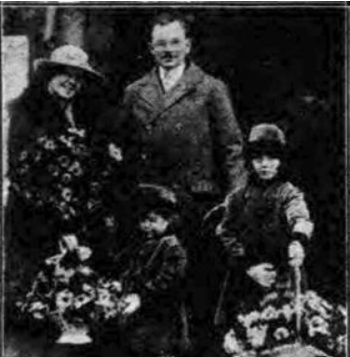
anemones. She was attended by Miss Margaret Ingram and Miss Pamela
Ingram, her little nieces, who wore coats and caps of stone coloured
velveteen, trimmed with fur, and carried baskets of coloured anemones.
They also wore necklaces of cornelians, the gift of the bridegroom. Mr.
Douglas Daniels (late Duke of Wellington's Regiment) carried out the
duties of best man. The service was choral, Mr. Geo. J. Kimmine,
presiding the organ. After the ceremony a reception was held at St.
Saviour's Mission Room. Only relatives of the bride and bridegroom were
invited, owing to the ill health of the bride's father. Later Mr. and
Mrs. Douglas left for Eastbourne, where the honeymoon is being a-spent,
the bride travelling in her wedding dress and fur coat. The wedding
presents included some beautiful silver, china, glass and several
cheques. - Kent & Sussex Courier - Friday 06 February 1920
Contributions
Do you have an ancestor whose
story should be told here? Please let us have the details.
Source
Sources for this article include:
Research by Lieutenant Colonel (Retired) Edward De Santis, MSCE, PE, MInstRE |