The Lordship of Annandale was established in the early 12th century by
David I of Scotland, who granted the territory to Robert de Brus, the
progenitor of the Bruce dynasty. The Brus family held Annandale for
nearly two centuries, playing a crucial role in Scottish history.
Annandale is a district of Dumfriesshire, Scotland, centred on the
dale or valley of the River Annan. It runs north–south through the
Southern Uplands from Annanhead (north of Moffat) to Annan on the Solway
Firth. It is bordered by Nithsdale to the west and Eskdale to the east.
Key Figures:
- Robert de Brus, 1st Lord of Annandale (c.
1113–1138) – Received the lordship from David I.
- Robert de Brus,
5th Lord of Annandale (1226–1292) – Resigned the title upon the
accession of John Balliol.
- Robert de Brus, 7th Lord of
Annandale (1304–1312) – Later crowned King Robert the Bruce in 1306,
leading Scotland to independence.
Later Lords:
After the Bruce
lineage, the lordship passed through various noble families, including
the Randolphs, Dunbars, and Douglases. By the late 15th century, it was
annexed to the Scottish Crown.
Annandale was strategically
significant, serving as a defensive stronghold against English
incursions. The motte-and-bailey castle in Annan, built by the Bruces,
remained a key fortification until the early 13th century.
The
Douglas Lords of Annandale emerged in the early 15th century when
the powerful Douglas family took control of the lordship. The Douglases were one of Scotland’s most influential noble houses, known
for their military prowess and territorial expansion.
Key
Douglas Lords of Annandale:
- Archibald Douglas, 13th Lord of
Annandale (1401/1409–1424) – Secured Annandale after defeating the
Dunbars, who had previously held the territory. Later,
Archibald Douglas, 4th Earl of
Douglas, Duke of Touraine
-
Archibald Douglas, 14th Lord of Annandale (1424–1439) – also 5th
Earl of Douglas Continued the Douglas dominance in southern Scotland.
- William Douglas, 15th
Lord of Annandale (1439–1440) – also 6th Earl of Douglas. His tenure was
brief before the lordship was annexed to the Crown.
By 1455, the
Douglas family's power was significantly reduced when James Douglas, 9th
Earl of Douglas, was forfeited, leading to the Crown reclaiming
Annandale.
The Lordship of Annandale: Dunbar, Douglas, and the
Settlement of 1409
George, tenth Earl of Dunbar and March, eldest son of Patrick the ninth earl and Lady Agnes Randolph, entered the closing years of the fourteenth century with expectations of strengthened royal favour. His youngest sister, Lady Elizabeth Dunbar, had been formally betrothed in 1399 to David, Duke of Rothesay, heir to the Scottish throne. The match, however, was overturned within months through the influence of Archibald, third Earl of Douglas, who secured Rothesay’s marriage to his own daughter Mary (sometimes styled Marjory) in February 1400. Feeling himself publicly wronged and politically displaced, the Earl of Dunbar wrote from his castle of Dunbar to King Henry IV of England on 18 February 1400, renouncing his allegiance to the Scottish Crown. His defection was followed by years of armed incursions across the Border.
During Dunbar’s exile, which lasted from 1400 until 1409, the political landscape of the east and west marches shifted decisively. Archibald, fourth Earl of Douglas, assumed possession of the lordship of Dunbar, the estates of the earldom of March, and the lordship of Annandale. When negotiations for Dunbar’s return were eventually opened with the regent, Robert, Duke of Albany, Douglas refused to surrender these territories unless compensated with the castle of Lochmaben and the lordship of Annandale in place of Dunbar and March. Albany accepted the arrangement, and on 2 October 1409, at Haddington, issued a charter granting to his cousin Archibald, Earl of Douglas and Lord of Galloway, the lordship of Annandale. The charter records that the fee of Annandale belonged to George of Dunbar, son and heir of George, Earl of March, and that both father and son resigned their rights in the presence of the leading lords and barons of the realm. The lordship was thereafter to be held by Douglas and the heirs‑male of his body, failing whom it would revert to the Earl of March and his nearest lawful heirs.
Annandale itself had a long and distinguished lineage. It had formed part of the inheritance of Black Agnes, daughter of the regent Thomas Randolph, Earl of Moray, and passed through her family before returning to the Crown. King David II was in possession of the lordship in 1361, when he granted a charter at Mouswald to John Carruthers, sealed with the special seal of the lordship of Annandale. George, tenth Earl of Dunbar and March, likewise used a distinct Annandale seal when, under the style “Dominus vallis Anandie et Mannie,” he issued a charter in 1375.
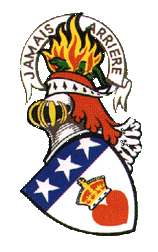
 When the Douglases held Annandale, they quartered their own arms with those of the ancient Bruce lordship, omitting the lion passant in chief. Margaret Stewart, Duchess of Touraine and eldest daughter of King Robert III, also bore the title Lady of Annandale in a crown charter of 3 May 1426, her seal quartering the arms of Annandale with those of Touraine and Douglas.
Shortly after receiving the formal grant of Annandale in 1409, the Earl of Douglas appointed Sir Herbert Maxwell as steward of the lordship, a position which, combined with the wardenship of the marches, helped to ignite the long and bitter feud between the Maxwells and the Johnstones.
The Douglases retained Annandale from the accession of Archibald the fourth earl in 1400 until the death without male heirs of William, sixth Earl of Douglas, in 1440. Under the terms of the 1409 limitation, the lordship should then have passed to George, eleventh Earl of March, but his forfeiture placed Annandale in the hands of the Crown. During their tenure, the Douglases consistently quartered the Bruce arms of Annandale with their own, a heraldic expression of the authority they exercised over one of the most historically resonant lordships of the Scottish Borders.
Contributions
Do you have an ancestor whose
story should be told here? Please let us have the details.
Source
Sources for this article include:
The Annandale Family Book of the Johnstones, Earls and Marquises of Annandale, by Sir William Fraser, K.C.B., LL.D.
|