This page is a stub.
You can help improve it.
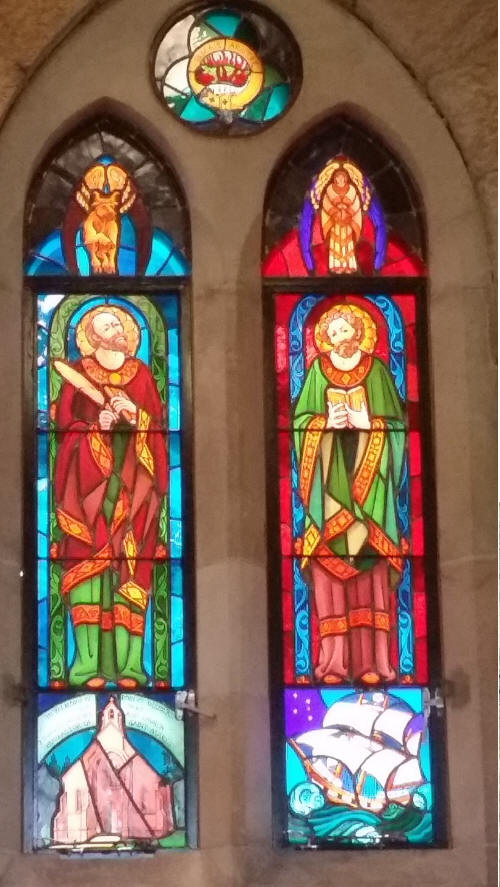
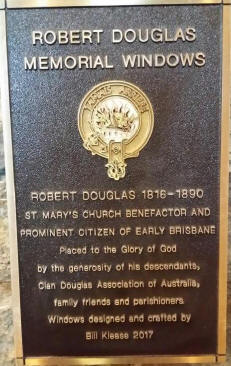
The Robert Douglas Memorial Windows
were constructed to tell a story that starts with Saint Matthew’s window
on the right, and ‘the great commission to take the word to the nations’
at the end of Matthew’s gospel. At the top is Matthew’s symbol of the
winged man, and Matthew, beneath, is holding a book (his gospel). At the
bottom is a sailing ship headed towards the Southern Cross which
represents the bringing of the word across the waters to Australia, as
per the commission. On the left is the figure of Saint Luke holding a
quill and his gospel. Luke was responsible for much of the writing of
the New Testament as well as his own gospel. Above him is a winged ox,
the traditional symbol for Luke. A depiction of St. Mary’s Church on the
bottom left panel is a symbol of the establishment of the church in
Brisbane.
Some of the imagery has a second meaning which relates to
the man to whom the windows are dedicated and his small role in carrying
out Matthew’s commission. Robert Douglas sailed to Australia as a
migrant from the United Kingdom and later built a life for
himself at Kangaroo Point at the same time as St. Mary’s Church was also
becoming established. He was a benefactor of this church and his
descendants have continued to worship there. They have also carried on
his involvement in the cattle industry and his association with the land
and its development throughout Queensland; a fact that influenced the
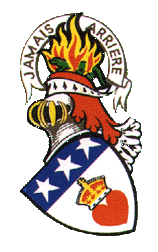
earth colour choices for the panels. The crest in the small top window
is that of the Red Douglas Earls of Angus line, one used with pride by
him and his descendants.
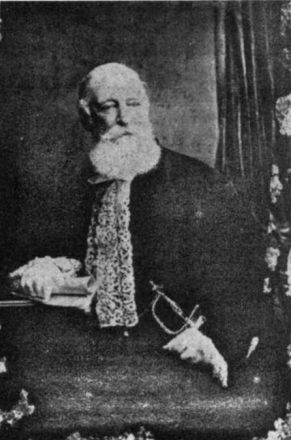
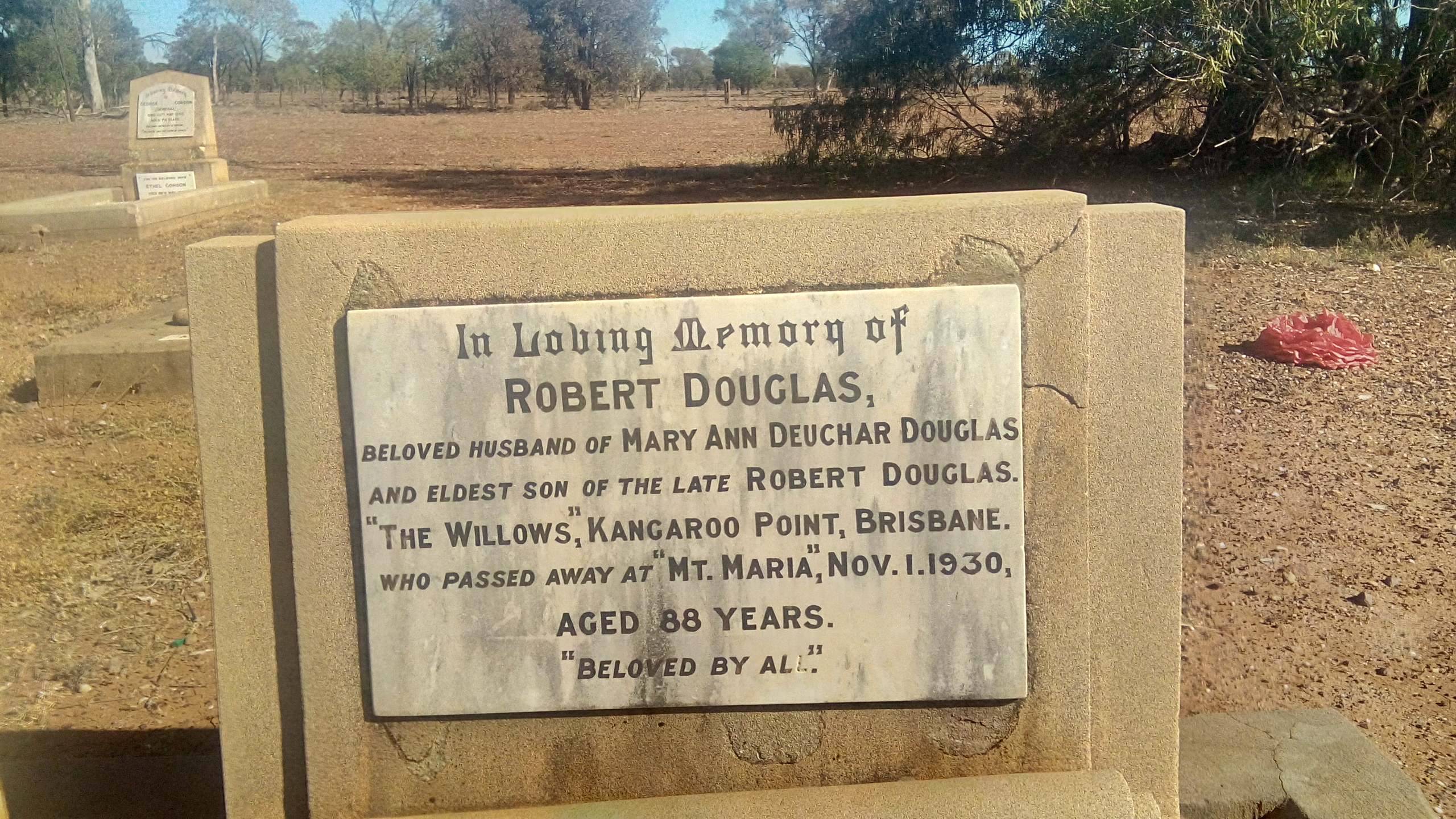
Robert Douglas of Kangaroo Point July 4 1816 to November 23 1890
Born in Clapham, London, Robert Douglas was the youngest child
of Robert Douglas of Ardrossan and Catherine Douglas nee Heard. In a
sense he was ‘Robert Douglas’ by default as he had two brothers before
him named Robert, both of whom had died as infants. His father, after
his marriage and loss of one of the earlier infant ‘Roberts’ on board
ship, had semi-retired from active sailing and started a ship’s
chandlery business on the Thames at 310 Wapping Street, London. Shipping
was big business then and the main form of transport as it was
pre-railway and certainly pre-motorised transport.
The family lived in various residences in London and Robert was born at
Clapham when they were taking their annual summer holiday there. The
other children were Colin 5, Catherine 3, and Agnes 2. Their mother,
Catherine, died of cancer four years later, leaving their father and
faithful nurse, Mary Moore to bring up the young children. (History
repeated as Robert of Ardrossan had also lost his mother, nee Mary
Railly, when he was about eleven and later Robert of Mt. Maria lost his
mother nee Sophia Poste when he was four).
Robert’s schooling seems to have been at a succession of London schools;
1822 Mrs. Will’s School at Petersfield; 1823 Mr. Chanel’s boarding
school at Homilton; 1830 Robert moved from Mr. Ward’s school at
Brentwood to Mrs. Slack’s school at Poplar. In about 1830-31, when
Robert was fourteen or fifteen, it was his father’s intention to have
him work in Douglas and Beattie’s counting house as a clerk. Robert
however, had other ideas and joined the Isabella as an apprentice seaman
- no clerical indoor position for him! His father had a share in the
Isabella with a Mr. Christie. The Captain was John Wildgoose and the
ship was bound for Demerara and the West Indian trade.
Robert Douglas 1816 – 1890 lived at Kangaroo Point from
1853 until 1884. He and his family watched the building of St.
Mary’s church in 1872 and since then many of his descendants have
had christenings and weddings in the lovely old stone
church.
As 2016 [is] the 200th year since his birth on 4th July, Ross
Douglas and Jan Shaw [have] initiated the idea and
investigated the cost of a stained glass window to
commemorate him. The estimated cost is around $6,000-
$7,000.
Robert Douglas of Kangaroo Point came to Australia in 1839,
and in 1983 when “A Douglas! A Douglas” was published, he
had 679(1) descendants - [now] in 2016 there are many more.
Sir James Douglas, of Canada, was a cousin of Robert Douglas of Kangaroo
Point and it is interesting to note parallels in their lives — both
travelled to the colonies, both had a sense of adventure combined with
an honourable duty to not only provide for their families but to take
part in community affairs and administration for the development of
their new homelands. This ‘Douglas’ quality is echoed by many of their
descendants today.
William Douglas c.1174
Archibald Douglas of Hermiston, 1213, 2nd of Douglas, 4th Lord of
Douglas
William Douglas ‘Long Legs’, 3rd of Douglas
William Douglas ‘Le Hardi’ born after 1256
Archibald Douglas of Liddesdale and Cavers, born 1297
William Douglas 1327~1384, 1st Earl of Douglas born c.1330
George Douglas 1378~1403, 1st Earl of Angus of the Douglas name
William Douglas 2nd Earl of Angus, died 1437
George Douglas, 4th Earl of Angus died 1463
Archibald, 5th Earl of Angus, ‘Bell the Cat’ born1449~1513
Sir William Douglas of Braidwood & Glenbervie, born c.1470; d.1513
Archibald Douglas of Glenbervie, c.1502; d. bef. 1570; married (2)
Elizabeth Irvine (Bessie)
John Douglas, writer in Inveresk of Cruixton & Stobbs, Quarrelholes
John Douglas, tailor in Inveresk & Musselburgh (married Alyson Beard)
John Douglas, merchant of South Leith
Robert Douglas, (elder) 1630~1717, soap manufacturer of South Leith
Robert Douglas, (younger) of Cruixton/Brockhouse 1667~1741, soap
manufacturer of South Leith
William Douglas 1696~1732 married Catherine Dunlop
Robert Douglas 1723~1812 married Mary Reilly
Robert Douglas of Ardrossan/Port Glasgow, 1759~1847, married Catherine
Heard
Robert Douglas 1816~1890, Kangaroo Point, married (1) Sophia Poste; (2)
Kate Gore de Styak.
Kangaroo Point.
The property we now occupy
was once a college for young ladies, a part of the Queensland
University. The property consisted of an area of three quarters
of an acre and had four wooden buildings constructed upon it.
One building was reconstructed into club rooms, a licensed bar,
library and large lounge, while the other was made into a hall
A lot of hard work was put in by the members on a voluntary
drive. Also, the Ladies Auxiliary gave a lot of their time and
energy to make sure we established ourselves in our new
surroundings
The next stage saw the construction of our
present club rooms, which was completed by 1971 and opened by
the Honorable Lord Mayor of the city of Brisbane, Mr Clem Jones,
on the 4th of June 1971. The past Chieftains who were the
Custodians from 1959 when Mr Gordon Benson, Mr George Robb, Mr
Jock Stewart, Mr T Campbell, Mr Neil McKenzie-Forbes and our
present Chieftain, Mr Peter Stewart Ross.
Our highlight
of the 80s was the rededication of the Robert Burnse statue on
its 60th anniversary on Sunday 6th of August 1989 and the guest
of honour the Governor Sir Walter and Lady Campbell and the
former Lord Mayor Alderman Sallanne Atkinson.
George Palmer;
February 1993
Auntie Aggie.
Agnes Douglas was born in the
12th of March, 1814, the sixth child of Robert Douglas of Ardrossan, Scotland,
and Catherine Douglas, nee Heard of Stonehouse. She came to
Australia in 1847 with her younger brother, Robert, later of
Kangaroo Point, Brisbane, his motherless children and her sister
Catherine.
Agnes Douglas was one of the first women to
hold title to land in what is now Queensland when she purchased
41 acres for £61 and ten shillings near Ipswich in 1848
She later married John Stevens and they took up 320 acres of
land near the mouth of the Logan River. This plantation was
known as Algeston Plantation and the Stevens were amongst the
first settlers to grow sugar and cotton in the Moreton Bay area.
After John Stevens died in 1870 and Robert's second wife
died in 1875, Agnes returned to live with her brother Robert as
housekeeper and mother to his children at The Willows, Kangaroo
Point. Later she was fondly known as 'Aunt Two-times' to her
great nephews and nieces who came to visit from the Morven
District.
DNA
Many descendants of Robert Douglas of
Kangaroo Point have had their DNA tested. These descendants have
discovered that they are descended from Niall of Nine Hostages, an Irish
warlord King of the 4th century as well as from Douglas ancestors.
Attachment:
•
Commission of Appointment for Robert Douglas (of Kangaroo Point) as
Sergeant at Arms to the Legislative Assembly of the Colony of Queensland
(Australia) in 1874.
Notes:
1.
and of those at least 50 women gave their sons ‘Douglas’ as a first or second name.
2. Robert Douglas sold 2 acres of land at Kangaroo Point to the Queensland Government
in 1885 for Yungaba. Robert’s home The Willows on the Brisbane River, became the home of the
Superintendent of Immigrants at Yungaba until 1893 when it was washed away in the Great Flood. Yungaba is a stately building on the Brisbane River constructed in 1887 as an
Immigration Depot.
For over 110 years, Yungaba played an outstanding role in receiving
immigrants who in turn, made a strong contribution to the population and
prosperity of the State of Queensland.
See also:
•
Descendants of
Robert Douglas [pdf; 2mb]
|