The Douglas Tree: A Legend of Chains and Lineage
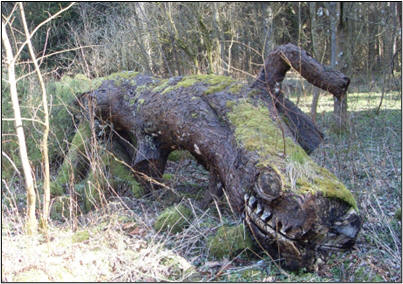
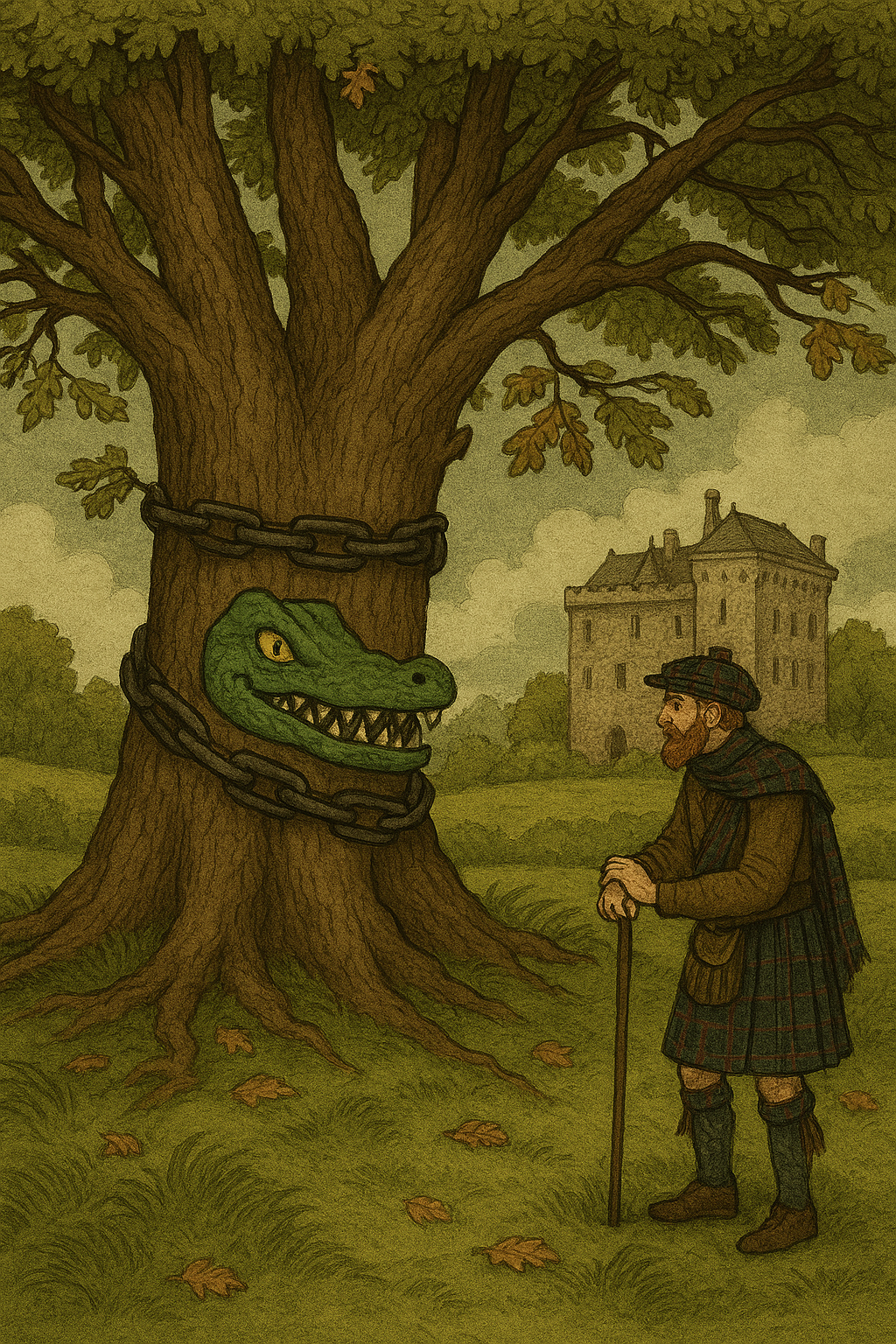
Near the entrance to the turning circle of Cavers House once stood a vast and ancient tree, believed to have been a chestnut. Known locally as the Douglas Tree, it rose from the mossy woodland floor in three immense trunks, forming a dense canopy that filtered the light above a bed of sphagnum and leaf litter.
At approximately twenty feet above the ground, heavy iron chains spanned between the great limbs. These chains, once wrapped around the trunks, had long since been absorbed into the growing wood. Taut and embedded, they appeared to brace the tree against collapse, their massive links stretched tight as harp strings.
Local tradition holds that the tree was bound in response to a curse. According to legend, in the late 19th or early 20th century, the Laird of Cavers dismissed a member of the household staff under contentious circumstances. The woman, reputed by some to be a witch, is said to have laid a curse upon the family: if any limb of the tree were to fall, the male line of the Douglas family would come to an end.
Alarmed, the Laird ordered the tree to be secured with the strongest iron chains available, each link forged and welded to withstand time and storm. For decades, the tree stood fast, the curse fading into memory.
Then, in October 1995, the remnants of Hurricane Opal swept across the UK. The Douglas Tree, after generations of defiance, finally succumbed. The chains snapped, and at least one of the great limbs fell.
Just days later, on 9 October 1995, Lord Alec Douglas-Home - former Prime Minister and the last surviving male of the Douglas line
- died at his home in the Scottish Borders.
Whether coincidence or the echo of an old superstition, the fall of the Douglas Tree and the passing of the Douglas line remain curiously entwined in local lore.
A local variation of the tale, shared by Gemma Lubbock, recounts the following:
"It was said that the tree’s branches - or the tree itself - must never touch the earth. If, with age, the tree grew close enough to risk contact with the ground, a joiner could fashion it into a small boat. As long as the boat remained afloat on the pond behind the house, the curse would be held at bay—since the tree, in essence, had never truly touched the soil."
Contributions
Do you have an ancestor whose
story should be told here? Can you add to this article? Please let us have the details.
|