This page is a stub.
You can help improve it.
The Douglas Clephane Horn
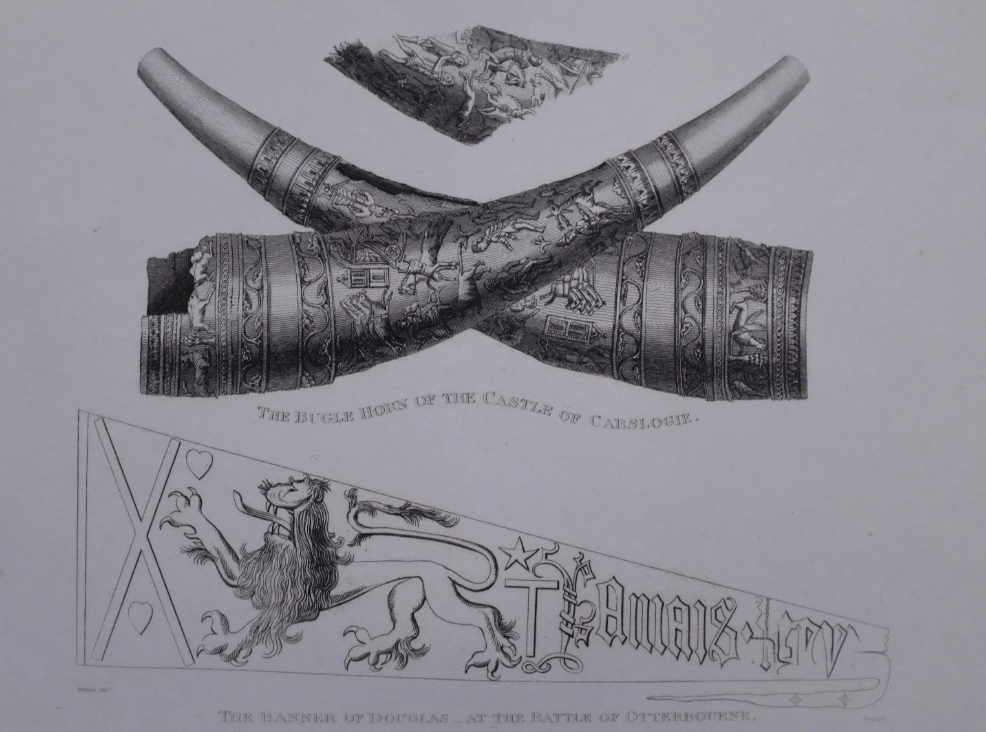
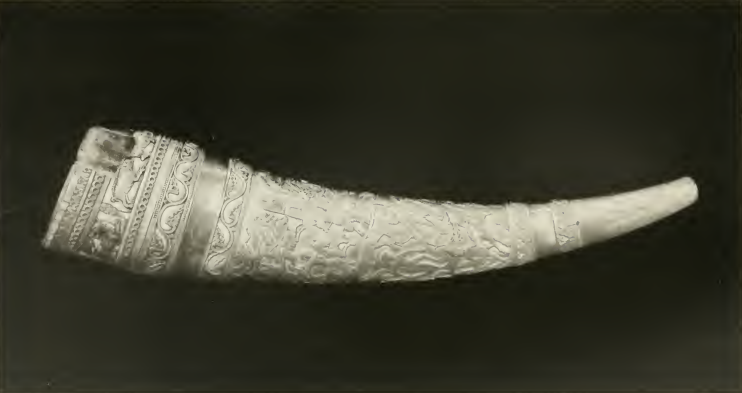
This horn, long held by the Clephane family of Kirkness and Carslogie, Fifeshire, is believed to have been in their possession since time immemorial. Made of ivory, it measures 22½ inches in length, with a circumference of 14 inches at a point 2½ inches from the broad end. The narrow end has a circumference of 3½ inches.
At the broad end, a piece measuring approximately 6 inches in length by 2½ inches in its greatest breadth has broken off. Additionally, the inner side of the horn is damaged and split continuously along its entire length.
For ease of description, the horn can be divided into three distinct sections:
1. The ornamental bands encircling the broad end, featuring leaf-scrolls, animals, and other motifs.
2. The central or main panel, displaying four rows of human and animal figures.
3. The decorative bands around the neck or narrow end.
The Iron Hand of the Douglas Clephanes of Carslogie
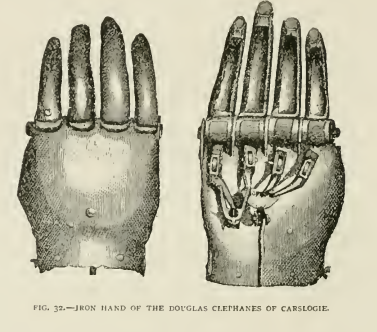
The hand, which is a left one, measures seven inches in length, with a breadth of 3½ inches at the junction of the fingers. The four fingers measure, respectively, 2½, 3, 3, and 3¾ inches in length.
The mechanism by which the fingers could be locked into position is relatively simple. On the inner side, the fingers are slightly toothed at their junction with the hand, resembling small cogwheels. Opposite each finger, a catchpin was held in place by a steel spring, allowing the fingers to remain firmly closed. To release the catchpins, the lever—shown in the engraving of the hand’s interior—was depressed. This action raised the rear ends of the catchpins, releasing the fingers so they could be extended.
At present, the catchpins are considerably worn, with only the one on the extreme left still functioning as intended. One of the springs is also missing (see Fig. 32).
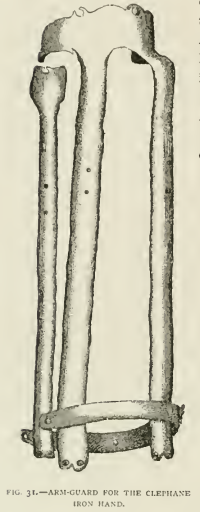
The wrist end of the hand was attached to a light iron framework (see Fig. 31) that extended up the arm as far as the elbow. A similar prosthetic, with a more complex mechanism, is found in the Meyrick Collection and is attributed to the sixteenth century. It is illustrated on Plate LXVII of Skelton’s *Ancient Arms and Armour*.
Another comparable example is housed in the Museum of Sigmaringen and is attributed to Götz or Gottfried of Berlichingen, who died in 1562. A further example resides in the National Museum of Munich, and Sir Walter Scott references such a device in *Border Antiquities*, vol. II, p. 206.
These relics—the horn and the iron hand—passed into the possession of the Northampton family through the marriage of the present Marquis’s father to Margaret, daughter of General Douglas-Maclean Clephane. The Marquis of Northampton now stands as the representative of the ancient Scottish family of Clephane.
At
the time of the above descriptions (1888) the Douglas Clephane items was in the possession of the
Marquis of Northampton.
The Douglas Clephane
Connection
The connection between the Clephane family of Carslogie, the Douglas family, and the Marquess of Northampton is woven through marriage and inheritance, linking Scottish heritage with English nobility.
Major General William Douglas-Maclean Clephane of Carslogie was a key figure in this lineage. His daughter, Margaret Clephane, married Spencer Joshua Alwyne Compton, the 2nd Marquess of Northampton, in 1815. Through this union, the Clephane family’s heirlooms—including the famed iron hand and the Douglas Clephane horn—passed into the Northampton family’s possession.
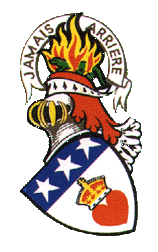
The Douglas connection comes through the Clephane line itself. William Douglas-Maclean Clephane bore a quartered coat of arms that included the Douglas heart and buckles, indicating descent or alliance with the Douglas of Kirkness branch. This heraldic tie suggests that the Clephanes had either intermarried with or were descended from a cadet branch of the Douglas family.
So, in short: the Clephanes of Carslogie were allied with the Douglases by blood or heraldic inheritance, and their legacy was carried into the English aristocracy through Margaret Clephane’s marriage to the Marquess of Northampton. A fascinating blend of Scottish valor and English peerage.
At
the time of the above descriptions (1888) the Douglas Clephane items was in the possession of the
Marquis of Northampton.
Contributions: Do you have an ancestor whose
story should be told here? Please let us have the details.
Source
Sources for this article include:
Scottish National memorials; edited by James Paton;
1890
|