A Scottish barony is a historical territorial dignity
granted by the Crown, originally tied to land ownership and feudal
rights, but now recognized as a noble title without legal jurisdiction.
Origins and Feudal Role
- Feudal baronies emerged in Scotland from the 12th century onward, when monarchs granted land as baronies to trusted individuals—often knights or nobles—via Crown Charters.
- These grants included not just land but baronial rights, such as holding courts, administering justice, and organizing markets.
- The caput (head) of the barony was typically a manor house or castle, serving as the administrative centre.
Legal and Social Status
- Under Scottish feudal law, barons held land directly from the Crown and were obliged to provide military service or other duties.
- A baron could sty- A baron could style themselves as “John Smith, Baron of Auchenshuggle”, and in earlier centuries, some barons were entitled to sit in Parliament.
- The title was not automatically hereditary—it had to be confirmed by the Crown upon succession.
Modern Transformation
- The Abolition of Feudal Tenure etc. (Scotland) Act 2000, effective from
2004, ended the legal link between baronies and land ownership.
- Today, a Scottish barony is considered a non-territorial dignity—a ceremonial and social title that retains historical prestige but no legal powers.
- Titles are recorded in the Scottish Barony Register, and while they can be bought or inherited, they are now akin to honors rather than feudal offices.
Cultural Significance
- Many baronies are deeply tied to local heritage, with families holding them for centuries.
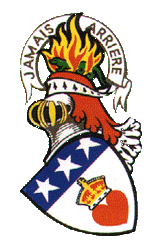
- They often feature in heraldry, with barons entitled to specific symbols such as the chapeau (cap of maintenance) instead of a coronet.
- Some baronies, like Ayton or Balmachreuchie, remain active in cultural and charitable roles, preserving their legacy through historical societies.
Prominent Douglas Feudal Baronies
| Barony |
Associated Branch |
Notes |
| Douglas |
Black Douglases |
The original heartland in Douglasdale, Lanarkshire; seat of
Douglas Castle. |
| Drumlanrig |
Douglases of Drumlanrig |
Held by Sir William Douglas, later elevated to Earl of
Queensberry. |
| Cavers |
Douglases of Cavers |
A cadet branch with strong clerical and Covenanting ties;
seat at Cavers House. |
| Dalkeith |
Earls of Morton |
Became the core of the Morton title; Dalkeith Castle was
their seat. |
| Angus |
Red Douglases |
George Douglas, illegitimate son of the 1st Earl of Douglas,
became Earl of Angus in 1389. |
| Morton |
Earls of Morton |
The barony evolved into the Earldom of Morton, a powerful
Douglas title. |
| Hawick and Tibbers |
Queensberry Douglases |
Subsidiary titles of the Lords and Marquesses of
Queensberry. |
| Liddesdale |
Black Douglases |
A strategic border barony, once held by the 1st Earl of
Douglas. |
Context and Legacy
- These baronies were not merely symbolic—they conferred
judicial, economic, and military authority in their regions.
- The Black Douglases dominated southern Scotland in the
14th–15th centuries, while the Red Douglases (Earls of Angus
and Morton) rose in influence thereafter.
- Many of these baronies were later elevated into peerage
titles, such as Earldoms and Marquessates, but their feudal
baronial roots remain traceable in land charters and
heraldic traditions.
Other Douglas Baronies
- Bothwell - created for David Olifard (ancestor of the current chief of the Oliphants)by King Malcolm IV in the mid 12th century
- Buittle - The Douglases of Dalkeith held immediate regality
over the barony from around 1325
- Herbertshire -
-
Sunderlandhall
-
Mordington
- Holydean
- Glenholm
- Balvenie
- Baky, or Bakie
-
Douglasdale
-
Carmichael
-
Staplegordon (Eskdale)
-
Town of Jedburgh (in barony)
-
Westerkirk (Eskdale)
-
Romanno (Berwickshire)
-
Bedrule (Teviotdale)
-
Kirkandrews in
Dumfries
-
Onele and Coull in
Aberdeen
-
Drumlanrig and Terregles in
Dumfries
-
West Calder in
Edinburgh
Douglas baronets
The Douglas of Glenbervie, Kincardine Baronetcy was created on 28
May 1625 in the Baronetage of Nova Scotia. (First creation)
The Douglas of Kelhead, Scotland Baronetcy was created 26 February
1668 in the Baronetage of Nova Scotia.
The Douglas of Carr, Perthshire Baronetcy was created on 23 January
1777 in the Baronetage of Great Britain for Captain (later Admiral)
Charles Douglas as a result of his service in Quebec during the
American Revolutionary War. Upon Sir Charles' death in 1789, his
eldest son, Vice-Admiral Sir William Henry Douglas, inherited the
title. Sir William was unmarried, and upon his death in 1809, the
baronetcy passed to his youngest brother, General Sir Howard
Douglas, their middle brother having died as well. The baronetcy is
now extinct.
The Douglas of Maxwell, Roxburgh Baronetcy was created 17 June 1786
in the Baronetage of Great Britain .
The Douglas of Castle Douglas, Kirkudbright Baronetcy was created 17
July 1801 in the Baronetage of the United Kingdom.
The Douglas of Glenbervie, Kincardine Baronetcy (second creation)
was created on 30 September 1831 in the Baronetage of the United
Kingdom.
Baron of Castlehill was held by a Comte de Douglas born 1717
at Castle Hill in Scotland.
Contributions
Do you have an ancestor whose
story should be told here? Can you add to this article? Please let us have the details.
|