This page is a stub.
You can help improve it.
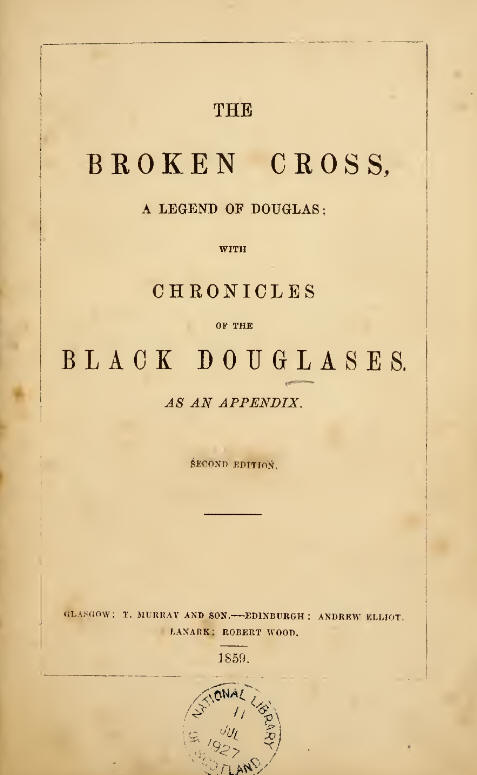
The Broken Cross: A Legend of Douglas, written by Herbert Reid and first published in 1859, is a historical romance that blends myth, prophecy, and the storied legacy of the Douglas family
- particularly the Black Douglases, one of Scotland’s most formidable medieval dynasties.
Overview of the Legend
The central motif of the “broken cross” serves as both a literal and symbolic element in the narrative. It is said to represent a prophetic omen foretelling the downfall of the Douglas line. The story is set against the backdrop of feudal Scotland, where the Douglases wielded immense power, often rivaling the crown itself.
Structure of the Book
• Part I: The Legend
This section dramatizes the tale of the broken cross, weaving in themes of loyalty, betrayal, and divine judgment. It likely draws on oral traditions and romanticized accounts of the Douglas family's rise and fall.
• Part II: Chronicles of the Black Douglases
The appendix offers a more historical account, detailing the exploits of the Black Douglases—figures
like Sir James “the Good” Douglas and Archibald the Grim—who were
central to Scotland’s Wars of Independence and later political
intrigues.
Symbolism and Themes
• The Cross: Possibly a family relic or battlefield token, the broken cross may symbolize fractured faith, internal division, or divine retribution.
• Prophecy: The legend hinges on a foretelling that the Douglas power would crumble when the cross was broken—an allegory for the family’s eventual eclipse by the crown and rival factions.
• Moral Undertones: Like many Victorian-era legends, it likely carries a cautionary tone about pride, ambition, and the limits of earthly power.
The Broken Cross: A Legend of Douglas is
available to download and read
in our library>>>
Contributions
Do you have an ancestor whose
story should be told here? Can you add to this article? Please let us have the details.
|