Douglass Light Infantry

Click here to 
Print this page

walking cane  


Charleston’s population was majority black and there were several local African American militia companies named after black and abolitionist heroes Like Crispus Attucks and William Lloyd Garrison. One of them was the Douglass Light Infantry.

The Douglass Light Infantry was an African American militia unit formed in Charleston, South Carolina, after the U.S. Civil War during the Reconstruction era. Most of its members were formerly enslaved men who named the unit in honour of the prominent abolitionist Frederick Douglass.

The unit was one of several Black militia groups that formed part of the National Guard of South Carolina following the Civil War. These units were significant symbols of African American citizenship and freedom in the post-war South.

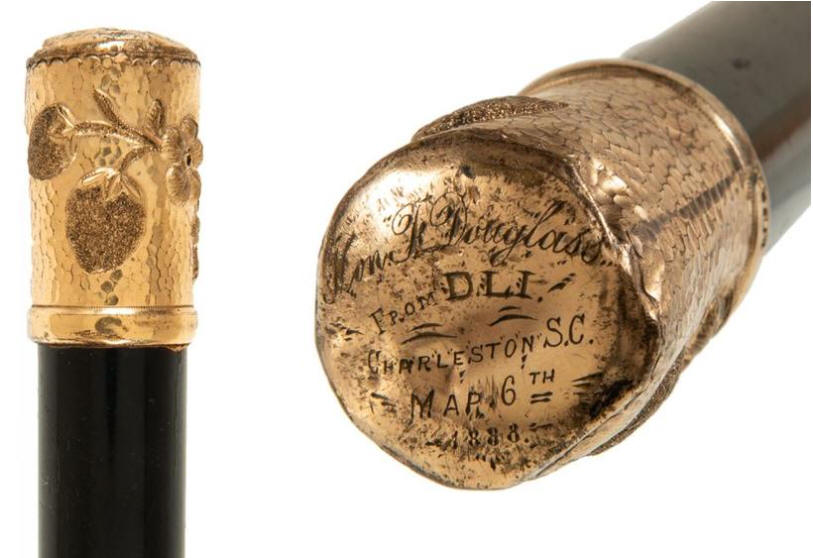
In March 1888, during a speaking tour of South Carolina and Georgia, Frederick Douglass visited Charleston. The Douglass Light Infantry honoured him by serenading him at their armoury and presenting him with a walking stick.

The cane had a gold cap engraved with "Hon. F. Douglass / From D.L.I. / Charleston, S.C. / Mar. 6th / 1888" and was decorated with engraved wild strawberries, which symbolized righteousness and spiritual merit. This walking stick is now a historical artefact in the collection of the South Carolina State Museum.

Like other Black militia groups in the state, the Douglass Light Infantry was eventually disbanded in 1896 due to the implementation of Jim Crow laws and segregationist policies that eroded the rights gained during Reconstruction.


Contributions
Do you have an ancestor whose story should be told here?  Can you add to this article? Please let us have the details.


Source


Sources for this article include:
  • xxx


  • Any contributions will be gratefully accepted


    Back to top


    The content of this website is a collection of materials gathered from a variety of sources, some of it unedited.

    The webmaster does not intend to claim authorship, but gives credit to the originators for their work.

    As work progresses, some of the content may be re-written and presented in a unique format, to which we would then be able to claim ownership.

    Discussion and contributions from those more knowledgeable is welcome.

    Contact Us

    Last modified: Sunday, 08 March 2026