This page is a stub.
You can help improve it.
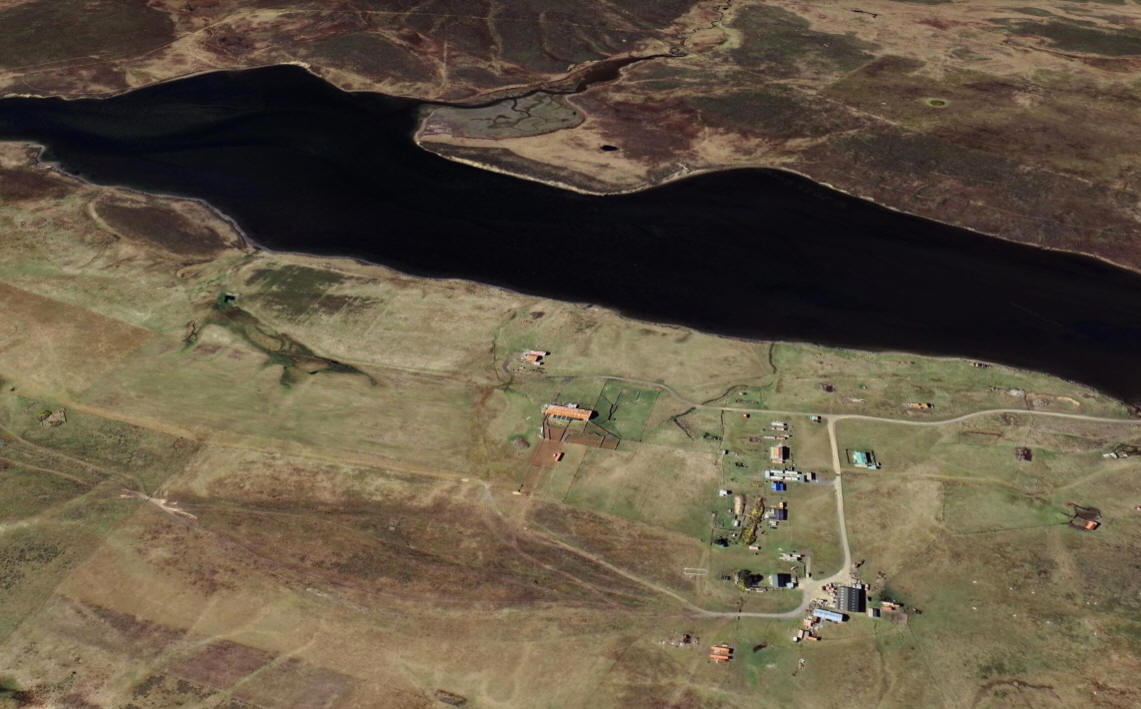
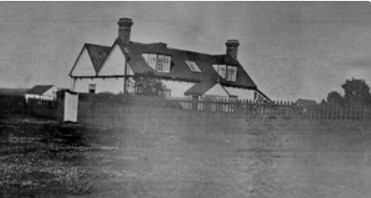 Douglas Station, formerly known as Howgate Station in honour of Robert Greenshields' birthplace
in Scotland, is situated on the western banks of Salvador Water in East Falkland. In the late 1980s, the government acquired the farm and divided it into four sections: King’s Ridge, Home Farm (within the settlement), Bombilla, and New House. Douglas Station, formerly known as Howgate Station in honour of Robert Greenshields' birthplace
in Scotland, is situated on the western banks of Salvador Water in East Falkland. In the late 1980s, the government acquired the farm and divided it into four sections: King’s Ridge, Home Farm (within the settlement), Bombilla, and New House.
Robert Greenshields, born in 1829 in Howgate, Carmichael, Lanarkshire, arrived in the Falkland Islands in 1865 as Flockmaster for the Falkland Islands Company (FIC). His son James accompanied him on the ‘Julie Tatham,’ while his wife Elizabeth and their other children followed in 1866 aboard the ‘Matilda,’ arriving on April 27.
At the time, the Falklands were undergoing a shift from wild cattle hunting to sheep farming, but rampant sheep scab and a shortage of shepherds led to severe losses. Greenshields was expected to remedy these issues, but his lenient management style made him ineffective against the camp’s rougher workers. In 1867, FIC’s new manager, F. E. Cobb, replaced Greenshields with William Wickham Blake, a more assertive figure familiar with handling sheep scab. As compensation, Cobb allowed Greenshields to manage 2nd Corral (Salvador) on shares, but this agreement ended in 1872.
Following his departure from FIC, Greenshields obtained land north of the San Carlos River, securing multiple licenses under his sons James and Thomas’ names, despite their being minors. By 1871, he held leases on seven adjoining sections, initially naming the estate Howgate Station before renaming it Douglas Station after a village near Carmichael. By 1875, he had amassed 7,000–8,000 sheep.
Greenshields passed away in 1878 at the age of 48, leaving his estate equally to his wife Elizabeth and their children, with the hope that the sheep farm would continue. His son James took over the farm but suffered a severe injury in 1896, losing an arm while lassoing a bullock. In 1898, he drowned along with nine others when their cutter vanished in Salvador Waters. His brother George then inherited Douglas Station.
The Greenshields family suffered further losses—several of Robert’s children passed away between 1883 and 1899, and Elizabeth, having outlived most of her family, died in London in 1917 at the age of 80.
James’s son Robert, educated in Britain, returned to manage the farm. He married Malvina Thomas in 1921, and they had two sons. After Robert’s death in 1947, his son Harland (great-grandson of Robert Greenshields) took over Douglas Station.
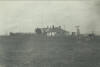 |
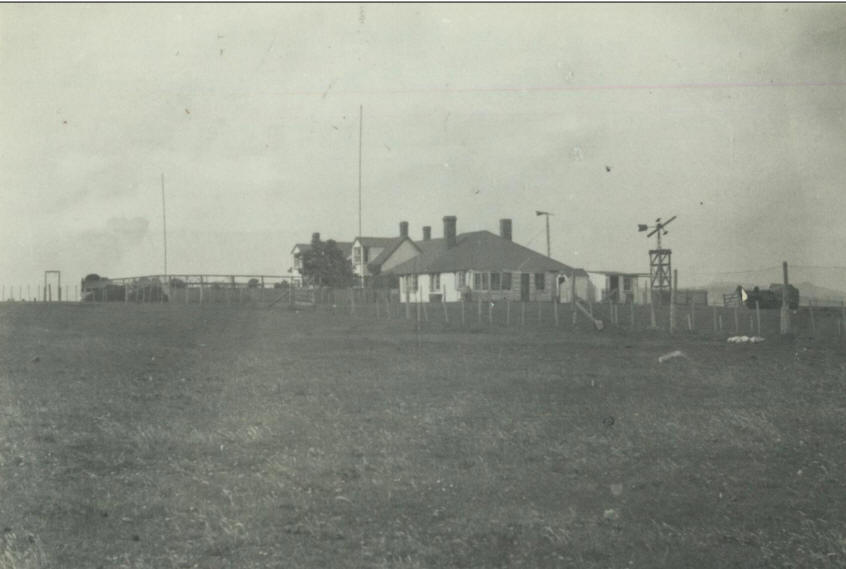
Douglas Big House, in 1952.
It looks to have been a
telecommunictions centre
at that time. |
In 1959, Horseshoe Bay was sold to the Falkland Islands Company, while Douglas Station remained in Greenshield family hands until 1982, when Harland Greenshield sold the farm to
a Mr. Camm. The estate was later subdivided into four sections—King’s Ridge, Home Farm (within the settlement), Bombilla, and New House.
Family notes:
•
William Douglas, bc1846 Scotland; son of John Douglas; 1865 hired
by Falkland Islands Company; 1866 living at Darwin Harbour; c1883 moved
from Falklands to Patagonia; 1889 inherited half-share of Useful
Station, Estancia Esperanza, Prov. Santa Cruz, from brother-in-law
Thomas Greenshields; d. 1907 Llanfyllin, North Wales. He married (1881
Falklands) Jane Greenshields; b. 1855 Carmichael, Lanarkshire; dtr. of
Robert Greenshields & Elizabeth Patterson. Their son, Robert
Greenshields Douglas died of wounds in Egypt in 1916. There is a memorial to
this family in St
Bride's Churchyard
•
Thomas Greenshields, a member of a Scottish family which owned 42,000
acres in the Falklands. He arrived in Patagonia in 1884, where he had a
ranch at Monte Dinero on the south-east tip of Santa Cruz. He married
Ann McMunn in 1889 but he died a few months later aged 29, leaving no
children. He was buried in Punta Arenas Public Cemetery, leaving a will
bequeathing William Douglas half of Useful Hill, the other half to his
brother George Greeshields and a share in Douglas
Station in
the Falklands to his brother James.
See also:
• Douglas families in the Falkland Islands in the 19th century
Contributions
Do you have an ancestor whose
story should be told here? Please let us have the details.
I have sourced a couple of poor quality images, however something with
more clarity of the station would be welcome.
Source
Sources for this article include:
https://falklands-southatlantic.com/ |