|
| |
Douglasdale, Calgary, Alberta
|
|
|
This page is a stub.
You can help improve it.
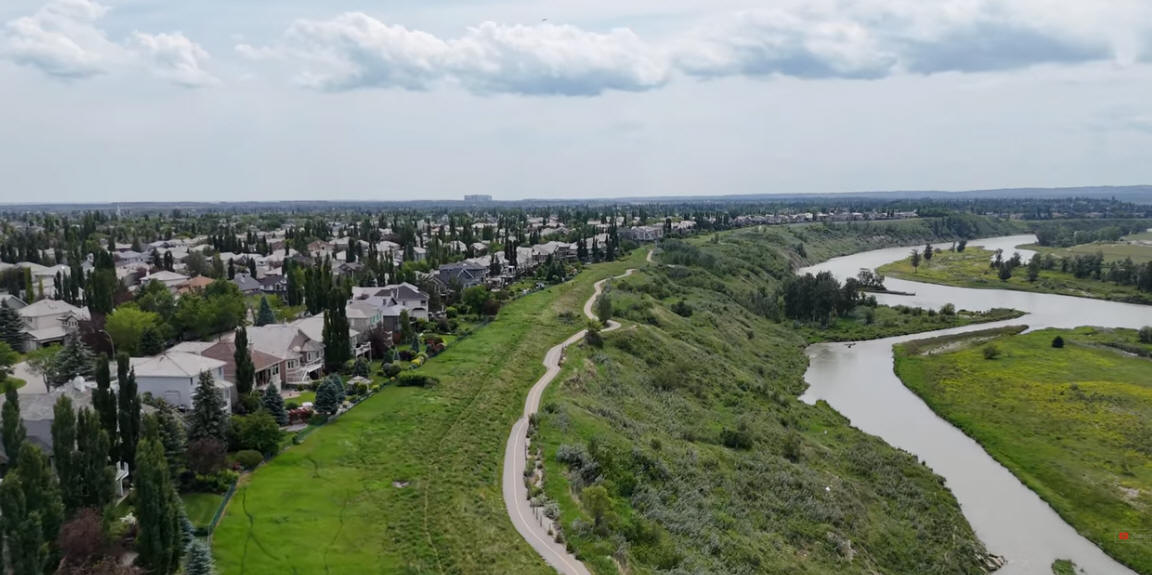
Douglasdale in Calgary, Alberta, takes its name from Thomas and Rachel Douglas, early settlers who established a homestead along the Bow River in the late 1800s. Their property, known locally as Douglasdale, became a recognizable landmark for travelers and ranchers in the area. When the neighbourhood was formally developed in the 1980s, the name was revived to honour that original family and their estate.
The modern community — Douglasdale/Douglasglen — was officially established in 1986, incorporating the historic name into a broader residential plan that also includes Douglas Glen and Quarry Park. The “dale” suffix reflects the area’s geography: a gentle valley descending toward the Bow River, echoing the pastoral character of the original Douglas homestead.
The Sentinels of the Bow: The Legacy of Thomas and Rachel Douglas
In the late 1880s, while the frontier town of Calgary was still a dusty collection of wooden storefronts and railway tents, Thomas and Rachel Douglas were establishing a homestead that would leave an indelible mark on the city’s geography. Settling on the south bank of the Bow River in what is now the community of Bowness, the Douglas family became pioneers of land stewardship long before "conservation" was a household word.
From Scotland to the Bow Valley
Thomas Douglas (born c. 1837–1840) and his wife Rachel (born c. 1845) were part of the vital wave of Scottish-descended settlers who moved west from Ontario following the completion of the Canadian Pacific Railway in 1883.
Unlike the massive corporate cattle syndicates that dominated the region, the Douglases were independent homesteaders. They built a sturdy log home that became a well-known landmark for travelers moving through the valley. Their life was defined by the rugged beauty of the riverbank, but more specifically, by a rare stand of Douglas Fir trees that grew on their property.
The Douglas Children:
A Pioneer Generation
To manage the demands of a riverside homestead, Thomas and Rachel raised a large family. Their children were among the first generation to grow up in the Bow Valley district, transitioning from the pioneer era into the modernization of early 20th-century Alberta:
Thomas Jr. and George: Both instrumental in the early ranching and agricultural industries of the Calgary area.
William and John: Who assisted in the homestead operations and later moved into the burgeoning transportation and rail sectors.
Robert, Janet (Jessie), and Annie: Who were frequently mentioned in the social columns of early Calgary newspapers, representing the emerging social fabric of the settlement.
An Accidental Sanctuary
The most enduring legacy of the Douglas family is ecological rather than architectural. During the late 19th century, it was standard practice for settlers to clear every tree from their land to create pasture or to sell the timber for construction.
Thomas and Rachel Douglas, however, chose to protect the massive firs on their property. Because they refused to "put the ax to the wood," they preserved one of the most easterly stands of Douglas Firs in North America. These trees, some now estimated to be 300 to 400 years old, survived the settlement era solely because of the family’s restraint.
The Modern Connection
Today, the original Douglas homestead is better known to Calgarians as the Wood’s Douglas Fir Sanctuary. While the name comes from Reverend George Wood, who later acquired a portion of the land for his charitable work, historical records credit the Douglas family with the original preservation of the grove.
The sanctuary stands today as a quiet testament to Thomas and Rachel's foresight. While the city of Calgary has grown to surround their original property, the ancient trees they once looked out upon from their cabin window remain standing
- a living bridge between the pioneer past and the urban present.
Notes:
• Douglas Fir trees are known to have been used by
the Indigenous peoples for bows due to its elastic quality. Due to this
the area was known as man-a-cha-pan which translates to "the place they
go for bows", which is what gave the Bow River its name. The sanctuary
is named after Reverend George Wood, a Scottish immigrant who founded
the Wood's Christian Homes and whose property the sanctuary used to be
part of. In 1962 the area that is now the Douglas Fir Trail was purchased along with Edworthy
Park by the City of Calgary to be developed into a park. In 1990 it was recognised as a Provincial Historical Resource by the provincial government.
Contributions
Do you have an ancestor whose
story should be told here? Please let us have the details.
|
Source
Sources for this article include:
xxx
Any contributions will be
gratefully accepted
|
|