This page is a stub.
You can help improve it.
  |
|
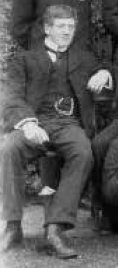
Kenneth Justyn Douglas (1880–1940) was born on 6 March 1880 in Bournemouth, Hampshire, the third son of
Dr Justyn George Durham Douglas, M.D., J.P., and Augusta May Douglas (née Ram). He was part of a distinguished family of ten children, many of whom served across the Empire in ecclesiastical, military, and civil roles.
Educated at Epsom College and later Sherborne School (day boy, May 1894–August 1899), where he rose to the Sixth Form and served as a Prefect. He went on to Queens’ College, Cambridge, continuing the family’s strong academic tradition.
Douglas entered the British Civil Service, initially appointed in 1908 as an Examiner in the Exchequer & Audit Department, before transferring to the Nigeria Civil Service, where he served from 1907 to 1933. His long tenure coincided with a formative period in the administration of the British Protectorate, and
he likely held senior financial or administrative posts during the consolidation of colonial governance.
During the First World War, he served as a Private in the Nigerian Land Contingent, a unit composed of colonial civil servants and volunteers who supported the West African campaigns. His service reflects the broader mobilisation of colonial personnel during the war, particularly in the Cameroons and East Africa theatres.
On 22 October 1918, he married *osephine Carey Duff at Broadstone, Dorset — a union recorded in the Broadstone parish registers. The couple later settled at Squirrel Hill, Littleworth Cross, Seale, near Farnham in Surrey, a rural residence that suggests a quiet retirement following his colonial service.
He died on 10 September 1940 at Stoke Wood Road, Bournemouth, during the early months of the Second World War. He was buried at St Laurence Church, Seale, Surrey, where his grave remains a testament to a life of imperial service and quiet domesticity.
See also:
•
The Douglas Brothers at Sherborne School
Contributions
Do you have an ancestor whose
story should be told here? Please let us have the details.
Source
This article is based on research by Rachel Hassall, Sherborne, Dorset.
|