Castello di Rezzanello and the Douglas-Scotti Family
About the Property
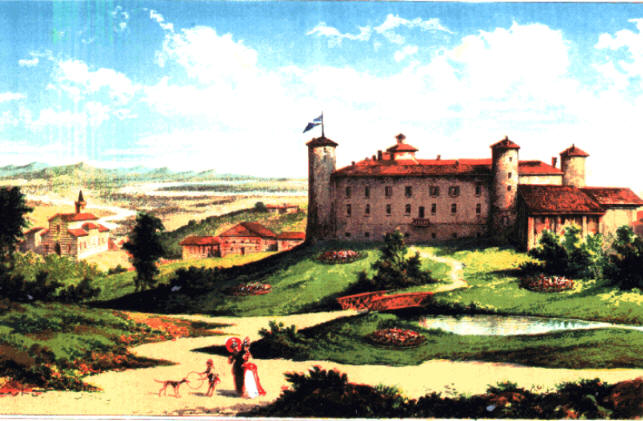
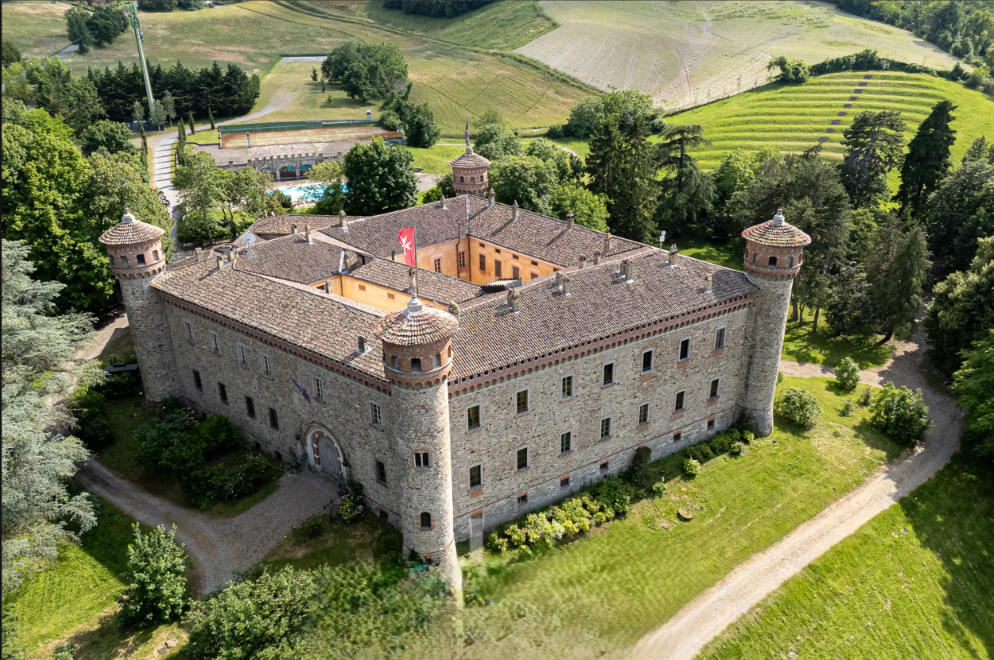
Set within the gentle hills of the Piacenza countryside, Castello di Rezzanello is an extraordinary medieval estate where over a thousand years of history meet timeless elegance. Originally founded around the year 1000, this remarkable castle rises from the heart of a magnificent 7-hectare private park, offering complete privacy in an enchanting landscape of mature trees, ornamental gardens, tranquil lakes, and rolling Italian countryside.
Defined by its four imposing towers and distinctive trapezoidal layout, the castle has been a silent witness to some of Northern Italy’s most significant historical events. It served as a refuge for the Guelphs in 1212 before becoming the residence of distinguished noble families, including the prestigious Scotti di San Giorgio, whose legacy remains woven into the very fabric of the estate.
In the early twentieth century, renowned architect Camillo Guidotti oversaw an exceptional restoration that transformed the property into the refined neo-Romanesque masterpiece admired today. Every intervention was designed to preserve the castle’s historical authenticity while introducing the comforts expected of an exclusive contemporary residence and hospitality destination.
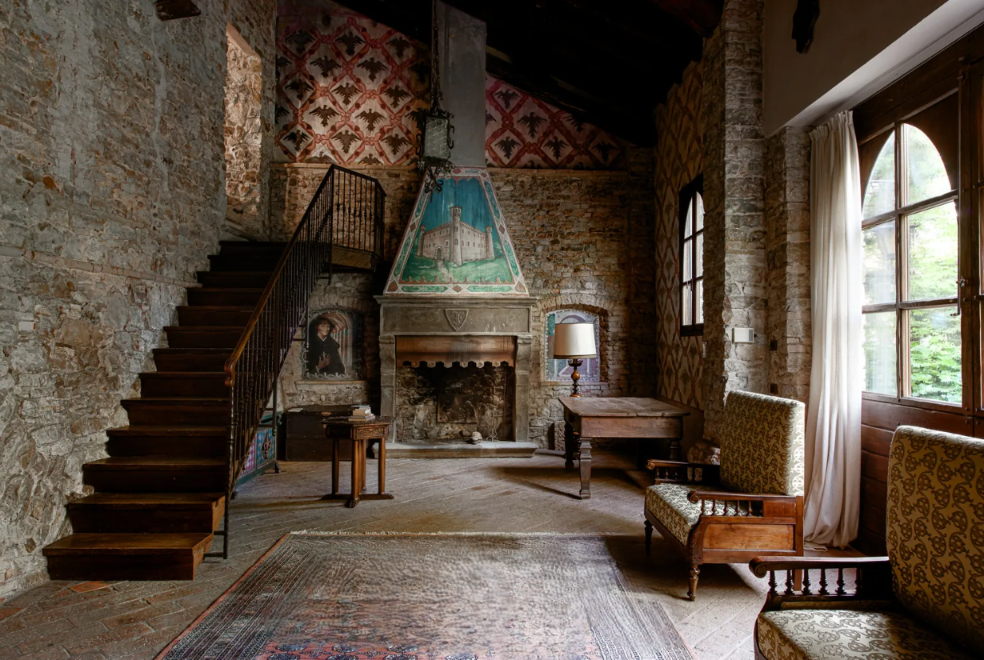
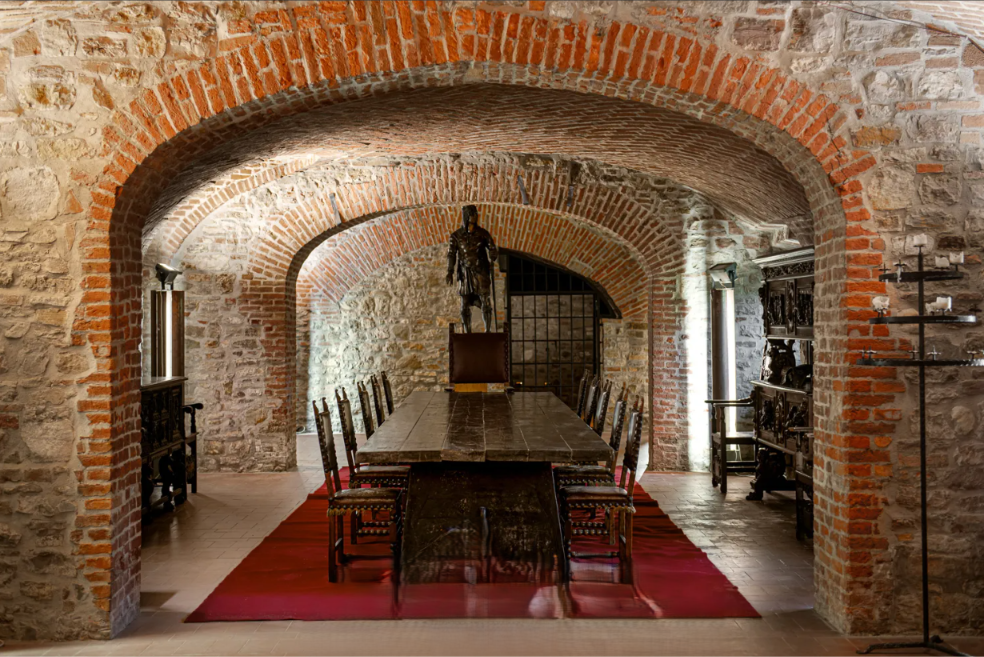
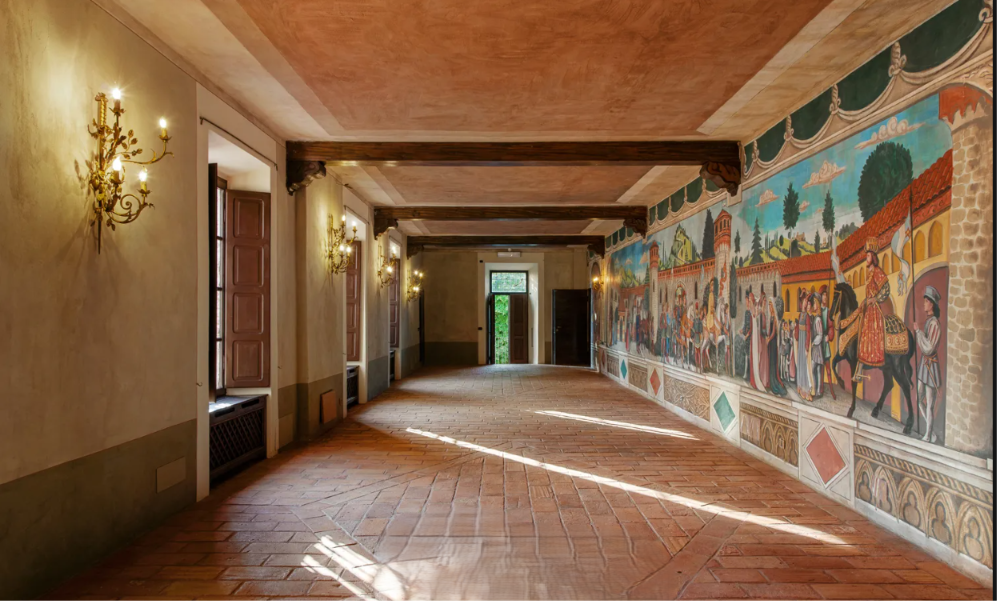
The castle extends across more than 100 rooms, including 23 elegant bedrooms furnished with antique pieces, magnificent four-poster beds, and carefully preserved period details. Grand reception halls, refined salons, and impressive architectural features create interiors of rare character, where every space tells a story while offering an atmosphere of sophistication and comfort.
Outside, the estate unfolds into beautifully landscaped grounds enriched by two scenic lakes, a charming pond, and a remarkable collection of exotic plants. The surrounding park provides an exceptional setting for peaceful daily living as well as unforgettable celebrations immersed in nature.
Internationally recognized as one of the area’s most prestigious event destinations, Castello di Rezzanello can host more than 2,000 guests within its remarkable collection of reception halls. Among its finest spaces is the celebrated *Salone dei Blasoni*, distinguished by the coats of arms of the noble families who shaped the castle’s remarkable history. Weddings, gala dinners, corporate events, cultural gatherings, and exclusive private occasions all find an extraordinary setting within these historic walls.
Origins: The Scotti Lords of Rezzano
The connection between the Douglas-Scotti
family and Castello di Rezzanello begins long before the castle itself
entered their possession. In the medieval period, the Scotti were among
the most powerful noble families of Piacenza, divided into several
prominent branches. One of these, descending from Ruffino Scotti(1), held
lordship over Mamago, Magnano, Castelbosco, and Rezzano - the territory
surrounding what would later become Rezzanello.
Although the
castle was not yet in Scotti hands, the territorial association between
the Scotti lineage and the Rezzano district forms the earliest thread
linking the family to the site. This deep-rooted presence in the region
would later shape the identity of the Douglas-Scotti line, whose
heritage blends Scottish martial tradition with Italian noble
continuity.
The Castle Through the Centuries
Castello di Rezzanello itself passed through a succession of owners
during the Renaissance and early modern periods. The Boccapiccina,
Chiapponi, and Gerolamini families each held the estate at different
times, and for a period it was administered by the Venerable English
College in Rome, which maintained ecclesiastical rights over the
property.
By the late eighteenth century, the castle had become a
contested asset, its ownership complicated by overlapping claims and the
extinction of the Chiapponi line. This moment of transition opened the
way for the Scotti to reclaim a historic foothold in the Rezzano region.
1796: The Scotti di San Giorgio Acquire Rezzanello
In 1796, the Scotti di San Giorgio branch formally acquired Castello
di Rezzanello. This event marks the decisive moment when the castle
entered the patrimony of the wider Scotti family - later known in part as
the Douglas-Scotti.
The acquisition was not straightforward. The
English College asserted lingering rights over the estate, leading to a
prolonged legal dispute. The Scotti ultimately secured full ownership
only after paying substantial compensation, demonstrating the strategic
importance they placed on Rezzanello as a noble seat.
A Noble Residence Reborn
Once the legal challenges were
resolved, the Scotti transformed Rezzanello from a medieval fortress
into a refined noble residence. Renovations modernised the structure
while preserving its imposing character, creating a home suitable for a
family whose identity straddled both ancient Italian nobility and the
martial traditions of the Douglas name.
During this period, the
castle became closely associated with Count Guglielmo Scotti, styled “of
San Giorgio and Rezzanello”, whose heraldic arms vividly express the
merged Douglas-Scotti identity. His shield combines:
- The
Douglas mottoes LOCK SICKER and DO OR DIE
- The unicorn crest, long
associated with Douglas heraldry
- The traditional Scotti
quarterings
This heraldic synthesis demonstrates that Rezzanello
was not merely a residence but a symbolic locus of the Douglas-Scotti
lineage - a place where the family’s dual heritage was consciously
displayed.
Decline and Departure
By the late
nineteenth century, the fortunes of the Scotti di San Giorgio had waned.
In 1898, the last heir of the line was forced to sell Castello di
Rezzanello, ending more than a century of Scotti ownership. Although the
Douglas-Scotti family continued elsewhere—most notably at Vigoleno, San
Giorgio, and in later generations Naples - Rezzanello remained an
important chapter in their story.
Significance
The history of Castello di Rezzanello
illuminates several key themes central to the Douglas-Scotti narrative:
- Territorial continuity: The Scotti presence in Rezzano predates
the castle’s acquisition by centuries.
- Noble identity: Rezzanello
became a stage upon which the merged Douglas-Scotti heraldic and
cultural identity was expressed.
- Historical transition: The
castle’s passage into and out of Scotti hands reflects the broader
fortunes of the family across the eighteenth and nineteenth centuries.
- Heraldic evidence: The arms of Count Guglielmo Scotti provide a
rare and vivid example of Douglas symbolism embedded within Italian
noble heraldry.
Rezzanello stands as a
heritage landmark - a place where the Italian and Scottish strands of the
family’s history intertwine, and where the Douglas - Scotti identity was
both lived and proclaimed.
See also:
'Rezzanello',
An Historical Monograph by Theologian Professor Belice Alessio' Member
of the Royal Italian Heraldic Academy; Piacenza, 1883 [pdf - Italian]
The Douglas-Scotti Family and Castello di Rezzanello
An Extract Prepared for the Douglas Archives
Introduction: The Castle’s Modern Renown
Although Rezzanello had
long been known to Piacentines and local antiquarians, its wider fame
arose only when it passed into the hands of the Douglas-Scotti family.
From that moment, the castle’s name travelled far beyond the hills of
Piacenza, carried by the social standing, international connections, and
dignities attained by the Douglas-Scotti Counts.
By the late
nineteenth century, Rezzanello was known not only throughout the Italian
aristocracy but also among distinguished families in France, England,
Germany, and Spain, and even as far afield as Yokohama, Lima, and New
York. This remarkable diffusion of reputation is attributed directly to
the Douglas-Scotti household.
Count Ferdinando
Douglas-Scotti: The First Modern Patron of Rezzanello
The monograph identifies Conte Don Ferdinando Douglas-Scotti as the
pivotal figure who first elevated Rezzanello's name to national and
international prominence. His influence derived from:
- the
dignities and honours conferred upon him,
- his extensive network of
acquaintances across Europe,
- and the virtues and reputation of his
wife, Marchesa Sofia Landi, whose presence further enhanced the family’s
standing.
Ferdinando did not merely enjoy Rezzanello as a
residence; he sought to enshrine its history, gathering documents from
Piacenza’s chronicles and from the family’s own archive. His intention
was to produce a formal monograph on the castle — a project interrupted
only by his death.
Marchesa Sofia Landi: A Pillar of
the Family's Reputation
The monograph pays notable
tribute to Marchesa Sofia Landi, wife of Count Ferdinando. Her personal
virtues, social grace, and cultivated reputation contributed
significantly to the esteem in which the Douglas-Scotti family was held.
Her influence is explicitly cited as one of the reasons
Rezzanello became known among aristocratic circles across Europe and
beyond.
Count Guglielmo Douglas-Scotti: Heir and Historian
Upon Ferdinando's death, his son Conte Guglielmo Douglas-Scotti
inherited Rezzanello. The monograph portrays him as deeply devoted to
honouring his father’s memory. In this spirit, he resolved to complete
the historical work his father had begun.
Guglielmo:
- commissioned Professor Belice Alessio to gather all available memories
and documents relating to Rezzanello,
- provided access to the
Douglas-Scotti family archive,
- and requested the composition of a
full historical monograph.
It is through Guglielmo's initiative
that the Monografia Storica di Rezzanello was completed in 1883.
He is formally styled:
“Conte di San Giorgio e di
Rezzanello”
This title, inherited with the estate, became a
defining element of the Douglas-Scotti identity.
The
Douglas-Scotti Family Archive
The monograph confirms the
existence of a substantial Douglas-Scotti archive, containing:
- medieval and
early-modern property records,
- ecclesiastical leases and enfiteusi,
- genealogical materials,
- legal documents relating to the
Chiapponi and earlier proprietors,
- and records of improvements
made after the Douglas-Scotti acquisition.
From the Chiapponi
section onward, the author states that his narrative is drawn primarily
from the Douglas-Scotti archive, underscoring its historical value.
The Title Count of Rezzanello
The monograph
clarifies the origin and legitimacy of the title:
- The Chiapponi
family first used the title “Conte di Rezzanello” in the early
eighteenth century.
- A French genealogical source (Abrégé
généalogique historique de la Maison de Scotti-Douglas) confirms its use
in 1724.
- The Douglas-Scotti adopted the title upon acquiring the
estate.
- By the nineteenth century, the title was validated by long
prescription — more than a century of continuous noble usage.
This provides authoritative grounding for the Douglas Archives’
genealogical records.
The Douglas-Scotti
Acquisition and Improvements
Although the monograph’s detailed
narrative of the acquisition appears later in the text, the introduction
summarises the essentials:
- Rezzanello passed from the Chiapponi
to the Douglas-Scotti family through a formal transfer of ownership.
- The Douglas-Scotti undertook significant improvements to the castle,
transforming it from a fortified structure into a refined noble
residence.
- These enhancements contributed to the castle’s modern
identity and to the family’s reputation as cultured custodians of their
ancestral lands.
A Douglas-Scotti Cultural Project
The monograph itself is framed as a Douglas-Scotti heritage
endeavour:
- Conceived by Count Ferdinando,
- Commissioned
and completed by Count Guglielmo,
- Based on the family archive,
- Dedicated to the Douglas-Scotti lineage,
- And reissued in modern
times to honour their legacy.
Thus, the Monografia Storica di
Rezzanello stands not only as a historical document but also as a
testament to the family’s commitment to preserving their heritage.
Summary
- Rezzanello's
modern fame is inseparable from Douglas-Scotti ownership.
- Count
Ferdinando and Marchesa Sofia Landi elevated the castle’s reputation.
- Count Guglielmo completed the historical project and preserved the
archive.
- The title “Conte di Rezzanello” is validated by
eighteenth-century usage and later prescription.
- The
Douglas-Scotti archive is a primary source for the castle’s history.
- The monograph is itself a Douglas-Scotti cultural legacy.
Notes:
1. Ruffino, son of
Lanfronco (1222), himself 10th Grandson of Sholto Douglas who Sholto
Douglas, at the head of his vassals, in 767 comes to Italy, Progenitor
of the Lords of Mamago, Castel Bosco, San Giorgio and Rezzanello
Contributions
Do you have an ancestor whose
story should be told here? Please let us have the details.
|