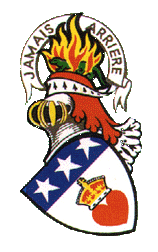
William
Douglas, mill owner
William Douglas (28 Feb 1745-30 Jan 1810) was the head of the firm
of William Douglas and Co., cotton spinners and merchants. He
served the office of constable of Manchester in 1780. He is
sometimes referred to as William Douglas of Penbleton.
William, Of the Old Hall, Pendleton, Lancashire, was the son and 7th child of
John Douglas (d. 1762) of St.
George's, Hanover Square, an innkeeper of the Hercules Pillars in
Hyde Park Road, London, and Mary Gardiner (d. 1766).
Of nine
siblings only the three boys survived. After the deaths of his
parents he brought up by his younger brother
James (1753–1819) in
Manchester, where James belatedly attended Manchester grammar
school. He was in business with his other brother,
Thomas (qv).
William Douglas, later to be known as Black Douglas
because of his harsh treatment of pauper children, set up water
powered hoist mill at the Pendleton Old Hall Site in 1780. Freedom
from Arkwright restrictions resulted in an increase in the size of
water powered mills. A letter in 1792 mentions 3,000 to 4,000
spindles at Douglas Mills. Douglas chiefly supplied the master
manufacturers with twist and warps, which were then distributed to
the handloom weavers. In 1782 the Douglas Mills were constructing
textile looms.
In 1786, he employed 5 girl and 3 boy
apprentices from St Giles in the Fields; in 1795 there were 15 and
12 from St Luke, Chelsea. He 'employed and paid a clergyman of the
Church of England to instruct them in their Bible catechism and
other religious duties on Sunday'. It is not clear from where these
children came, but pauper children from as far away as Glasgow were
placed in the Lancashire mills. William Douglas had, in 1795,
apprenticed to him Mary Anne Finch from St Anne's Parish,
Westminster, with 'hours of labour seldom exceed(ing) 12 hours a day'
- and 'never at night'. The Douglas Green Mills in Salford
were sometimes referred to as the Cripple Factory or The White Slave
Mill.
He was appointed an Honorary Burgess of Glasgow,
22 Dec 1784.
He married Mary Hargreave, daughter
of George Hargreave and Mary Marsden and had 5 children. He is
described as 'a key player' in the cotton industry and amassed a
fortune. In the history of the Hargreave family, he is described as
a banker, possibly Messrs. Douglas, Smalley & Co, in Holywell,
established by his son John.
He died 30 Jan 1810 at Pendleton Hall, and was
succeeded by his son, John Douglas of Gyrn, a cotton spinner in Holywell, Flintshire.
His ghost was said to haunt the area for many years after.
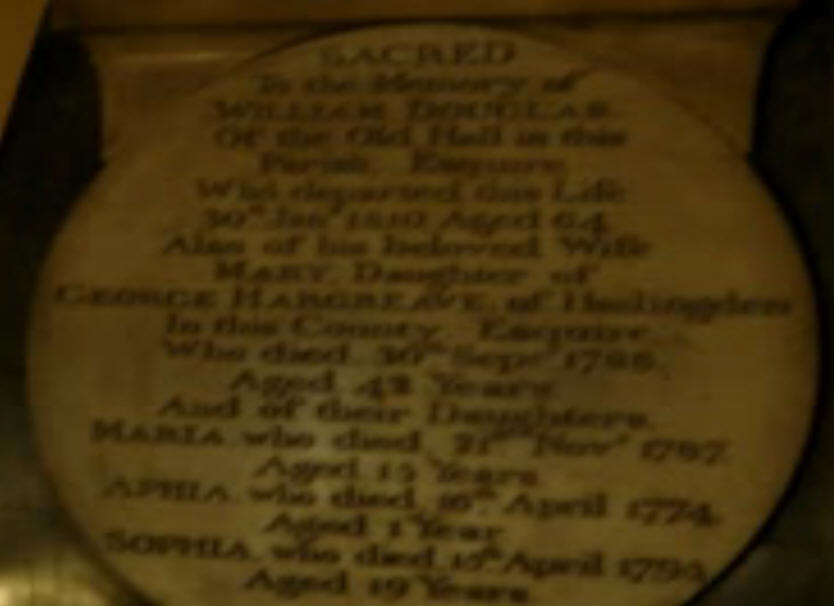 There is a memorial to him in the upper gallery of St Thomas's Church, Pendleton, which
reads:
There is a memorial to him in the upper gallery of St Thomas's Church, Pendleton, which
reads:
Sacred to the memory of William Douglas of the Old Hall in
this parish, esquire.
Died 30th Jan 1810 aged 64 years.
Also
his beloved wife Mary died 30th Sept 1788 aged 42 years.
also
their daughters
Maria died 21st Nov 1787 aged 15 years.
Aphia
died 18th April 1774 aged 1 year.
Sophia died 18th April 1795
aged 19 years.
Not listed on the memorial is his daughter, Charlotte. She
seems to turn up as a spinster of Leaf Square, Pendleton in the
1820s, yet there are claims she has descendants in Somerset.
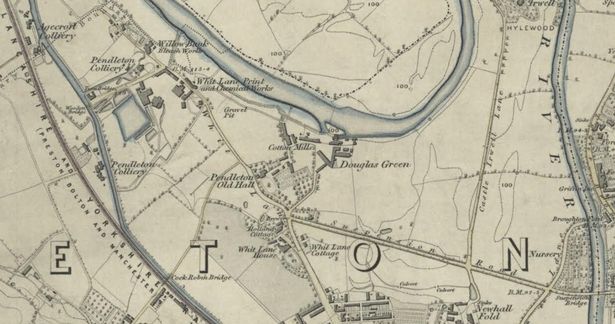 Map
of Pendleton
Map
of Pendleton
The attached pdfs contain additional information about William
Douglas.

By these accounts, he was not a very nice man!
See also:
•
The Cotton Twist Company
Any contributions will be
gratefully accepted
Errors and Omissions
|
|
The Forum
|
|
What's new?
|
|
We are looking for your help to improve the accuracy of The Douglas
Archives.
If you spot errors, or omissions, then
please do let us know
Contributions
Many articles are stubs which would benefit from re-writing.
Can you help?
Copyright
You are not authorized to add this page or any images from this page
to Ancestry.com (or its subsidiaries) or other fee-paying sites
without our express permission and then, if given, only by including
our copyright and a URL link to the web site.
|
|
If you have met a brick wall
with your research, then posting a notice in the Douglas Archives
Forum may be the answer. Or, it may help you find the answer!
You may also be able to help others answer their queries.
Visit the
Douglas Archives Forum.
2 Minute Survey
To provide feedback on the website, please take a couple of
minutes to complete our
survey.
|
|
We try to keep everyone up to date with new entries, via our
What's New section on the
home page.
We also use
the Community
Network to keep researchers abreast of developments in the
Douglas Archives.
Help with costs
Maintaining the three sections of the site has its costs. Any
contribution the defray them is very welcome
Donate
Newsletter
If you would like to receive a very occasional newsletter -
Sign up!
Temporarily withdrawn.
|
|
|
|
|
|
|
|