-
 Also
known as Also
known as
- Bride of the Isles; Bridget of Ireland; Bridget; Brigid of Kildare
Brigit; Ffraid; Mary of the Gael
- Memorial
- 1 February;
10 June: translation of her relics
- Profile
- Daughter of Dubtach, pagan Scottish king
of Leinster, and Brocca, a Christian Pictish slave who had been
baptized by Saint Patrick. Just before Brigid's birth, her mother was
sold to a Druid landowner. Brigid remained with her mother till she
was old enough to serve her legal owner Dubtach, her father.
She grew up marked by her high spirits and tender heart, and as a
child, she heard Saint Patrick preach, which she never forgot. She
could not bear to see anyone hungry or cold, and to help them, often
gave away things that were Dubtach's. When Dubtach protested, she
replied that "Christ dwelt in every creature".
Dubtach tried to sell her to the King of Leinster, and while they
bargained, she gave a treasured sword of her father's to a leper.
Dubtach was about to strike her when Brigid explained she had given
the sword to God through the leper, because of its great value. The
King, a Christian, forbade Dubtach to strike her, saying "Her
merit before God is greater than ours". Dubtach solved this
domestic problem by giving Brigid her freedom.
Brigid's aged mother was in charge of her master's dairy. Brigid took
charge ,and often gave away the produce. But the dairy prospered under
her (hence her patronage of milk maids, dairy workers, cattle, etc.),
and the Druid freed Brigid's mother.
Brigid returned to her father, who arranged a marriage for her with a
young bard. Bride refused, and to keep her virginity, went to Bishop
Mel, a pupil of Saint Patrick's, and took her first vows. Legend says
that she prayed that her beauty be taken from her so no one would seek
her hand in marriage; her prayer was granted, and she regained her
beauty only after making her vows. Another tale says that when Saint
Patrick heard her final vows, he mistakenly used the form for ordaining
priests. When told of it he replied, "So be it, my son, she is
destined for great things."
Her first convent started with seven nuns. At the invitation of bishops,
she started convents all over Ireland. She was a great traveller,
especially considering the conditions of the time, which led to her
patronage of travellers, sailors, etc. Brigid invented the double
monastery, the monastery of Kildare on the Liffey being for both monks
and nuns. Combeth, noted for his skill in metalwork, became its first
bishop; this connection and the installation of a bell that lasted over
1000 years apparently led to her patronage of blacksmiths and those in
related fields.
- Born
- 453 at Faughart, County Louth, Ireland
- Died
- 1 February 523 at Kildare, Ireland of natural causes; buried in
Downpatrick, Ireland with Saint Patrick and Saint Columba; head
removed to Jesuit church in Lisbon, Portugal
- Name Meaning
- fiery arrow (= brigid)
- Patronage
- babies, blacksmiths, boatmen, cattle, chicken farmers, children whose parents are not married,
dairymaids, dairy workers, fugitives, infants, Ireland, mariners,
midwives, milk maids, newborn babies, nuns, poets, poultry farmers,
poultry raisers, sailors, scholars, travellers, watermen,
- Representation
- abbess, usually holding a lamp or candle, often with a cow nearby
Several important members of the Douglas family are interred within St
Bride's Church, in Douglas village,
in Lanarkshire, Scotland.
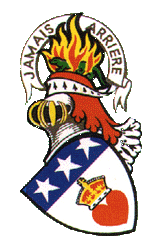
Saint Bride, patron saint of the Douglas family
Saint Bride was adopted as their patron saint by the early Douglases
and it is said that they swore their oaths by St Bride of Douglas.
The feast day of Saint Bride is first February, and on this day
in 1330 the Good Sir James Douglas, who on the eve of setting off to the
Holy Land with the heart of King Robert the Bruce, was in his last
residence in Scotland at the fortress of the Park of Douglas which is
situated between Park Hall and Coalgill. Sir James committed himself
to the protection of St Bride and granted to the Abbey of Newbattle half
the land of Kulmad, the other half already being in the ownership of the
Abbey. This gift was conditional upon a choral mass being performed
at the altar of st Bride which was within their monastery and on her
commemoration day, 1st February, and that in her honor the monks would
feed 13 poor people on that day.
Excerpt from The Newbattle Charter:

See also:
• St
Bride's Church, Douglas
• St Bride's
Collegiate Church, Bothwell
• Battle of St Bride
• St. Michael's Church,
Linlithgow
• Window in St Bride's Church, Douglas, depicting
Saint Bride
|
|