|
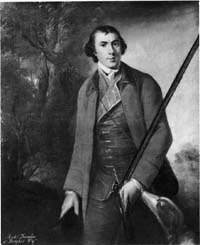 Archibald James Edward Douglas
[formerly Stewart], first Baron
Douglas (1748–1827), litigant and politician, the
son of Sir John Stewart of Grandtully, third baronet (1687–1764), and his
wife,
Lady Jane Douglas (1698–1753),
was born on 10 July 1748 at Faubourg St Germain, Paris. Archibald James Edward Douglas
[formerly Stewart], first Baron
Douglas (1748–1827), litigant and politician, the
son of Sir John Stewart of Grandtully, third baronet (1687–1764), and his
wife,
Lady Jane Douglas (1698–1753),
was born on 10 July 1748 at Faubourg St Germain, Paris.
His early life was
dominated by the efforts of his parents and supporters to establish his
identity as nephew and heir of
Archibald Douglas,
duke of Douglas (bap. 1694, d. 1761). His mother, the duke's only
sister, had in 1746 married without her brother's knowledge Colonel John
Stewart, a former Jacobite sympathizer and veteran of the Swedish army,
and fled to the continent. Two years later she informed the duke of the
marriage and notified him that she was (at the age of fifty) pregnant.
Subsequently she reported the birth on 10 July 1748 of twin boys, named
Archibald and Sholto(1). The irascible and eccentric duke disapproved of the
marriage, cut off his sister's allowance, and—encouraged by the duke of
Hamilton's family, who stood next in line to the sister as heir—refused to
recognize the twins as hers. In 1751 the family returned to Britain, where
they lived a hand-to-mouth existence as Colonel Stewart was soon
imprisoned for debt.
Sholto and Lady Jane both died in 1753.
Archibald's
upbringing was taken over by Lady Schaw of Greenock, and, after her death
in 1757, by the duke and duchess of Queensberry, who saw to his education,
first at Rugby School (1759–61) and then at Westminster School (1761–5).
The reclusive duke of Douglas surprisingly married in March 1758, and the
new duchess, Margaret Douglas of Mains,
became an aggressive advocate of Archibald's claim to the Douglas estates,
which were said to be worth in excess of £12,000 a year. Before the duke
died, she convinced him to reinvestigate the case and to name Archibald as
his heir. Following the duke's death in July 1761, Archibald Stewart was
duly served heir and took the surname Douglas.
This set the stage
for one of the eighteenth century's most famous legal battles, the Douglas
cause. Archibald's inheritance was challenged by the Hamiltons, who argued
that he and his brother were supposititious. The Hamilton lawyers put
together a plausible circumstantial argument that Archibald was actually
Jacques Louis Mignon, the son of a Parisian glassworker, who had
disappeared in July 1748. The case was litigated at great length and
expense (the two sides spent £54,000 between them). It attracted
tremendous interest, especially in Scotland. Not only was a large estate
at stake, but many felt that requiring Archibald Douglas to in effect
prove his identity raised a question that could endanger the security of
inheritance in general. In Scotland the Douglas side enjoyed broad popular
support, with James Boswell an especially eager partisan, though many of
the literati favoured the Hamilton side. In 1767 the court of session
decided by the casting vote of the lord president against Douglas. Douglas
appealed to the House of Lords which, following the opinions of law lords
Mansfield and Camden, reversed the decision without a division.
Douglas settled easily into the life of a landed magnate. He was an
improving landlord who continued the rebuilding of Douglas Castle begun by
his uncle, though investment in the Ayr bank of
Douglas, Heron & Co.,
which failed in 1772, complicated his finances during the 1770s. He also
achieved a degree of political prominence as he worked to resurrect the
Douglas interest in Lanarkshire, Berwickshire, Forfarshire, and elsewhere.
He was elected member for Forfarshire in 1782, and was made lord
lieutenant of the county in 1794. During the following year he raised a
regiment of fencibles(2). In parliament he was a loyal, if silent, follower
of Henry Dundas and William Pitt, a status that facilitated his successful
pursuit of a peerage. Although he would have preferred an earldom, he was
created Baron Douglas of Douglas in 1790.
Douglas married twice
into ducal families: first, on 13 June 1771, Lady Lucie Graham
(1751–1780), daughter of the second duke of Montrose, and second, on 13
May 1783, Lady Frances Scott
(1750–1817), sister of the third duke of Buccleuch; among the children
born of this second marriage was
Caroline Lucy Scott, novelist. Horace Walpole commented that ‘it is proof
of his sense, that he can forgive her person in favour of her
merit’ (to Lady Ossory, 17 April 1783, Walpole, Corr.,
33.399).
He was also the father of George Douglas
(1788-1838), Captain in the Royal Navy, and Sholto Scott Douglas
(1785-1821), a Captain in the 6th Inniskillen Dragoons at Waterloo.
Douglas died on 26 December 1827 at
Bothwell Castle, Lanarkshire. He was buried in Douglas parish church
in the same county. Forever identified with the Douglas cause, as an adult
he proved a rather unexceptional aristocrat.
Notes:
(1) It would be assumed that a woman of such advanced years, pregnant for the
first time, would take great care and settle down in comfort to await the birth.
Lady Jane, however, abruptly moved from Aix-la-Chapelle to Paris in the eighth
month of her pregnancy accompanied only by her husband and a maid. Supposedly
this was to place her under the care of the best doctors in France. In the end
the doctor who delivered the babies could never be found nor could the woman who
was purported to have owned the house in which the births took place.
Even though twins were reported in letters, the couple returned to Rheims in
July, 1748 with only one infant. When questioned about the other baby it was
said he was left in the care of the doctor.
It wasn't until November, 1749 that the couple, again in the company of the
same maid, returned to Paris to retrieve their son. Interestingly, it was later
found that there had been two kidnappings in Paris in that period of time, one
in July, 1748 and another in November, 1749. Witnesses claimed, in both cases,
that the baby boys were carried off by a Lady, a Gentleman and their maid. This
was enough to convince the court, albeit in a very close decision, to award the
Douglas properties to the Duke of Hamilton.
Robert Burns's funeral procession through Dumfries.
The
Royal Dumfries Volunteers, or which Burns was a member, wore blue
coats so presumably the Angusshire Regiment are leading. |
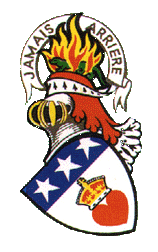
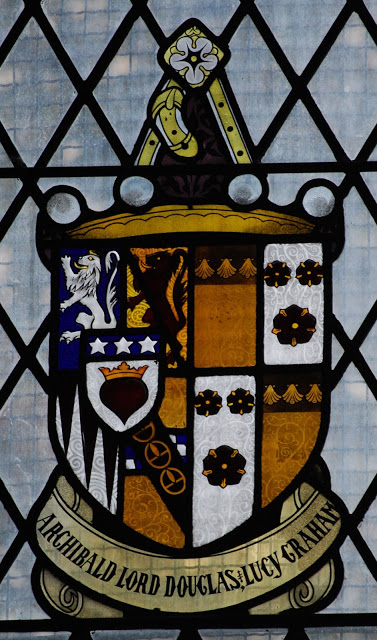
The arms of Douglas of Douglas on the dexter (left) side of
the shield are blazoned: Quarterly: 1, Azure a lion rampant
argent crowned with an imperial crown or (Galloway); 2, Or a
lion rampant gules surmounted by a ribbon in bend sable
(Abernathy); 3, Argent three piles gules (Wishart); 4, Or a fess
checky azure and argent surmounted of a bend sable charged with
three buckles of (Stewart of Bonkill); overall on an escutcheon
Argent a heart gules crowned or on a chief azure three mullets
argent (Douglas of that Ilk).
The paternal arms of his wife, Lucy Graham, are blazoned:
Quarterly: 1 and 4, Or on a chief sable three escallops or
(Graham); 2 and 3, Argent three roses gules (Montrose). ` |
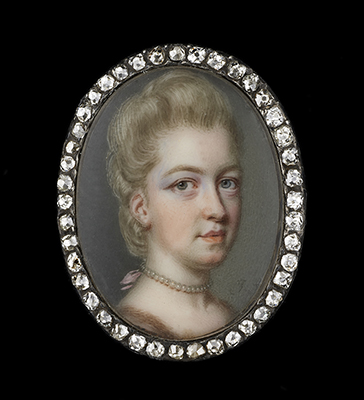 |
This portrait is probably of Lady Lucy Douglas, daughter of
William Graham, 2nd Duke of Montrose (1712-1790) and Lucy
Manners (c.1717-1788), who, on 13th June 1771, married Archibald
Douglas, 1st Baron Douglas (1748-1827). Lucy died in 1780 at
Bothwell Castle aged twenty-nine, leaving two sons and a
daughter, and Douglas then married Lucy’s close friend Lady
Frances Scott (1750-1817), daughter of Francis Scott, Earl of
Dalkeith (1720-1750).
In 1771, the year of her marriage, Lucy was painted in pastels
by Hugh Douglas Hamilton, and the present work, which shows the
sitter with a slightly fuller-face, was probably painted not
long after.
The wife of Lucy’s cousin Lord George Manners-Sutton was also
painted by Smart, as well as a number of other Scottish peers
relations including Sholto Douglas, 15th Earl of Morton
(c.1732-1774) and his younger half-brother the Hon. John
Douglas.
|
| A photographic copy of the portrait on Hon
Jane Margaret Douglas, which hung in The Hirsel, the earl of
Home's residence. |
|
|
| |
(2) In 1795, he raised the Angusshire Regiment of Fencible Infantry,
who served in Ireland and Dumfries, as well as being involved with
founding the Angus Volunteers Company of Fencible Men earlier in the same
year. It was the latter Company that where on duty at the funeral of
Robert Burns in 1796 (although some references have inaccurately
attributed this to the former group). Some sources claim that he was the
Colonel of the Forfar and Kincardine Militia
in Ireland in 1815.
3. If the same man, then as Archibald Douglas of Douglas, he was in
1788 recorded as owner of:
• Baxtonlees, another name for Peel in the upper headwaters of the
Liddel, near the eastern border of Castleton Parish.
• Lintalee, a house about a mile south of Jedburgh on the banks of the
Jed Water and formerly in the Jed Forest.
• Swinnie, a hamlet and farm off the A68 on the B6357 towards Hallrule.
and in 1780, parts of
• Bonjedward.
4. This death notice puts some of the assumptions about Archibald
into question It is dated 17th January 1804
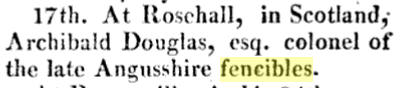
Note that Rosehall was later named
Douglas Support, the family
home of the 'Blythswood Douglases'.
Birth: 1748
Death: 1827
Father: Sir John (3rd of Grandtully) Stewart
Mother: Jane (of Douglas) Douglas b:
17 MAR 1697/98
Marriage 1: Lady Lucy
Graham, dau of Duke of Montrose, by whom he had:
- • Archibald Douglas,
2nd Baron Douglas of Douglas b. 25
Mar 1773, d. 27 Jan 1844
•
Charles Douglas,
3rd Baron Douglas of Douglas b. 26
Oct 1775, d. 10 Sep 1848
• Jane Margaret Douglas
b 1780 married Henry, Lord Montagu, second son of Henry,
third Duke of Buccleuch.
Marriage 2: Lady Frances
Scott, daughter of Francis Scott,
Earl of Dalkeith, by whom he had:
- • Hon.
Caroline Lucy Douglas
She married Admiral Sir George
Scott on 27 October 1810. She died on 20 April 1857.
• Frances
Elizabeth Douglas She married
William Moray Stirling in
1826. She died on 14 September 1854.
• Mary Sidney Douglas She
married Robert Douglas in 1821. He died in
1844. He lived at Strathany.
• Hon. Sholto Scott Douglas
b. 1785, d. 1821
•
Reverend James
Douglas, 4th Baron Douglas of
Douglas b. 9 Jul 1787, d. 6 Apr 1857
•
Hon.
George Douglas
He was born on 2 August 1788. He died in 1838, unmarried.
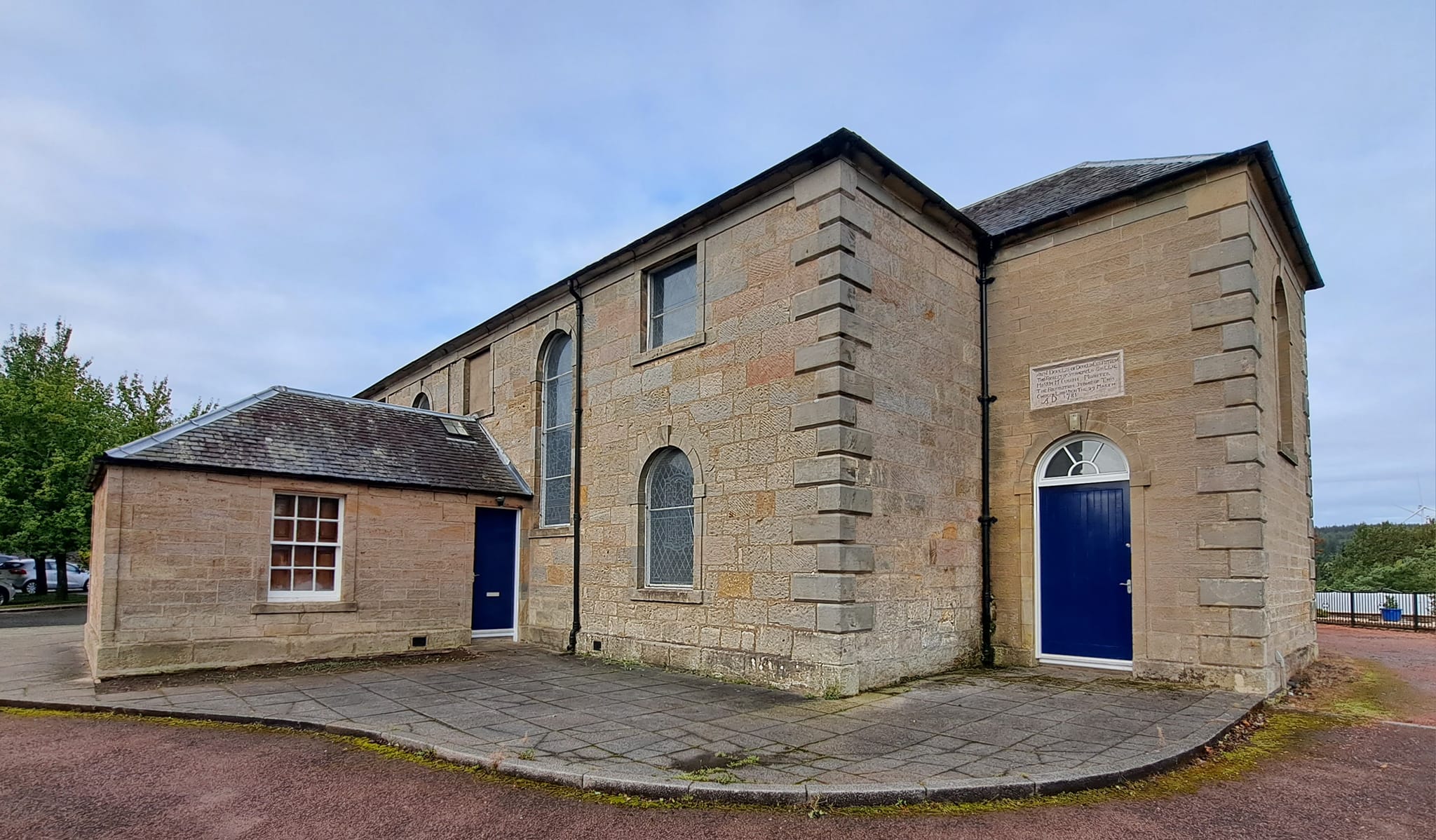
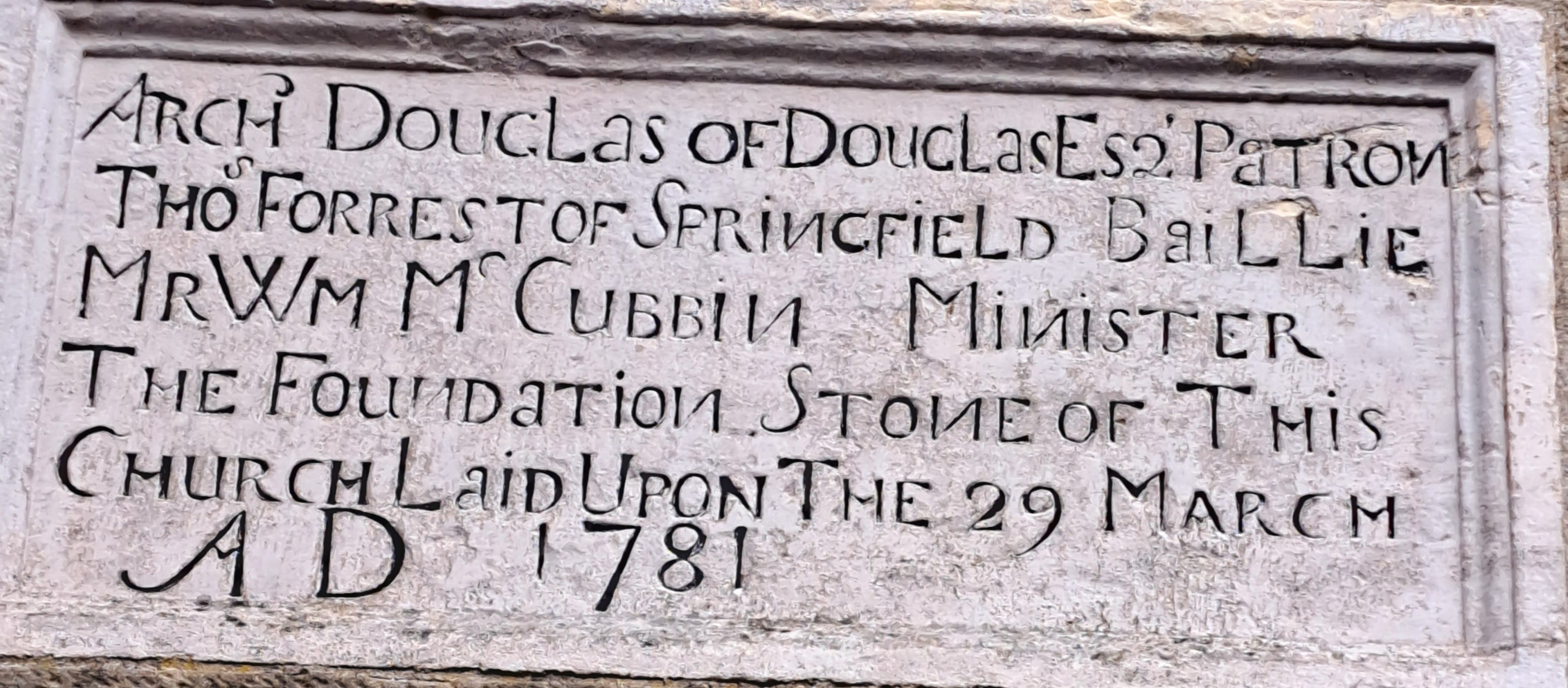
I have not yet identified this church in the village of Douglas, Lanarkshire. What was it?
What is it used for now?
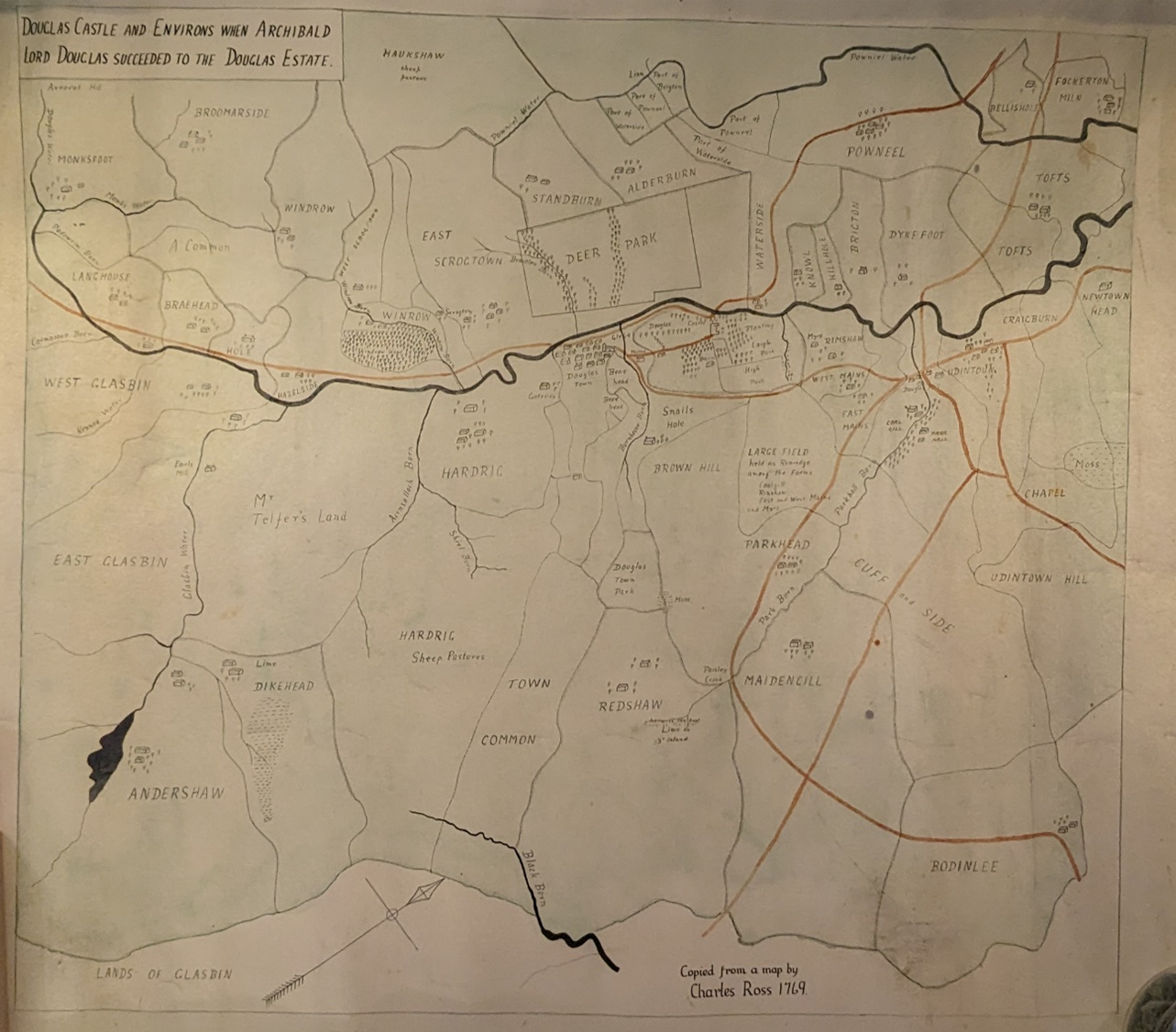
Map of Douglas Castle environs when Archibald (Stewart) Douglas succeeded to the estate
See also:
Douglas of
Douglas
The Douglas cause
|
|