|
"In the times of Don Alonso, King of Aragon,” says Zurita in his annals,
“a Scots knight, of the name of Douglas, landed in our country with 200 men
under his command, who performs such acts of valour against the Moors, as were
sufficient to give us the victory, but they all perished in the combat; and the
grief which was felt for their loss, threw the King into a dangerous illness,
and the whole army into a general consternation."
The Battle of Teba in August, 1330 and the fate of Sir James de Douglas,
the Good or the Black are forever entwined. We know from historical accounts
that Sir James lost his life in the battle by helping to attack the Teba
Castle from the valley below. The battle was between King Alfonso XI of
Castile and Muhammed IV, the Sultan of Granada.
However whether Sir James was lost in a skirmish or in the main battle is up
for conjecture.
Teba is now a township in the present day province of Malaga in Andalusia,
Spain.
What is also not so certain is the part of the story that as Sir James, the
Good Lord of Douglas was dying he fulfilled his promise to his dying friend
Robert the Bruce, King of the Scots ie that he would take his embalmed heart to
the Crusades. Is this a fact or a myth constructed after the days of Sir James
that he flung Bruce’s heart before him as he was dying in the battle? I suppose
it could be a story to build up the credibility of the brave and courageous
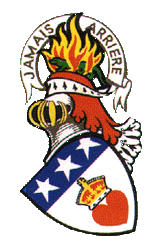
Knight. This story is indelibly rewritten every time the Douglas crest or coat
of arms is displayed or conjured up, for the ‘Douglas heart’ is the central
theme.
Even if it is a myth or a mystery, the ‘Douglas heart’ remains as an integral
part of the identity of Douglas as a surname.
King Alfonso had success in 1327 in capturing the castles of Olvera, Pruna
and Torre Alhaquime. In 1330 it was decided to mount an attack on the castle of
Teba. The word was sent to Christian Nobles and Knights to assemble at Alfonso’s
headquarters in Cordoba. Sir James Douglas as history shows was one such Knight
who responded to the call.
This event slotted in with another earlier even in Scotland in 1329. As
Robert the Bruce lay dying he made a last request to his friend and trusted
Lieutenant who was Sir James Douglas. After his death, Sir James should take his
embalmed heart and bear it with him on crusade.
Jean de Bel in his Chronicles tells that Bruce wanted his heart taken to the
Holy Land and presented to the Church of the Holy Sepulchre. While the poet John
Barbour says that Bruce wished his heart be carried into battle against God’s
foes.
Whatever the true specific request, the call to arms by King Alfonso fitted
in with Sir James Douglas’ mission.
In the Spring of 1330 Sir James Douglas armed with ‘a safe conduct’ from
Edward III of England and ‘a letter of recommendation’ to King Alfonso, left
Berwick to sail for Sluys in Flanders. Jean de Bel said that Douglas was
accompanied by one Knight Banneret, six ordinary Knights and twenty Esquires.
Douglas and his party remained in Sluys for 12 days and then departed by ship
for Spain, finally embarking at Seville. There he presented his credentials to
King Alfonso.
Finally the ‘Battle of Teba’ was put into action. King Alfonso formed his
army for the advance south. It is surmised that Sir James Douglas commanded the
lead division, it was the ‘Vaward or Vanguard’ or he may have been in charge of
the foreign Knights’.
Five miles from Teba Alfonso set up camp and a fortress. But he was hampered
by access to water to feed livestock. At about the same time the Sultan’s
massive cavalry forces were 10 miles from Teba under the command of Uthman bin
Abi-L-Ula, a Berber Noble, who quickly identified this weakness and began
raiding parties and it is said that Sir James Douglas may have been killed in
one of these initial skirmishes.
Though many perhaps like to think that Sir James Douglas died in a more decisive
encounter some days later.
John Barbour also tells that Douglas’ body and the casket (or locket)
containing the embalmed heart of Bruce were recovered after the main battle and
his bones with the flesh were boiled off them and taken with the casket back to
Scotland.
Contributed by Sally Douglas
In 1329, King Robert the Bruce of Scots (1306-1329), on his death bed,
insisted that after his death, his friend the 'Good
Sir James' Douglas should cut out his heart and carry it in a casket on a
pilgrimage to the holy lands. Douglas did as he was commanded and, in 1330, he,
along with the Sinclairs of Roslin and Keith the Marishal with several other
Lords of note, set sail for the holy lands.
Unfortunately they only got as far as southern Spain, where they became
embroiled in the battle of Teba besieging the Moorish castle of the Star on
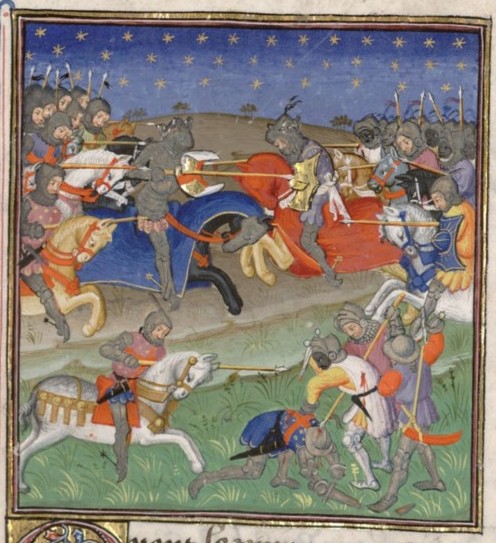
behalf of their new found Spanish allies. During the battle the Moors feinted a
retreat drawing Douglas and his knights into an ambush. The Spanish were wise to
such tactics and did not follow Douglas into the trap. Somehow, Douglas was able
to fight his way clear but turned back into the fray on seeing Sinclair
encircled by the Moors and about to be slain.
Historians have debated as to why the Moors picked on Sinclair as a prime
target rather than Douglas who was certainly the most important Scottish knight
present. It appears the Moors, though an extremely intelligent society, were
totally ignorant to the significance of western heraldry. They were used to
fighting English knights with red crosses on their surcoats and shields and
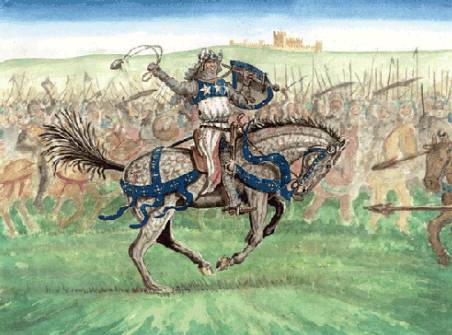
French knights with white crosses. So when Douglas came along with three stars
on his coat this meant nothing to them, whereas Sinclair had a great black cross
on his surcoat and shield. He must be a really important leader.
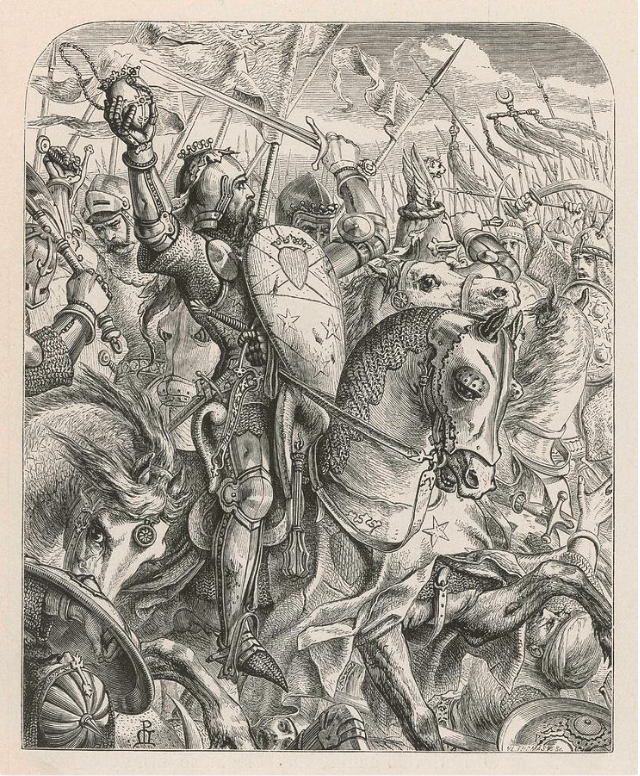
As Sinclair fell under many blows, Douglas, realising he too was about to
die, tore the casket containing Bruce's heart from around his neck and threw it
at the Moors, following his king into battle for one last time.
Soon after, the Castle of the Star was taken by the Spanish/Scots forces.
Both Douglas and Sinclairs's bodies were recovered, along with Bruce's heart
which was taken home to Scotland and buried at Melrose
Abbey where it remains to this day.
The following comments have been received from Jack Fotune, via
our Forum:
With regard to the account of the battle of Teba on this site, and the
possible significance of William Sinclair's coat of arms, I though I would
offer the observation that during the three hundred years or so that
chivalric heraldry had been evolving in western Christendom, Granadan forces
would have become familiar with the range of heraldic devices worn by
Christian knights in Spain and by the occasional 'Stranger Knights' who,
like Douglas, from time to time joined them from France, England and
elsewhere. They would also have been familiar with the crosses worn by the
various Spanish military Orders. It seems they had even started developing a
heraldic system of their own. It does not seem that wearing a cross for a
blazon excited particular hostility on the part of the Moorish soldiers. It
can't have been a rare sight, although the Berber 'Volunteers of the Faith'
from Morocco, who possibly formed the principal part of the relief force
brought up to Teba by the emir Uthman, appear to have been particularly
militant defenders of Muslim territory against the encroaching Christians.
In any case, there is no suggestion in our one C14th source that includes
the incident (John Barbour's 'Brus,' Book 20) that Sir William Sinclair was
singled out by the Moors. He may simply have been hindmost in the hasty
withdrawal back to the main body of Christian troops, or just unlucky. The
story of the thrown heart is a literary invention that appeared much later.
According to the earliest version ('Buk of the Howlatt', Richard Holland)
Douglas is shown repeating this stunt during a succession of battles before
he is killed, as Holland tells the story, fighting in Palestine (He makes no
mention of Spain). It was later adapted and inserted into Barbour's 'Brus'
as a gesture Douglas made to encourage his men at the start of the battle in
Spain. It appears to have been Walter Scott who in 'Tales of A Grandfather'
added the final embellishment of Douglas throwing the Heart in extremis,
although the story appeared anonymously ten years previously in Encyclopedia
Brittanica, (5th Edition) published in Scotland in 1817. Since the Scots
died fighting the Granadan relief force from Malaga, their bodies were
recovered almost immediately. There was no need to wait till the castle
fell. With only one named knight left alive, Sir William Keith of Galston
who had been kept from the fatal battle by a broken arm, it would seem that
the survivors may even have left before the castle fell a few days later. In
any case they would have been occupied in preparing the dead knights'
remains for transport home (See 'Brus' Book 20). By the way, the 'Castle of
the Star' is a name that appears to have evolved after the Reconquista.
Nobody seems to be able to say when (research needed), and sadly, the fine
castle keep included in Andrew Spratt's paintings is now thought, according
to the museum at Teba Castle, to date from the Christian occupation period
after 1330.
See also:
• A visit to Teba by the Douglas
family
• Illustrations by Andrew Spratt
|