|
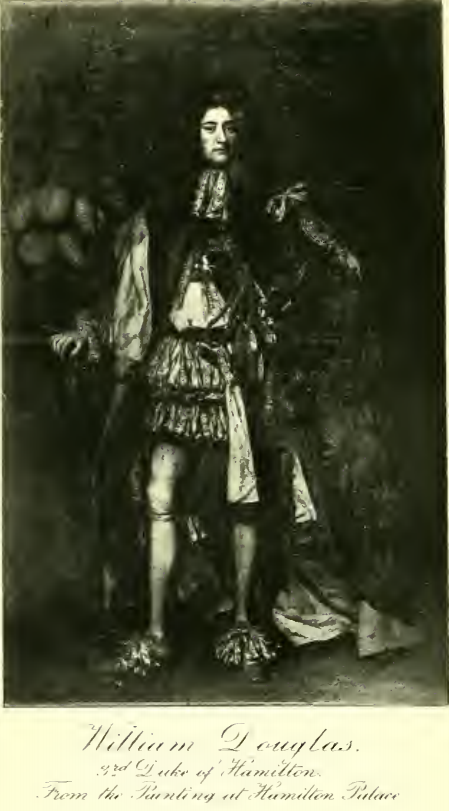
Also 1st Earl of Selkirk William (3rd Duke of Hamilton) Douglas-Hamilton was born 24 DEC 1634, and
died 18 APR 1694. He was the son of William,
1st Marquess of Douglas and Mary (of Huntly) Gordon.
|
| |
He married Anne
(Duchess of Hamilton) Hamilton, daughter of James (1st Duke of
Hamilton) Hamilton and Mary Feilding. She was born 24 DEC 1632, and died
17 OCT 1716. |
|
|
Children of William (3rd Duke of Hamilton) Douglas-Hamilton and Anne
(Duchess of Hamilton) Hamilton are:
| i. |
James
(4th Duke of Hamilton) Douglas-Hamilton was born 11 APR 1658,
and died 15 NOV 1712 in Hyde Park, London. He married Anne
Sunderland BEF. 5 JAN 1686/87. He married Elizabeth Gerard 17 JUL
1698, daughter of Digby 5th Lord Gerard. |
| ii. |
William Douglas-Hamilton. |
| iii. |
Charles
(2nd Earl of Selkirk) Douglas-Hamilton was born 3 FEB 1661/62,
and died 13 MAR 1738/39 in dsp. |
| iv. |
John
(3rd Earl of Selkirk) Douglas-Hamilton was born 1665, and died
3 DEC 1744. He married Anne (of Cassillis) Kennedy BEF. 26 JUN
1694, daughter of John (7th Earl of Cassillis) Kennedy and Susan
(of Hamilton) Hamilton. He married Elizabeth (of Owthorpe)
Hutchinson 1701, daughter of Charles (of Owthorpe MP) Hutchinson. |
| v. |
Basil
Lord Hamilton was born 16 DEC 1671, and died 25 AUG 1701. He
married Mary (of Baldoon) Dunbar, daughter of David Dunbar and
Eleanor (of Eglingtoun) Montgomerie. She was born 1677.
Their son, Dunbar, succeeded as 4th Earl of Selkirk. |
| vi. |
George
(1st Earl of Orkney) Hamilton died 29 JAN 1736/37. He married
Elizabeth Villiers 25 NOV 1695, daughter of Edward (Sir) Villiers
and Frances (of Suffolk) Howard. She died 19 APR 1733. |
| vii. |
Archibald
(Capt MP) Douglas-Hamilton was born 1673, and died 5 APR 1754.
He married Jane (of Abercorn) Hamilton 29 SEP 1719, daughter of
James (6th Earl of Abercorn) Hamilton and Elizabeth Reading. |
| viii. |
Mary Douglas-Hamilton. |
| ix. |
Catherine
(of Hamilton) Douglas-Hamilton died 11 JAN 1706/07. She
married John (1st Duke of Atholl) Murray 24 MAY 1683, son of John
(1st Marquess of Atholl) Murray and Amelia Sophia Stanley. He was
born 24 FEB 1658/59, and died 14 NOV 1724. |
| x. |
Susannah
(of Hamilton) Douglas-Hamilton. She married John (2nd Earl of
Dundonald) Cochrane, son of William Lord Cochrane and Catherine
(of Cassillis) Kennedy. |
| xi. |
Margaret
(of Hamilton) Douglas-Hamilton died 6 DEC 1731. She married
James (4th Earl of Panmure) Maule 5 FEB 1686/87, son of George
(2nd Earl of Panmure) Maule and Jean (of Loudoun) Campbell. He was
born ABT. 1658, and died 22 APR 1723. |
|
Neither James, 1st Duke of Hamilton, nor his brother, William, 2nd Duke, left any male
heirs, so the titles and estates of the family were transferred to Duchess Anne,
the daughter of the 1st Duke. She married Lord William Douglas, who, at the
restoration of the monarchy, was created Duke of Hamilton for the duration of
his life.
King James appointed him a privy counsellor and a Commissioner of the
Treasury. However, he refused to support the dispensing power claimed by the
King, and, upon the arrival of the Prince of Orange, he headed the delegation of
Scottish noblemen and gentlemen who waited upon William at Whitehall.
He was selected to be the leader of the Whig party and, after a keen contest,
was elected President of the Convention at Edinburgh in 1689. The Convention
declared that James had forfeited the throne, and, after the Convention was
formed into a Parliament, Hamilton was appointed President of the Council and
Lord High Admiral of Scotland and, in 1693, Lord High Commissioner to the
Parliament.
William died in 1694 and was succeeded by his eldest son, James, 4th
Duke of Hamilton, who was born in 1658.
Source: http://www.geocities.com/hamiltonweb2000/_private/HAMILTONHX.HTM
- Birth: 24 DEC 1634
- Death: 18 APR 1694
Father: William (1st Marquess of
Douglas) Douglas b: 1589
Mother: Mary (of Huntly) Gordon b: 1610
Marriage 1 Anne
(Duchess of Hamilton) Hamilton b: 24 DEC 1632
Children
James
(4th Duke of Hamilton) Douglas-Hamilton b: 11 APR 1658
William
Douglas-Hamilton
Charles
(2nd Earl of Selkirk) Douglas-Hamilton b: 3 FEB 1661/62
John
(3rd Earl of Selkirk) Douglas-Hamilton b: 1665
Basil
Lord Hamilton b: 16 DEC 1671
George
(1st Earl of Orkney) Hamilton
Archibald
(Capt MP) Douglas-Hamilton b: 1673
Mary
Douglas-Hamilton
Catherine
(of Hamilton) Douglas-Hamilton
Susannah
(of Hamilton) Douglas-Hamilton
Margaret
(of Hamilton) Douglas-Hamilton
William, 2nd duke of Hamilton (1616-1651),succeeded to the dukedom on his
brother's execution in 1649. He was created earl of Lanark in 1639, and in the
next year became secretary of state in Scotland. Arrested at Oxford by the
king's orders in 1643 for "concurrence" with Hamilton, he effected his
escape and was temporarily reconciled with the Presbyterian party. He was sent
by the Scottish committee of estates to treat with Charles I. at Newcastle in
1646, when he sought in vain to persuade the king to consent to the
establishment of Presbyterianism in England. On the 26th of September 1647 he
signed on behalf of the Scots the treaty with Charles known as the
"Engagement" at Carisbrooke Castle, and helped to organize the second
Civil War. In 1648 he fled to Holland, his succession in the next year to his
brother's dukedom making him an important personage among the Royalist exiles.
he returned to Scotland with Prince Charles in 1650, but, finding a
reconciliation with Argyll impossible, he refused to prejudice Charles's cause
by pushing his claims, and lived in retirement chiefly until the Scottish
invasion of England, when he acted as colonel of a body of his dependants. He
died on the 12th of September 1651 from the effects of wounds received at
Worcester. He left no male heirs, and the title devolved on the 1st duke's
eldest surviving daughter Anne, duchess of Hamilton in her own right.
Anne married in 1656 William Douglas, earl of
Selkirk (1635-1694) who was created duke of Hamilton in 1660 on his wife's
petition, receiving also several of the other Hamilton peerages, but for his
life only. The Hamilton estates had been declared forfeit by Cromwell, and he
himself had been fined £1000. He supported Lauderdale in the early stages of
his Scottish policy, in which he adopted a moderate attitude towards the
Presbyterians, but the two were soon alienated, through the influence of the
countess of Dysart, according to Gilbert Burnet, who spent much time at
Hamilton
Palace in arranging the Hamilton papers. With other Scottish noblemen who
resisted Lauderdale's measures Hamilton was twice summoned to London to present
his case at court, but without obtaining any result. he was dismissed from the
council ill 1676, and on a subsequent visit to London Charles refused to receive
him. On the accession of James II, he received numerous honours, but he was one
of the first to enter into communication with the prince of Orange. He presided
over the convention of Edinburgh, summoned at his request, which offered the
Scottish crown to William and Mary in March 1689. His death took place at Holyrood on the 18th of April 1694. His wife survived until 1716.
The Earl of Selkirk is a title in the Peerage of Scotland, created on
the 4th August 1646 and awarded to a William Douglas the younger son of
William Douglas, 1st Marquess of Douglas. Since the younger William
Douglas was only twelve at the time this award of the earldom (together
with the subsidiary title of Lord Daer and Shortcleuch) had little to do
with his specific accomplishments and a great deal to do with generally
encouraging the loyalty of the Douglases to the crown.
Our William
later hit the jackpot in the seventeenth century marriage game when he
married Anne Hamilton in 1656. Not only was Anne Hamilton a wealthy
heiress but also Duchess of Hamilton in her own right. Duke of Hamilton by
virtue of this marriage, on the 20th September 1660 William was
additionally created Duke of Hamilton for life and adopted the surname of
Douglas-Hamilton to reflect his new status. It later occurred to William
that since he was now a duke and that his eldest son would inevitably
inherit that title, that his own title of Selkirk was surplus to
requirements. Therefore on the 6th October 1688 William surrendered the
titles of Earl of Selkirk and Lord Daer and Shortcleuch in order that they
might be regranted to his second surviving son Charles.
The
particularly notable feature of this recreation of the dignity of Selkirk
in 1688 was the special remainder that defined the course of descent for
the title. It specified that in the event of the failure of the male line
by Charles or his descendants, that the title should pass to the Duke's
younger sons or their heirs male. And should the lines of all the younger
sons fail, then the title should pass back to the senior line of the Dukes
of Hamilton, but only until such time as the reigning Duke could produce a
younger son, who would then inherit and start a new line of Earls of
Selkirk. (Technically what is known as a shifting limitation and
afterwards generally disapproved of by the House of Lords when it was
given the opportunity.)
|
|