|
| |
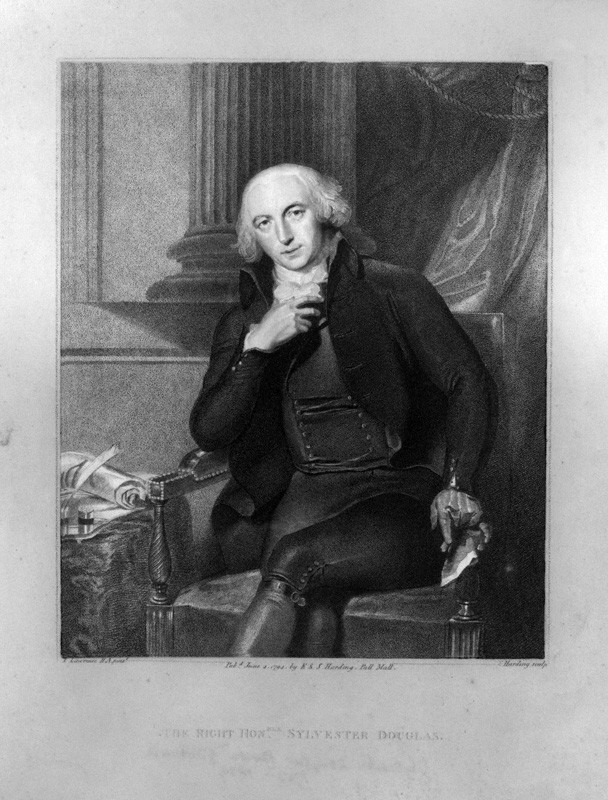
Sylvester Douglas, Baron Glenbervie
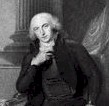 Sylvester Douglas,
Baron Glenbervie (1743–1823), politician and diarist,
was born in Fechil, Aberdeenshire, on 24 May 1743, the elder and only
surviving son of John Douglas (1713/14–1762), landowner, of
Whiteriggs,
Kincardineshire, and his first wife, Margaret Gordon (d. 1747),
daughter and coheir of James Gordon of Fechil. His father was descended from
a brother of Sir William Douglas of Glenbervie, later earl of Angus, and
resided at Fechil after having bought out his wife's two sisters, who were
second cousins of George Keith, the Jacobite Earl Marischal. Douglas's pride
in his genealogy is displayed in the account of his family which he
published in the third edition of Lyric Poems
(1806) by his brother-in-law, the poet James Mercer (1734–1804), who had
married his only sister, Katherine Douglas. Sylvester Douglas,
Baron Glenbervie (1743–1823), politician and diarist,
was born in Fechil, Aberdeenshire, on 24 May 1743, the elder and only
surviving son of John Douglas (1713/14–1762), landowner, of
Whiteriggs,
Kincardineshire, and his first wife, Margaret Gordon (d. 1747),
daughter and coheir of James Gordon of Fechil. His father was descended from
a brother of Sir William Douglas of Glenbervie, later earl of Angus, and
resided at Fechil after having bought out his wife's two sisters, who were
second cousins of George Keith, the Jacobite Earl Marischal. Douglas's pride
in his genealogy is displayed in the account of his family which he
published in the third edition of Lyric Poems
(1806) by his brother-in-law, the poet James Mercer (1734–1804), who had
married his only sister, Katherine Douglas.
Douglas was educated at
Foveran School, Aberdeen, where bullying by a young kinsman, so he later
alleged, damaged his development. From 1754 his father engaged tutors (Alan
Gordon, John Calder, and Alexander Gall) to teach him at home, until in 1757
he entered King's College, Aberdeen, of which he later became rector from
1805 to 1814. He lived at home, his father having moved to Aberdeen, and
left college without a degree in 1760. After his father's death he spent
some time in Edinburgh, proceeded to London in 1765, and took a medical
degree at Leiden in 1766, with a dissertation ‘De stimulis’. He travelled to
Paris, then toured Italy and progressed to Vienna, from where he visited
Hungary; his first publication was to be an account of Tokay wines in the
Philosophical Transactions (1773). He returned
to London in 1769, switched from medicine to the law, and entered Lincoln's
Inn in 1771. When called to the bar in 1776 he had already embarked on
reporting the disputed parliamentary elections to the 1774 House of Commons,
which were published in four volumes in 1775 and 1777. From 1778 he reported
Lord Mansfield's judicial decisions in king's bench, published in 1783. He
was elected FSA in 1781 and FRS 1795.
By 1784 Douglas's election
reports were said to earn him £3000 a year. He had also, since his call,
practised on the Oxford circuit, and for a decade to 1794 he was king's
attorney. Tall and high-nosed with beetling black brows, he was more
remarkable for his assimilative capacity and ambition than for any
originality. One of the prosecuting counsel for Warren Hastings's
impeachment, he moved in whig circles, joining Brooks's Club and the Whig
Club in 1789, when he made a momentous marriage on 25 September that year.
His bride, Catherine Anne North (1760–1817), to whom he had been introduced
by Lord Sheffield, was the eldest daughter of
Frederick North, second earl of Guilford (1732–1792), the former premier,
and his wife, Anne Speke, and was her father's match for wit and ugliness.
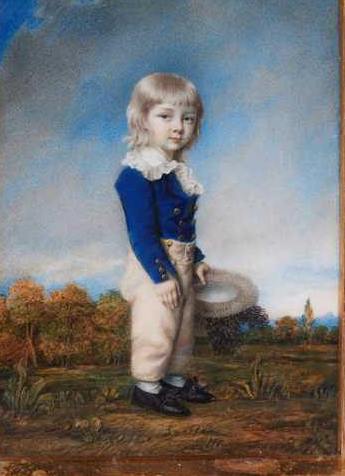
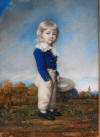 They had a son, Frederick Sylvester
North Douglas, who pre-deceased him, but both of their daughters were
stillborn. Douglas's whig friends had encouraged him to look to high legal
office during the Regency crisis, but even the solicitor-generalship would
have left him much poorer than his professional income, and he was in no
hurry to enter parliament, which served him better with its crop of election
and canal disputes. They had a son, Frederick Sylvester
North Douglas, who pre-deceased him, but both of their daughters were
stillborn. Douglas's whig friends had encouraged him to look to high legal
office during the Regency crisis, but even the solicitor-generalship would
have left him much poorer than his professional income, and he was in no
hurry to enter parliament, which served him better with its crop of election
and canal disputes.
The death of his father-in-law in 1792 freed
Douglas from whig shackles. He joined the phalanx of Portland whigs who went
over to Pitt the younger's administration. He took silk on 7 February 1793,
and became a bencher of his inn (of which he was to be treasurer in 1799).
After complaining loudly of not having been made solicitor-general to the
prince of Wales, he was offered a commissionership at Toulon, captured from
the French, in September 1793. As this appointment was worth £1500 a year
and not pensionable, Douglas declined, preferring an under-secretaryship at
the Foreign Office. In January 1794, however, he agreed to become chief
secretary to the lord lieutenant of Ireland, and was sworn of the Irish
privy council on 20 January and of the British privy council on 4 May.
Report had it that having failed to ‘bustle himself into the Chancellorship
of Ireland’, he ‘bullied himself into the Secretaryship’ (Walpole, 12.124).
He sat for St Canice in the Irish parliament. Recalled from Dublin with
Viceroy Westmorland in January 1795, he was unable to obtain the sinecure
Irish secretaryship of state, being told this was reserved for Irishmen, but
he was offered compensations: the first vacant lordship of the Treasury at
home, a seat at the Board of Control for India, a pension of £800, half of
which was to descend to his son, and a seat in parliament. The latter was
for Fowey, where he was by-elected on 14 February 1795 with ministerial
backing, having failed in his negotiations elsewhere. His pension, awarded
on 21 March 1795, was actually set at £600 for life and the same in
survivorship for himself or his son unless he accepted office of £1000 a
year (a condition which reflected his stated aspiration to succeed John
Robinson as surveyor of woods and forests). He gave his maiden speech on
disputed elections on 14 April 1795, but was shouted down when he defended
Westmorland's Irish administration on 19 May. In June he took his seat at
the Board of Control, but chafed for further employment. Lord Camden would
not have him as his chief secretary at Dublin, although the king had
suggested it, and he tried to make himself useful to ministers in debate,
coming to the defence of Henry Dundas and of Pitt, whose
Poor Relief Bill he helped to prepare. In March 1796 he obtained a
seat at the Board of Trade.
Douglas sat for Midhurst on Lord
Carrington's interest in the 1796 parliament. In September he was invited to
accompany Lord Macartney to the Cape with the promise of succeeding him as
governor in eighteen months' time, and of receiving a £2000 pension two
years later. He agreed, on condition that he would be raised to the Irish
peerage, but his wife disapproved, and her influence on his decisions was
paramount. He jobbed with Dundas to place him at the Treasury board instead.
In the Commons he served as committee chairman and teller, and was a notable
promoter of the Irish union: his speech of 22 April 1799 answering
objections to it was published in 1800. When in January 1800 he was again
offered the governorship of the Cape, his wife took the blame for his
refusal. After talk of a continental mission, he settled for the Cape in
October 1800, and was duly created Baron Glenbervie on 30 November. Pitt's
resignation spared him the Cape, and from Addington he requested the Home
Office. Instead he was appointed joint paymaster-general, in March 1801, to
which he would have preferred a return to Dublin or promotion on the Board
of Control, and finding himself second fiddle at the pay office, he angled
to replace Dundas in charge of Scottish affairs. As his Irish peerage
enabled him to sit at Westminster, he was by-elected for Plympton Erle as a
government nominee on 6 July 1801; he made himself useful in debate, and was
offered the presidency of the Board of Control. This still did not satisfy
his ambitions as he would have preferred the vice-presidency of the Board of
Trade, presiding in Lord Liverpool's absence, or better still, the
speakership. He scorned, as Lord North's son-in-law, Addington's proposal of
a diplomatic mission to the United States in December 1801, even though he
introduced a bill easing commercial relations with America, and on 24 May
1802 reminded Addington that he had no objection to negotiating a commercial
treaty with France.
In January 1803 Glenbervie, who sat for Hastings
as a Treasury nominee in that parliament, succeeded Robinson as surveyor of
woods and forests, thereby enabling Addington's brother to replace him at
the pay office, although he would have preferred to have held both. He
obtained £3000 a year, but not for life, and promotion in the peerage might
have compensated him. Ostensibly for health reasons he took little part in
debate, and in February 1804 gave up the Board of Trade. On Pitt's return to
power that year he was a doubtful supporter, and offered to relinquish
office only if compensated. By September he was listed as a reliable
government supporter, and in 1805 defended Lord Melville against charges of
naval maladministration. He was mortified to lose his surveyorship when the
Grenville administration took over in February 1806. He complained that the
pension he negotiated was only a fifth of what he had been earning in 1793,
and tried to obtain compensatory employment hearing appeals to the privy
council. He did not seek re-election to parliament that year. The Portland
ministry restored him to the surveyorship of the woods and forests in April
1807, reducing his salary but not sufficiently to allow him to retain his
pension: this saved the public £1600 a year. In July 1810, when his office
was reformed, he became first of three commissioners. Then, and in 1812, he
was criticized as a jobber in the Commons, and Lord Liverpool was reluctant
to let him serve in 1814 in view of his pension claims. He travelled on the
continent, and his later years were devoted to a vain attempt to guide his
son's career. His wife died on 6 February 1817 and his son in 1819. Cared
for by his daughter-in-law, he turned to literary pursuits. Nothing came of
a projected biography of Lord North, but he managed a translation of part of
the Italian poet Fortiguerri's Ricciardetto,
published in 1822. From 1812 he was a trustee of the British Museum. He died
at Cheltenham on 2 May 1823, whereupon his title became extinct. His
journals and diaries, published piecemeal in 1910 and 1928, are a record of
his aspirations and disappointments, interlaced with scandalous anecdotes,
political gossip, and travel notes, which account for their attraction as a
period piece.On his death on
2 May 1823, the
barony became extinct.
The following is extracted from The Annual Biography and
Obituary for the Year 1824, Volume 8
The Right Hon. SYLVESTER DOUGLAS,
BARON GLENBERVIE OF
KINCARDINE, F. R. AND A. S.
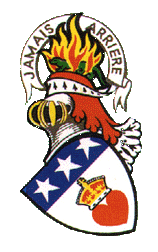
Motto — Per Yarios Casui.
Lord
Glenbervie was the eldest son of John Douglas, Esq. of Fechil, in the parish
of Ellon, county of Aberdeen. The said John Douglas was tenth in lineal
male descent.
from William Douglas, first Earl of Douglas; which
William . was paternal nephew and successor, as heir male, to James, eighth Lord
Douglas, (called by the Scottish historians the good Sir James,) who
flourished in the time of Robert Bruce, King of Scotland, and Edward I.,
King of England. The said William was seventh in male descent from William
de Douglas, first Lord Douglas, who was descended from Sholto Douglas, said
to have flourished in 700. John Douglas was the great-great-grandson, and
became (in consequence of the death of his elder brother George, and of
Robert and James, the only sons of George, who both died unmarried,) lineal
heir male of the body of the Reverend James Douglas, of Glenbervie; which
James was brother to William the ninth Earl of Angus, the said ninth earl
being the sixth in lineal male descent from the above-named William, the
first Earl of Douglas, and great-grandson to Archibald, the fifth Earl of
Angus, (styled the Great Earl,) whose second son was Gawin Douglas, Bishop
of Dunkeld, author of the celebrated translation of Virgil.
The said
Archibald was the common ancestor of the Lady Margaret Douglas, maternal
sister of James V. of Scotland, niece of Henry VIII., grand-daughter of
Henry VII., and grandmother of James the first of England and sixth of
Scotland; being the mother of Lord Darnley, and of the present Archibald
Lord Douglas; of the Duke of Hamilton; of the Earl of Selkirk; of Sir
William Hamilton, K. B.; of Sir Alexander Douglas, Bart, (styled of
Glenbervie); and of the late Lord Glenbervie.
John Douglas, Esq.,
Lord Glenbervie's father, who was born in 1714, and died in 1762, married
Catharine, the second of the three daughters and co-heirs of James Gordon of
Fechil, great-grandson to the celebrated geographer, Robert Gordon of
Straloch, author of the Geography of Scotland, inserted in Bleau's Atlas.
The said Catharine Gordon was second cousin to the last Earl Marischal,
George Keith; they being grandchildren of George Hay, second Earl of Kinnoul,
by his two daughters, the Ladies Mary and Catharine. By her Mr. Douglas had
issue Sylvester, the late Lord Glenbervie, and Catharine, who married James
Mercer, of Sunny Bank, Aberdeenshire, Esq., and died in 1802.
Lord
Glenbervie was born May 24. 1743. He received the rudiments of his education
near the place of his nativity, whence he went to the University of
Aberdeen; and, after prosecuting his studies there for two or three years,
travelled with the present Lord Douglas over the Continent. While abroad,
and particularly during his residence at Paris and Vienna, Mr. Douglas mixed
in gay and expensive society to an extent which led to the sale of his
paternal property at an early period of his life, and happily forced upon
him the necessity of applying his mind and talents to some profession, by
which he might obtain the means of honourable, independence. His situation
and feeling at this period are well expressed in the following "Ode to
Poverty," written by himself at the time: —
TO POVERTY.
WRITTEN ON MY
RETURN FROM VIENNA, MARCH, 1769.
Come, Poverty, to Pleasure's snares,
To wild Ambition's loftier cares,
While calm Content succeeds;
Teach me, stern goddess, to deride
The miser's gold! the monarch's pride
t
The hero's boasted deeds!
Teach me, while I no more pursue
The rainbow hope, which still in view
Still cheats the grasping
fool,
To shun the thresholds * of the great,
No courtly sycophant,
nor yet
Seditious faction's tool-
Too long the dazzling glare of
courts..
Where Fortune with Ambition sports,
Drew my fond
thoughts astray:
Too long was Pleasure's path my choice,
While, deaf
to Reason's sober voice,
I heard her syren lay.
Ambition!
Pleasure! fatal pair!
My buoyant spirits, light as air,
No gloomy
damp opprest;
'Till won by their delusive charms,
I clasp'd them in
my youthful arms,
. And press'd them to my breast.
'Twas then
the poison they infus'd
Which, through my inmost frame diffus'd
Mad Passion's feverish rage;
But Poverty, though Reason fail,
With
force resistless shall prevail,'
Its fury to assuage.
» "
Forumque vitat, et superba
Civium potentiorum limina." Hob. VOL. Till. Z
The profession of the law was that to which Mr. Douglas determined to devote
himself. At the age of thirty-one, he entered at Lincoln's Inn; and,
notwithstanding his former long-continued habits of indulgence, — habits so
destructive in general of all inclination for laborious study, — he applied
with such earnestness and industry to his new pursuit, and especially to the
law pf controverted elections, that he soon became highly and justly
celebrated for his legal acquirements, and for several years was in
possession of the principal practice in that very lucrative branch of the
profession, — the election-law. He was also selected by the House of Commons
as one of their counsel to assist the managers of the impeachment of Warren
Hastings, Esq.
Having thus obtained considerable eminence as a
professional man, Mr. Douglas, on the 26th September, 1789, married the
Honourable Katharine Anne North, eldest daughter of Frederic Lord North,
afterwards Earl of Guilford; an amiable and excellent woman; who, besides
many more valuable qualities, possessed, to use Lord Glenbervie's own words
*, "the most prompt, genuine, and brilliantwit," which, however, "was always
vigilantly checked and reined in by a proportionate share of tact, good
nature, and delicacy." The admirable character of this lady is fully and
touchingly painted in the following inscription on a tablet, which, after
her decease in January, 1817, was placed in Hampton church:
"Near this
place are deposited The mortal remains of Lady Katharine Anne North, Lady
Glenbsrvje. "Those who knew her while she sojourned on earth, and who knew
how to form a just estimate of that rare union of the soundest
understanding, the kindest, tenderest heart, the happiest temper, and the
most lively yet innocent wit, by which she was so eminently distinguished:
those who had opportunities of contemplating the steady firmness and
edifying tenour of her principles, affections, and conduct as a daughter, a
sister, a mother, and a wife; as a Christian, a friend, and a member of
society: those who can bear testimony to the severity with which she
scrutinised her own thoughts, words, and actions, and her ever charitable
indulgence towards those of others, will be best able to conceive, and will,
perhaps, sympathise with the sentiments of unavailing sorrow and regret
(though not daring to arraign the impenetrable dispensations of Providence)
with which her aged husband has dictated this scanty and inadequate memorial
of her excellence."
This marriage naturally introduced Mr. Douglas
into political life. On the junction of a portion of the Whigs with Mr.
Pitt's administration, in 1793, he was made a king's counsel, and appointed
chief secretary to the Earl of Westmoreland, then lord-lieutenant of
Ireland. In 1795 he was appointed one of the commissioners for the affairs
of India. In 1798, he became one of the lords of the Treasury. In 1800, he
was appointed governor of the Cape of Good Hope; and was on that occasion
advanced to the dignity of a peer of Ireland, by the title of Baron
Glenbervie of Kincardine. He did not, however, go to the Cape of Good Hope;
his views having been altered by a change in the ministry the day before
that which had been fixed for his embarkation, and a determination to
restore that valuable colony to the Dutch. On the 20th February, 1801, His
Lordship kissed His Majesty's hand on being nominated joint
paymaster-general of the forces, in the room of Mr. Canning. In 1803, Lord
Glenbervie was appointed to the office of surveyor-general of the king's
woods, forests, and chases; which office he resigned in 1806, but was again
appointed to it in the following year. To the duties of this office he
applied himself with the most ardent zeal and perseverance; and the
advantages which the public have derived from his exertions are
considerable. The efforts of all His Lordship's predecessors, from the very
establishment of the office itself, had been confined to cutting down the
wood. Lord Glenbervie was actuated by a more wise and provident spirit; and,
while he was the surveyor-general, between thirty and forty thousand acres
were inclosed, and carefully planted. To him, therefore, the present
flourishing condition of the King's woods, forests, and chases, is chiefly
attributable. His Lordship was also for some years vice-president of the
Board of Trade.
Lord Glenbervie sat in the Irish parliament for St.
Canice, or Irish Town; and in the British and Imperial parliaments, first
for Fowey, then for Midhurst, afterwards/or Plympton, and, lastly, for
Hastings. He was a frequent speaker. His reasoning was always close and
logical, and was occasionally enlivened by dry and effective sarcasm; and
his utterance, which was slow and solemn, was in strict harmony with the
profound and intellectual expression of his countenance. One of his most
celebrated speeches was made on the 23d of April, 1799, on seconding the
motion of the Right Hon the Chancellor of the Exchequer, for the House of
Commons to agree with the House of Lords in an address to His Majesty
relative to the union with Ireland; of which measure Lord Glenbervie was a
warm and an able advocate. In 1801, he repeatedly took part in the debates
on the "Corn Bill." In 1802, he suggested an important amendment in the
"Navy Abuse Bill," relative to the legal questions which might be be raised
about supposed difficulties. On the 8th of April, 1805, when the House of
Commons decided on the conduct of Lord Melville, who had been implicated in
a Report from the Commissioners of Naval Inquiry, Lord Glenbervie voted in
the minority of 216 to 217. On the 26th of June following, he was chosen by
ballot one of a committee of seven, to inquire into and examine the secret
matter contained in the Eleventh Report of the Commissioners of Naval
Inquiry; and afterwards, as chairman of the committee, delivered in the
report of their proceedings.
Lord Glenbervie had an only son, the
Hon. Frederic Sylvester North Douglas, who was educated at Westminster
school, and was afterwards a student of Christ Church, Oxford; where he
gained the first class honours, and took the degree of M. A. On various
occasions he displayed the greatest taste, learning, and judgment; and among
other productions, published a valuable work "On certain Points of
Resemblance between the ancient and modern Greeks," derived from the
observations which he made during his travels in that country; which will
always be interesting to literature. During two parliaments Mr. Douglas sat
in the House for the borough of Banbury, and gave great earnest of future
eminence and celebrity.
In July, 1819, he married Harriet, eldest
daughter of William Wrightson, Esq. of Cusworth, Yorkshire; a union which
promised lasting felicity to both parties. To the inexpressible grief,
however, of his family and friends, and the deep and general regret of the
public at large, on the 21st of October following, a sudden illness, —
effusion on the brain, — deprived his country of one who promised to be
among her brightest ornaments, in the 29th year of his age. The subjoined
just and eloquent tribute to his * memory appeared a few days after in the
Morning Chronicle : —
"The early death of the Hon. Frederic North Douglas
demands more than common notice. Indefatigable in his attention to public
business, he brought to the consideration of every subject a clear,
vigorous, and active understanding; a copious fund of information, the
spirit and the tact of a man of business. He had devoted, at an early age,
all his faculties to public life, and in the opinion of the most judicious
among his contemporaries, he would have obtained the highest distinctions of
parliament, and of the state. As a classical and a general scholar, greatly
accomplished in languages and in letters, few were his superiors; but it is
for his friends. alone to speak with justice of his social merits.
Inheriting, with the name, the humour of Lord North, the characteristic
humour of his family, which appeared to be rather the effusion of playful
spirits and of social enjoyment than the effort of wit, dnd being free from
spleen or vanity, was incapable of inflicting pain, he enlivened every
society by his presence. A. cheerful and agreeable companion, a warm and
generous friend, a kind and affectionate son, nothing remained to make his
private character more amiable, but that most endearing relation of all,
which, with every prospect of happiness, he bad undertaken only a few months
before bis lamented death."
• Such was the language in which the
public press spoke of Mr. Douglas. The following inscription, placed near
his remains in Hampton Church, will further show the affliction of those who
were near to him in blood and affection, and the irreparable loss which
society sustained by his premature decease:
"In Memory
of
The
Honourable Frederic Sylvester North Douglas,
only son of Sylvester Lord
Glenbervie,
and of Katharine Anne,
Daughter of Frederic second Earl
of Guilford;
in two successive Parliaments
Representative of the
borough of Banbury:
who, during the short but not obscure career
assigned him by Providence,
was distinguished, both in public and
private life,
by splendid talents and extensive acquirements,
by an
ardent attachment to literature,
a Patriotism consistent, disinterested,
and rational,
an unaffected zeal in the cause of Benevolence and
Religion,
the kindest heart, the most conciliating manners,
and a
conscientious and cheerful discharge
of all the social duties and
charities
of a Friend, a Son, a Husband,
a Senator, and a Christian.
He was born February 8. 1791, married July 19. 1819, to Harriet,
eldest daughter of William Wrightson, Esq. of Cusworth, in the county of
York, and died October 21. in the same year."
It is impossible for any
one of common feeling to contemplate the state into which Lord Glenbervie
must have been thrown by this unexpected calamity, without emotion. Lady
Glenbervie had died only two years before. That event was a heavy blow; but
it was in the course of nature, and was therefore an evil for which her
noble husband must have been in some degree prepared. But the death of his
son, his only son, was not merely an additional, it was an unlooked-for
affliction. The grief which it occasioned, deep in itself, must have been
embittered by disappointment. Had it occurred at an earlier period, it would
have been sufficiently severe; but it was delayed until every circumstance
conspired to aug-' ment the anguish of the infliction. It is after the
labours of tillage are successfully over, when the corn has sprung healthily
and luxuriantly from the earth, and every thing indicates the near approach
of an abundant and glorious harvest that the storm, by which the
cultivator's hopes are in a moment destroyed, falls with its most
overwhelming and heart-break* ing effect.
But the influence of a
sound philosophy, and the [draft stages] of a cultivated taste, were perhaps
never more strikingly exemplified than in His Lordship's case. By plunging
into literary studies and amusements, he was enabled in some degree to
divert his attention from retrospects under which he must otherwise have
speedily sunk. Among various* deployments of a similar nature, to which he
devoted himself with almost youthful alacrity and relish, he translated the
first canto of " Rieciardetto," a humorous Italian poem by Fortiguerri
which translation was published in 1822, with an introdnetiotti relative to
the principal romantic, burlesque, and1 mock-heroic' poets, and notes,
critical and philological. The original Is rendered into English with spirit
and correctness;, and the whole work does great honour to the learned and
Venerable. translator. He also occupied some of the latter years of his life
in preparing for publication a new edition of the transition of Virgil into
Scottish verse, by his ancestor, Gawin Douglas, Bishop of Dunkeld, with a
life of the author; and* a Comparison between English and Italian
literature. He had likewise made considerable progress in what, if
completed* must have proved a most interesting work, namely, an account of
the private and political life of his father-in-law, Lord North; for which,
it is understood, he had very copious materials, having been the surviving
executor of His Lordship's widow, Lady Guilford; and in that character
having become possessed of all Lord North's correspondence with the King
during his ministry, as well as with the eminent persons who were his
colleagues in the administration.
In addition to very eminent
classical acquirements, Lord Glenbervie was considered one of the first
modern linguists of his time; and nothing was more remarkable than the way
in which he retained his powers and faculties on literary subjects to the
very last; and after they had become somewhat imperfect on matters requiring
less mental exertion.
In December, 1822, his lordship, feeling the
infirmities of age increase, went to Bath for the winter, accompanied by his
son's widow, the Hon. Mrs. F. S. N. Douglas, from whom he experienced,
during the latter part of his life, the most affectionate and unremitting
attention. He visited Clifton and Cheltenham; but at length he was seized
with a violent illness, which, after two months' duration, terminated his
life at Cheltenham, on the 2d of -May, 1823, in the 80th year of his age.
Besides an account of the Tokay and other wines of Hungary, inserted in
the Philosophical Transactions for 1773, Lord Glenbervie was the author of "
History of the Cases of Controverted Elections, determined during the first
Session of the 14th Parliament of Great Britain," 4 vols. 8vo. 1777; 2d
edition, 1802. "Reports of Cases determined in the Court of King's Bench, in
the 19th, 20th, and 21st Years of George III." fol. 1783; 3d edition. 2 vols,
royal 8vo. 1790. Many years ago His Lordship published "Lyric Poems,"
written by the late James Mercer, Esq., who had married Lord Glenbervie's
sister, to which a life of the author, and an account of his own family,
were prefixed. The celebrated Lord Mansfield used to instance the preface to
this last-mentioned volume as a fine specimen of prose composition.
See also: Douglas of Glenbervie
|
|
Errors and Omissions
|
|
The Forum
|
|
What's new?
|
|
We are looking for your help to improve the accuracy of The Douglas
Archives.
If you spot errors, or omissions, then
please do let us know
Contributions
Many articles are stubs which would benefit from re-writing.
Can you help?
Copyright
You are not authorized to add this page or any images from this page
to Ancestry.com (or its subsidiaries) or other fee-paying sites
without our express permission and then, if given, only by including
our copyright and a URL link to the web site.
|
|
If you have met a brick wall
with your research, then posting a notice in the Douglas Archives
Forum may be the answer. Or, it may help you find the answer!
You may also be able to help others answer their queries.
Visit the
Douglas Archives Forum.
2 Minute Survey
To provide feedback on the website, please take a couple of
minutes to complete our
survey.
|
|
We try to keep everyone up to date with new entries, via our
What's New section on the
home page.
We also use
the Community
Network to keep researchers abreast of developments in the
Douglas Archives.
Help with costs
Maintaining the three sections of the site has its costs. Any
contribution the defray them is very welcome
Donate
Newsletter
If you would like to receive a very occasional newsletter -
Sign up!
Temporarily withdrawn.
|
|
|
|
|
|
|
|
|
|