   |
|
|
|
|
| ||||||
|
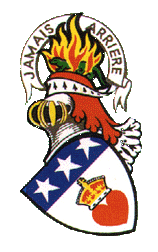
Sir Kenneth Mackenzie-Douglas
Lieutenant-General Sir Kenneth MacKenzie Douglas, 1st Baronet (1754–1833), born Kenneth MacKenzie, was the first Baronet of the Douglas of Glenbervie, Kincardine Baronetcy (second creation). He was created baronet in 1831. Born as Kenneth MacKenzie in Dundee in 1754, his father was Kenneth Mackenzie, of Kilcoy, Ross-shire, and his mother Janet, a daughter of Sir Robert Douglas, 6th Baronet of Glenbervie (first creation). He was commissioned as an ensign in the 33rd Foot in 1767, and was promoted lieutenant in 1775. MacKenzie transferred to the 14th Foot in 1783. He served in Guernsey, the West Indies, Flanders, Gibraltar, and Egypt. He joined the 90th Foot in 1784, when, under Thomas Graham, (later Lord Lynedoch), he trained light company troops. On the death of Lieutenant-Colonel Ogilvie of the 44th Foot, Mackenzie transferred to that regiment, taking command. Following a decision by the British Army to train some line regiments in light infantry techniques, Sir John Moore, a proponent of the light infantry model, offered his own regiment of line infantry, the 52nd (Oxfordshire) Regiment of Foot, for this training, at Shorncliffe Camp. Mackenzie was appointed lieutenant colonel of the 52nd. They formed a brigade with the 95th Rifles, and three line regiments. Much of the training was undertaken by Lieutenant-Colonel Kenneth MacKenzie, who devised many of the tactics of light infantry training, He was responsible for many of the drills and exercises of the "Shorncliffe System". Injured after a fall from a horse in late 1803, he took leave, during which time he married Rachel Andrews, of Shorncliffe. (They had 6 sons and one daughter.) He saw some active service at Cadiz, but his health remained poor, and he spent most of the war convalesceing in England. In 1811 he was given command of the light infantry troops then in England. Made baronet in 1831 he also changed his surname to Douglas that year. He died in 1833 and was succeeeded by his son Robert Andrew Mackenzie-Douglas. He had a sister, Janet, bc 1762 who married John Snodgrass; minister of the Middle Church, Paisley, Scotland.
DOUGLAS, Sir KENNETH (1754–1833), lieutenant-general, was the son and heir of Kenneth Mackenzie of Kilcoy, Rossshire, by Janet, daughter of Sir Robert Douglas, bart., author of the ‘Peerage,’ and sister of Sir Alexander Douglas, last baronet of Glenbervie, and passed the whole of his active military career under the name of Mackenzie, which he did not exchange for that of Douglas until 1831. He entered the army at the age of thirteen as an ensign in the 33rd regiment on 26 Aug. 1767, and joined that regiment in Guernsey, where he remained until its reduction on the conclusion of peace in 1783. He had been promoted lieutenant in 1775, and exchanged with that rank from half pay into the 14th regiment, with which he remained in the West Indies until its return in 1791. With the 14th he went to the Netherlands and served throughout the campaign of 1793, acting as a volunteer in the trenches before Valenciennes. He was wounded before Dunkirk. As senior lieutenant he commanded a company nearly all through the campaign of that year. His excellence as an officer became known to Thomas Graham of Balgowan, afterwards General Lord Lynedoch, who asked for his services when he was raising the Perthshire Light Infantry, better known as the 90th regiment. On 13 May 1794 Mackenzie was gazetted both captain and major into the newly formed regiment. With two such men as Graham and Hill as colonel and lieutenant-colonel, the 90th was soon fit for service, and was in the end of 1794 sent on foreign service, first to the Ile Dieu and then to Gibraltar. In 1796 it was chosen as one of the regiments to accompany Sir Charles Stuart to Portugal, and Mackenzie was made a local lieutenant-colonel and appointed to command all the flank companies of the various regiments as a battalion of light infantry. Sir Charles Stuart [q. v.] superintended Mackenzie's system of training and manœuvring, and made his battalion a sort of school of instruction for all the officers present with the army in Portugal. When Sir Charles Stuart went to Minorca in 1798, he took Mackenzie with him as deputy adjutant-general, and he was promoted lieutenant-colonel for his services at the capture of that island on 19 Oct. 1798. When Sir Ralph Abercromby succeeded Sir Charles Stuart in the command in the Mediterranean, Mackenzie was acting adjutant-general in Minorca, but he at once threw up his staff appointment to accompany his regiment in the expedition to Egypt. In the battle of 13 March the 90th regiment was more hotly engaged than any other corps and lost two hundred men in killed and wounded, and as Colonel Hill himself was wounded Mackenzie as senior major took the regiment out of action. In the battle of 21 March the 90th was also hotly engaged under the command of Mackenzie, and in recognition of his services he was appointed lieutenant-colonel of the 44th regiment before Alexandria in the place of Lieutenant-colonel Ogilvie, killed in that battle. He commanded that regiment in Egypt and then at Gibraltar until 1804, when the government determined to train some regiments as light infantry and summoned him to take command of the 52nd in camp at Shorncliffe. Sir John Moore was the general commanding the camp, and it was there that the famous light division of Peninsular fame was trained and disciplined. It is said that the new system was really the work of Mackenzie (Moorsom, History of the 52nd Regiment), though the spirit inspired was undoubtedly that of Sir John Moore. While at Shorncliffe Mackenzie was thrown from his horse and received so severe a concussion of the brain that he was obliged to go on half-pay, and unable to accompany his regiment to the Peninsula. He was, however, promoted colonel on 25 April 1808, and was in that year considered to be sufficiently well to accompany his old friend Graham to Cadiz, where he commanded a brigade for a short time until he was again obliged to return to England on account of his health. On 4 June 1811 he was promoted major-general, and soon after appointed to command all the light troops in England with his headquarters in Kent. In 1813 he accompanied Sir Thomas Graham to the Netherlands, and acted as governor of Antwerp after the surrender of that city during the peace of 1814, and throughout the campaign of 1815. He then retired to Hythe, where he had married, while in camp at Shorncliffe, Rachel, the only daughter and heiress of Robert Andrews of that place, and where he took a keen interest in local affairs and became a jurat. Mackenzie was promoted lieutenant-general on 19 July 1821, and made colonel of the 58th regiment on 1 March 1828. He was created a baronet ‘of Glenbervie’ on 30 Sept. 1831, and took the name of Douglas instead of his own by royal license on 19 Oct. 1831. He died at Holles Street, Cavendish Square, on 22 Nov. 1833, and was buried at Hythe.
See also:
| ||||||||||||||||||||||||||||||||
|
The content of this website is a collection of materials gathered from a variety of sources, some of it unedited. The webmaster does not intend to claim authorship, but gives credit to the originators for their work. As work progresses, some of the content may be re-written and presented in a unique format, to which we would then be able to claim ownership. Discussion and contributions from those more knowledgeable is welcome. Last modified: Friday, 17 May 2024 |
