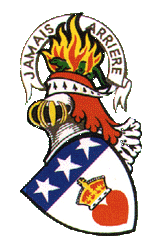
James Douglas of Pittendreich, 4th Earl of Morton.
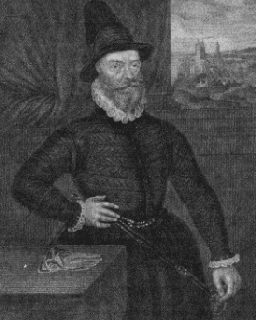 James
Douglas, jure uxoris 4th Earl of Morton (c. 1525 – 2 June 1581) was
the last of the four regents of Scotland during the minority of King
James VI. He was in some ways the most successful of the four, since
he did manage to win the civil war which had been dragging on with
the supporters of the exiled Mary, Queen of Scots. However he came
to an unfortunate end: during his time as regent he introduced the
maiden, a primitive guillotine, to Scotland, and he was eventually
executed by it himself.
James
Douglas, jure uxoris 4th Earl of Morton (c. 1525 – 2 June 1581) was
the last of the four regents of Scotland during the minority of King
James VI. He was in some ways the most successful of the four, since
he did manage to win the civil war which had been dragging on with
the supporters of the exiled Mary, Queen of Scots. However he came
to an unfortunate end: during his time as regent he introduced the
maiden, a primitive guillotine, to Scotland, and he was eventually
executed by it himself.
He was the second son of Sir
George
Douglas of Pittendriech who before 1543 had married
Elizabeth (d. 1574), daughter of James Douglas, 3rd Earl of Morton.
In 1553 James Douglas succeeded to the title and estates of his
father-in-law, including Dalkeith House in Midlothian, and Aberdour
Castle in Fife. In 1563 he became Lord Chancellor of Scotland.
Though his sympathies were with the reformers, he took no part in
the combination of Protestant reformers in 1565, but he headed the
armed force which took possession of Holyrood Palace in, March 1566
to effect the assassination of David Rizzio, and it was to his house
that the leading conspirators adjourned while a messenger was sent
to obtain Queen Mary's signature to the "bond of security."
The queen, before complying with the request, escaped to Dunbar, and
Morton and the other leaders fled to England. Having been pardoned,
Morton returned to Scotland early in 1567, and with 600 men appeared
before Borthwick Castle, where the queen after her marriage with Bothwell had taken refuge. He was present at the remarkable
conference at Carberry Hill, and he also took an active part in
obtaining the consent of the queen at Lochleven to an abdication. He
led the army which defeated the queen's forces at the
Battle of Langside in 1568, and he was the most valued privy counsellor of the
Earl of Moray during the latter's brief term of office as regent. On
the death of the Earl of Mar (28 October 1572), Morton, who had been
the most powerful noble during this regency, and also during that of
the Earl of Lennox, at last reached the object of his ambition by
being elected regent. In many respects Morton was an energetic and
capable ruler. He effected at Perth, in February 1573, with the aid
of Elizabeth of England's envoy, a pacification with George Gordon,
5th Earl of Huntly, the Hamiltons and the Catholic nobles who
supported Mary. Only Edinburgh Castle held out, and this, aided by
English artillery, he succeeded in taking after a brave resistance
by Kirkcaldy of Grange and Maitland of Lethington.
The
ensuing execution of these men put an end to the last chance of
Mary's restoration by native support. But while all seemed to favour
Morton, there were under-currents which combined to procure his
fall. The Presbyterian clergy were alienated by his leaning to
Episcopacy, and all parties in the divided Church by his seizure of
its estates. Andrew Melville, who had taken over as leader from John
Knox, was firmly against any departure from the Presbyterian model,
and refused to be won by a place in Morton's household. As well as
the pressure from the Presbyterians, Colin Campbell, 6th Earl of
Argyll and John Stewart, 4th Earl of Atholl, both leading Roman
Catholics and members of the Queen's party in league with Alexander
Erskine, governor of Stirling Castle and the custodian of young King
James, received such widespread support, that Morton had no option
but to resign his Regency.
He surrendered
Edinburgh Castle,
Holyrood Palace, the Great Seal and the Honours of Scotland,
retiring to Lochleven, where he busied himself in laying out
gardens. But his ambition could not deny itself another stroke for
power. Aided by the young earl of Mar, he got possession of
Stirling
Castle and the person of the king. Civil war was avoided only by the
influence of Sir Robert Bowes, the English ambassador. A nominal
reconciliation was effected, and a parliament at Stirling introduced
a new government. Morton, who secured an indemnity, was president of
the council, but Atholl remained a privy councillor in an enlarged
council with the representatives of both parties. Shortly afterwards
Atholl died of poison, it was said, and suspicion pointed to Morton.
His return to power was brief, and the only important event was the
prosecution of the two Hamiltons, who still supported Mary and saved
their lives by flight to England. The final fall of Morton came from
an opposite quarter.
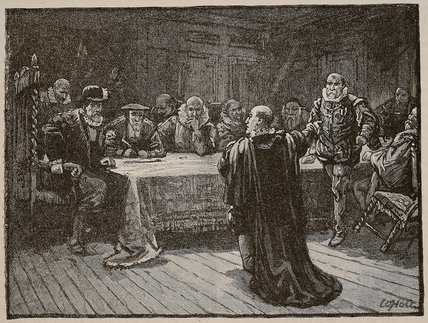 |
| The Earl of Arran accusing
Morton of Darnley's murder |
In September 1579 Esmé Stuart, the
king's cousin, came to Scotland from France, gained the favour of
James by his courtly manners, and received the lands and earldom of
Lennox, the custody of
Dumbarton Castle, and the office of
chamberlain. One of his dependants, Captain James Stuart, son of
Lord Ochiltree and brother-in-law of Knox, had the daring to accuse
Morton at a meeting of the council in Holyrood of complicity in the
murder of Darnley, and he was at once committed to custody. Some
months later Morton was condemned by an assize for having taken part
in that crime, and the verdict was justified by his confession that
Bothwell had revealed to him the design, although he denied
participation in its execution.
His lands, and those of his family, were forfeited in May 1581

He was executed on the 2nd of
June 1581. The method of his execution was the "maiden" — a
guillotine he had himself brought from Halifax, England, having been
"impressed by its clean work". His corpse remained on the
Scaffold for the following day, until it was taken for burial in a
Common grave at Greyfriars Kirkyard. His head however remained on a
spike outside the Tolbooth of Edinburgh for eighteen months until it
was ordered to be reunited with his body in December 1582.
Although Morton's final resting place is allegedly marked with a
small sandstone post incised only with the initials "J.E.M." for
James Earl of Morton, this is simply a Victorian marker for a lair
edge, twisted in meaning for convenience. Logically, were a marker
allowed (which was not permitted for executed criminals) firstly it
would more logically read "J.D.", and secondly it would have been
cleared away in 1595 when all stones were removed from Greyfriars!
The attainted earldom of Morton passed by charter at his death
to a grandson of the 3rd earl, John Maxwell, 7th Lord Maxwell
(1553-1593), who had previously claimed the title. In 1586, however,
the attainder was rescinded in favour of
Archibald Douglas, 8th Earl
of Angus, a nephew of the 4th earl.
After the execution of her husband, Morton's wife, Dame Elizabeth
Douglas was found by an inquest to be incapable of managing her
affairs, as she was "idiot and prodigal" in the language of the
time. King James VI signed a warrant to appoint a legal guardian
called an "administrator and tutor" to supervise and protect her
property.
The title of Earl of Morton passed by charter to
the son of Dame Elizabeth Douglas's sister Beatrix, John Maxwell,
8th Lord Maxwell. Maxwell had been in dispute with Regent Morton
over the title, and while the former Regent was in prison, Maxwell
had made a contract with the Duke of Lennox on 29 April 1581. Lennox
would work to give Maxwell rights over the Morton earldom, and make
him the legal guardian of James Douglas and Dame Elizabeth's three
daughters. The three sisters, like their mother would be declared
incapable by a "brieve of idiotry". However, it appears one of them,
Lady Elizabeth, married James Richardson, natural son of Robert
Richardson, (d.1578), the son of Robert Richardson (died 1578) was a
Scottish Prior of St Mary's Isle Lord Treasurer.
In 1586,
however, the title was given to Archibald Douglas, 8th Earl of
Angus, a nephew and legal heir of Regent Morton. Maxwell was still
able to use the title, though it did not descend to his heirs.
Although some reports
state that they had 6 -10 children, it is generally stated that James and
Elizabeth died
without children. However, James did sire four children out of wedlock:
| |
|
| |
partner(s)
unknown |
| |
(i) |
James
Douglas, Prior of Pluscardine had issue |
| |
m.
(mcrt 18.02.1577/8) Anna Home (dau of George Home, fiar of Spott) |
| |
(ii) |
Archibald
Douglas of Pittendreich |
| |
m.
(mcrt 09.11.1590) Elizabeth Sutherland (dau of Alexander Sutherland of
Duffus) |
| |
(a) |
Elizabeth
Douglas |
| |
m.
John Innes of Leuchars |
| |
(iii) |
George
Douglas of Parkhead |
| |
(a) |
Sir
James Douglas of Parkhead, later of Torthorwald (d 07.1608) |
| |
m.
(before 11.08.1587) Elizabeth Carlyle (a 08.05.1642, dau of William,
Master of Carlyle) |
|
((1)) |
|
James
Douglas, Lord Torthorwald |
| |
|
m1.
(before 06.1611, div) Elizabeth Gordon (dau of Sir Robert Gordon of
Lochinvar) |
| |
|
((A)) |
James
Douglas (bpt 02.01.1621) |
| |
|
m2.
(11.1618, div 1622) Anne Saltonstall |
| |
((2)) |
|
Sir
George Douglas of Mordington |
| |
|
Identified
in BP1857 (Lockhart) as brother of James, Lord Torthorwald. Although it is
known that there was a George in this generation, the dates suggest he
should be of a generation earlier
|
| |
|
((A)) |
Martha
Douglas |
| |
m.
(1619) Sir James Lockhart of Lee (b 1596, d 04.06.1674, Judge as Lord Lee) |
| |
((3)) |
|
other
issue - Archibald, John |
| |
(iv) |
William
Douglas of Mosshouses (d before 11.1605) |
| |
(v) |
3 daughters (see above) |
See also:
Morton's House, Edinburgh
Any contributions will be
gratefully accepteddsp;