Vice-Admiral Sir Henry Percy Douglas
 Vice-Admiral
Sir Henry Percy Douglas KCB CMG FRGS FRAS AICE (1 November 1876 – 4
November 1939) was a British naval officer who specialised in
surveying and was Hydrographer of the Navy. he was the 2nd son of
Admiral Sholto
Douglas, CB Born 1st November 1876, in Rock Ferry,
Cheshire, died 4th November 1939.
Vice-Admiral
Sir Henry Percy Douglas KCB CMG FRGS FRAS AICE (1 November 1876 – 4
November 1939) was a British naval officer who specialised in
surveying and was Hydrographer of the Navy. he was the 2nd son of
Admiral Sholto
Douglas, CB Born 1st November 1876, in Rock Ferry,
Cheshire, died 4th November 1939.
Percy Douglas, hydrographer, was
born at Dacre Hill, Higher Bebington, Cheshire, on 1 November 1876,
the second son of Admiral Sholto Douglas (1833–1913) and his first
wife, Maria Louisa, the only daughter of William Bickford, of
Stonehouse, Devon. He entered the training ship Britannia as a naval
cadet in 1890 and in 1892 was appointed to the Cleopatra on the
North America and West Indies station as midshipman. At the end of
1895 he was transferred to the Majestic, the flagship of Lord Walter
Kerr in the channel squadron, and in 1896 he was promoted
sub-lieutenant. Then followed the usual courses at Greenwich and
Portsmouth. Having decided to enter the surveying branch, he served
in the Stork, a surveying ship, in the Pacific for nearly three
years; he was promoted lieutenant in 1898. In that year he married
Katherine Chute, the second daughter of Captain John Mackenzie,
Lincolnshire militia, of Belmont, near Kirkcudbright. They had one
daughter.
Until the end of 1906 Douglas was continuously
employed on surveying work in the Red Sea, the Mediterranean, China,
the west coast of Africa, and home waters. He then had a short spell
ashore as naval assistant to the hydrographer, and in June 1907
joined the Egeria at Esquimalt for survey work in the north Pacific.
A year later he was selected for command of the Waterwitch for the
survey of the Malacca Strait and other Far Eastern waters. In March
1910 he was brought to Whitehall to be superintendent of charts in
the hydrographic department, a post he held for nearly five years,
and at the end of the year was promoted commander. By this time
Douglas was recognized as one of the ablest of the younger surveying
officers, and when Admiral John de Robeck, at the beginning of the
Dardanelles campaign, asked the Admiralty for the addition to his
staff of a good surveying officer, Douglas was sent out in February
1915 and joined the flagship Inflexible. Later he transferred to the
Queen Elizabeth and Lord Nelson. De Robeck's dispatches contain
several mentions of his ‘work of inestimable value to the fleet’.
His expertise was in fact indispensable for successful landing
operations: he compiled and printed new local charts and dealt with
problems of minefields, ranges, and indirect bombardment. His zeal
and ability were recognized by promotion to acting captain in
October 1915, confirmed two months later.
In June 1916, after
the evacuation of the Gallipoli peninsula, Douglas returned to the
hydrographic department and held the new office of director of the
naval meteorological service from April 1917 until January 1918.
Then Admiral Roger (afterwards Lord) Keyes, who had been chief of
staff to de Robeck, asked for Douglas's assistance on his staff at
Dover in preparation for the Zeebrugge and Ostend exploits. He was
accordingly appointed to the Arrogant (Keyes's flagship) for
indirect firing duties. Keyes reported that his services were
invaluable and his dispatches of May 1918 stated that the
preparation of the routes from the starting point of attack by the
removal of obstructions and the placing of navigational marks and
marks for the long-range bombardments were carried out by Douglas
and his assistant. For this service he was appointed CMG and
received the Belgian order of Leopold and the Italian silver medal
for valour.
From February 1919 until July 1921 Douglas was
assistant hydrographer, after which he resumed duty at sea in
command of the Mutine, and later the Ormonde, for surveys in British
Guiana and the West Indies. He received the official commendation of
the governors of Honduras, Jamaica, and Bermuda for surveying work
in their waters.
Douglas returned to the Admiralty as
hydrographer of the navy in October 1924 and, on completing the
normal five years in that office, was offered and accepted an
extension for three more years on condition of retiring from the
active list. He was appointed CB in 1929 and KCB in 1933. He reached
flag rank in February 1927 and was promoted vice-admiral on the
retired list in 1931.
Douglas was much interested in the
technical side of his professional work and had a probing, inventive
mind for the discovery of new aids to navigation. When in command of
the Waterwitch he developed the Douglas–Schafer sounding gear, which
did much to facilitate the accurate determination of the depth of
water in from 20 to 100 fathoms. He received the thanks of the Board
of Admiralty ‘for devising and perfecting a sounding traveller for
rapid sounding for ships under weigh’ and was given a money prize
for this service. He was an enthusiastic advocate of echo-sounding,
and it is mainly owing to his enterprise that this valuable
invention was adopted for general use. Various improvements in
surveying apparatus are due to him, especially the development of
the 45° prismatic astrolabe.
In hydrography, Douglas's
interest was chiefly in improvements of instruments and the geodetic
and astronomical control of marine surveys, and he did much to
improve both; he maintained his study of meteorology, begun
officially in 1917. He was from 1928 to 1932 Admiralty
representative on the Discovery executive committee, appointed by
the Colonial Office for the promotion of research in the southern
and Antarctic seas, and took a leading part in the design,
equipment, and manning of the new ship built for that purpose. He
gave close and invaluable personal attention to all her proceedings
until she was finally laid up shortly before the outbreak of war in
1939. This work led to his being associated with other polar
exploration schemes, in which his expert help was readily and
unobtrusively given. He had many intimate friends, particularly in
the scientific world, and seldom made enemies. He was a younger
brother of Trinity House.
Sir Henry Percy Douglas devised the Douglas Sea Scale which
classifies Sea Swell, Wind, and Wave length and height. It is wide
use today -
http://www.eurometeo.com/english/read/doc_douglas
& http://en.wikipedia.org/wiki/Douglas_Sea_Scale.
There are other sea scales in use such as the Beaufort Wind Scale
which was used by Sir Douglas Mawson on his Banzare Voyages to the
Antarctic in 1929/30 and 1930/31. The Douglas Sea Scale and the
Beaufort Wind Scale are complimentary measurement navigational
scales.
A further innovation by Sir Henry Percy Douglas (when he was a
Captain) was the Douglas
Navigation Protractor and the Douglas-Appleyard Arcless Sextant.
After retirement from the service
Douglas was appointed acting conservator of the Mersey and chairman
of the Dover Harbour Board. On the outbreak of war in September 1939
he was employed as commodore superintendent of Dover, where he died
on 4 November following; he was buried at sea on 7 November at his
own wish in the Strait of Dover.
His name is inscribed on the
Dover Harbour Board World War II memorial.
This is from the Chatham Naval Memorial:
DOUGLAS, Vice Admiral, Sir HENRY
PERCY, K C B, C M G, H.M.S. Pembroke, Royal Navy. 4 November 1939.
Age 63. Son of Admiral Sholto Douglas, C.B., and Maria Louisa
Douglas; husband of Katherine Chute Douglas. Younger Brother of
Trinity House; Chairman of the Dover Harbour Board 1934; Conservator
of the Mersey. 33, 1.
Note: His wife's maiden name was
Mackenzie. They married 28/12/1899
Rank History RankDate
attainedSourceMidshipman15 September 1892ADM 196/44Sub-Lieutenant14
March 1896ADM 196/44Lieutenant30 September 1898ADM 196/44Commander31
December 1910ADM 196/44Captain31 December 1915Navy List Apr
1929Rear-Admiral01 February 1927Navy List Apr 1929Vice-Admiral01
June 1931ADM 196/44
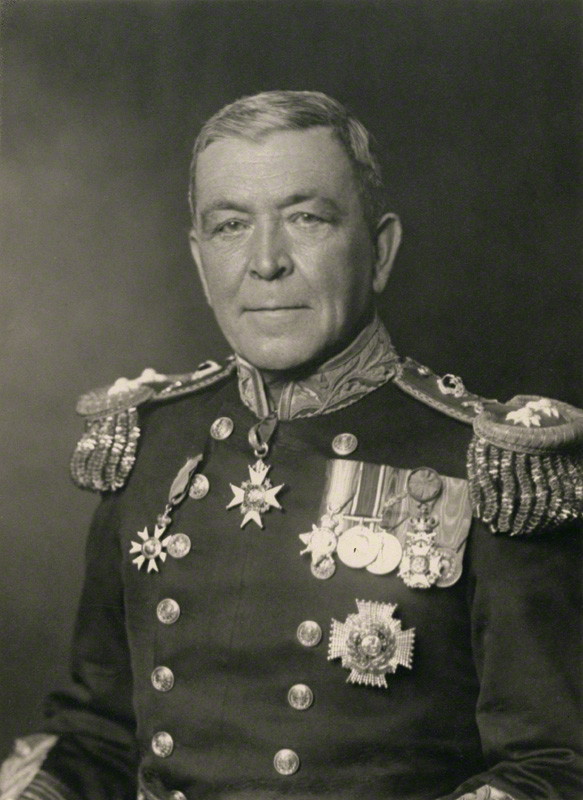
_Percy_Douglas_by_Walter_Stoneman,_1919.jpg) bromide
print by Walter Stoneman, 1919
bromide
print by Walter Stoneman, 1919
Any contributions will be
gratefully accepted
Errors and Omissions
|
|
The Forum
|
|
What's new?
|
|
We are looking for your help to improve the accuracy of The Douglas
Archives.
If you spot errors, or omissions, then
please do let us know
Contributions
Many articles are stubs which would benefit from re-writing.
Can you help?
Copyright
You are not authorized to add this page or any images from this page
to Ancestry.com (or its subsidiaries) or other fee-paying sites
without our express permission and then, if given, only by including
our copyright and a URL link to the web site.
|
|
If you have met a brick wall
with your research, then posting a notice in the Douglas Archives
Forum may be the answer. Or, it may help you find the answer!
You may also be able to help others answer their queries.
Visit the
Douglas Archives Forum.
2 Minute Survey
To provide feedback on the website, please take a couple of
minutes to complete our
survey.
|
|
We try to keep everyone up to date with new entries, via our
What's New section on the
home page.
We also use
the Community
Network to keep researchers abreast of developments in the
Douglas Archives.
Help with costs
Maintaining the three sections of the site has its costs. Any
contribution the defray them is very welcome
Donate
Newsletter
If you would like to receive a very occasional newsletter -
Sign up!
Temporarily withdrawn.
|
|
|
|
|
|
|
|