.jpg) |
| Gustav Otto Douglas (1687-1771, Earl, of Sweden, later, the
Russian soldier and politician, governor of Estonia, Albu and
Kukevere landlord). |
Count Gustaf (also Gustav) Otto Douglas (1687–1771) was a Swedish mercenary.
He
was Administrator
of Finland, 1717 - 1721.
Gustav Otto Douglas was born in
Västerbotten County, the son of Governor Colonel Gustaf Douglas (1648-1705),
and Beata Margareta Stenbock (1661-1735). His paternal grandfather was the
Swedish Field Marshal
Robert Douglas, Count of Skenninge, and
his maternal grandfather, Field Marshal Gustaf Otto Stenbock.
His
siblings were Ebba Charlotta Douglas, Christina Catharina Douglas, Vilhelm
Douglas, Hedvig Douglas, Beata Margareta Falkenberg (born Douglas).
In 1721 Douglas became chairman of the
great Estonian Commission, 1725 Major General, Lieutenant General in 1729,
1737 General of a manager and governor of Estonia 11 August 1738 - March 22
1740 . In 1744 he resigned from government service.
He was captured by Russians during
the Battle of Poltava. He was eventually employed by the Russian army during
the Great Northern War, and in 1717 was placed in charge of the occupation
of Finland.
While resident in Turku, Douglas is reputed to have
killed a Russian attendant during festivities of some kind. After being
sentenced to imprisonment, Douglas bought his freedom with the lives of two
hundred Finns, followed by the same number of horses, one from each of the
families of these men. Douglas is believed to have made several inhumane
pronouncements on the scorched earth policy he employed during the
occupation of Finland. By making the land uninhabited and uninhabitable, he
sought to leave nothing for his former employers the Swedes to retake. He is
generally believed to have been a more cruel and sadistic figure even than
his Russian superiors, and bears comparison with Kurtz of Joseph Conrad's
Heart of Darkness, particularly when one considers the
10,000 slaves estimated to have been taken to Russia from Finland during the
Greater Wrath.
He married Helena von
Schlippenbach on 6th Oct 1715 in Tallinn.
He died on Feb 2 1771
in Tallin, Estland.
His son,
Robert Wilhelm von Douglas (06.23.1724, Tallinn 10.20.1778 Albu),
married Juliane Margarethe von Knorring (1725-1805); they had 10
children.
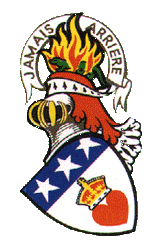
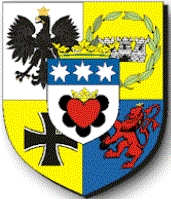
| Gustav's coat of arms |
 |
| Robert's coat of arms. |
Gustav was an ancestor of
Archibald Douglas, who was commander in
Chief of the Swedish army during WWII.
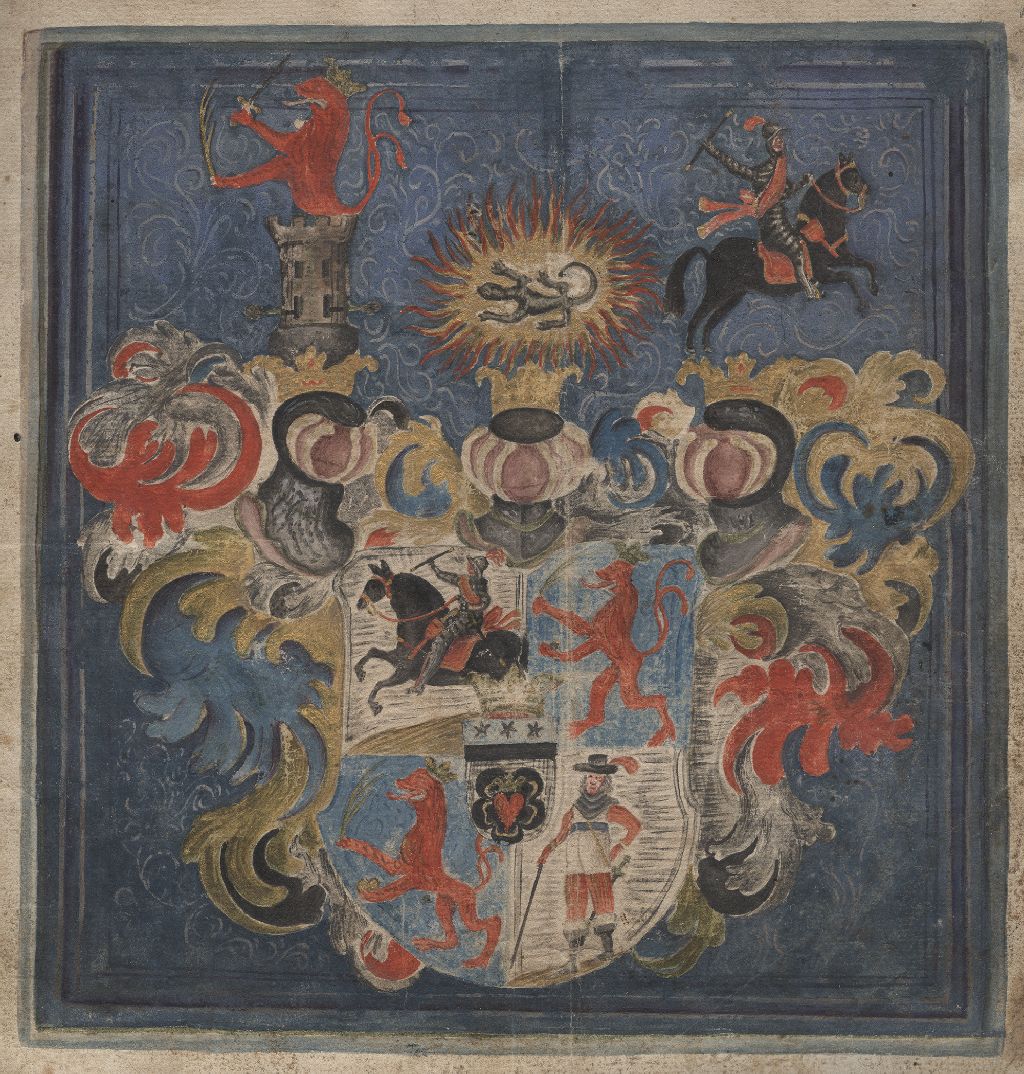
Douglases in Sweden. — Quarterly. 1. Argent, a knight in armour,
with
a red surcoat, brandishing a sword, and mounted on a brown horse.
2 and
3. Azure, a lion rampant gules, crowned or, holding in dexter paw a
palm
branch proper, and in tlie sinister a plate. 4. Argent, a soldier of
seventeenth century with gold coat and boots and red overalls, holding pike
in
dexter hand. En surtout, Argent, a cinquefoil sable surmounted by a
heart
gules, on a chief azure three stars of the field. [Plate VI., fig.
6.]
CRESTS :
Dexter, A tower argent, and issuing therefrom a demi lion
rampant gules,
crowned or, in dexter paw a sword, and in sinister a palm
branch, both
proper ; Middle, A salamander vert in flames or ; Sinister,
A knight on
horseback, as in first quarter. SUPPORTERS : Two unicorns
argent.
|
|