|
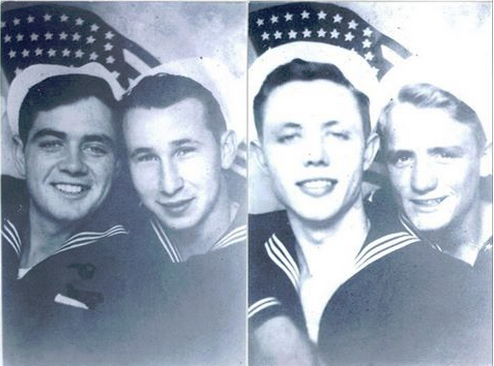 |
| Brothers Garfield Douglas (far l.) and General Preston Douglas
(third from l.) and their Buddies. Garfield Douglas left Newcomb,
Tennessee within two weeks after the bombing of Pearl Harbor.
There was a massive local volunteering of troops, both sons from
this family distinguished to have served in every major US War.
General Preston was not yet of age and had to get his father's
permission, so left later. The brothers were both on the USS
Helena that was torpedoed in the Solomon Islands, but served in
different sections of the ship. |
The Department of Defense POW/Missing Personnel Office announced
Thursday (circa September 2007) that the remains of a U.S. serviceman from Tennessee who had
been missing since World War II have been identified and will be
returned to his family for burial with full military honors.
The Department of Defense identified Seaman 1st Class General P.
Douglas, U.S. Navy, of Newcomb, in Campbell County, Tenn.
He will be buried Jan. 26 2008 in Sneedville in nearby Hancock County,
according to the Department of Defense.
On July 6, 1943, the light cruiser USS Helena was struck by torpedoes
fired by Japanese destroyers off the coast of Kolombangara Island,
Solomon Islands, in what would become known as the Battle of the Kula
Gulf.
More than 700 servicemen were rescued, but Douglas was one of more
than 150 servicemen who were missing after the ship sank.
In June 2006, a resident of Ranongga Island, Solomon Islands,
notified U.S. officials that he had exhumed human remains and Douglas'
dog tag that he found near a trail by his village.
The officials contacted the Joint POW/MIA Accounting Command (JPAC),
and representatives subsequently traveled to Ranongga Island to examine
the burial location. The officials verified that no additional remains
were present.
The remains were identified by using dental records, other forensic
identification tools, and circumstantial evidence. Scientists and the
Armed Forces DNA Identification Laboratory also used DNA in the
identification.
Ship's Loss Recalled
The USS Helena Web site lists the following description of how the
ship, which had been commissioned in September 1939 was sunk by Japanese
torpedoes.
"By midnight 5 July, 1943, Helena's group was off the northwest
corner of New Georgia (island), with three cruisers and four destroyers
composing the group.
"Racing down to face them were three groups of Japanese destroyers, a
total of 10 enemy ships. Four of them peeled off to accomplish their
mission of landing troops.
"By 0157 Helena began blasting away with a fire so rapid and intense
that the Japanese later announced in all solemnity that she must have
been armed with 6-inch machine guns.
"Ironically, Helena made a perfect target when lit by the flashes of
her own guns. Seven minutes after she opened fire she was hit by a
torpedo and within the next three minutes, she was struck by two more.
Almost at once she began to jackknife. Below, she was flooding rapidly
even before she broke up. In a well drilled manner, Helena's men went
over the side.
"Helena's history closes with the almost incredible story of what
happened to her men in the hours and days that followed. When her bow
rose into the air after the sinking, many of them clustered around it,
only to be fired on there. About a half hour after she sank, two
American destroyers came to the rescue.
"At daylight, the enemy was in range once more, and again the
destroyers, Nicholas (DD 449) and Radford ( DD 446 ), broke off' their
rescue operations to pursue. Anticipating an air attack, the destroyers
withdrew for Tulagi, carrying with them all but about 275 of the
survivors.
"To those who remained they left four boats manned by volunteers from
the destroyers' crews. Captain C.P. Cecil, Helena's commanding officer,
organized a small flotilla of three motor whaleboats, each towing a
lifecraft, carrying 88 men to a small island about 7 miles from Rice
Anchorage after a laborious all-day passage. This group was rescued the
next morning by the destroyers USS Gwin and USS Woodworth.
"For the second group of nearly 200, the bow of Helena was their
lifecraft, but it was slowly sinking.
"Disaster was staved off by a Navy Liberator (patrol plane) that
dropped lifejackets and four rubber lifeboats.
"The wounded were placed aboard the lifeboats, while the able-bodied
surrounded the boats and did their best to propel themselves toward
nearby Kolombangara Island.
"But wind and current carried them ever further into enemy waters.
Through the torturous day that followed, many of the wounded died.
"American search planes missed the tragic little fleet, and
Kolombaranga gradually faded away to leeward.
"Another night passed, and in the morning the island of Vella Lavella
loomed ahead. It seemed the last chance for Helena's men and so they
headed for it. By dawn, survivors in all three remaining boats observed
land a mile distant and all who were left were safely landed.
"Two coastwatchers and loyal natives cared for the survivors as best
they could, and radioed news of them to Guadalcanal. The 166 sailors
then took to the jungle to evade Japanese patrols.
"Surface vessels were chosen for the final rescue, Nicholas and
Radford, augmented by USS Jenkins (DD 447) and USS O'Bannon (DD-460) set
off 15 July, 1943 to sail further up "The Slot" than ever before,
screening the movement of two destroyer-transports and four other
destroyers.
"During the night of 16 July, the rescue force brought out the 165
Helena men, along with 16 Chinese who had been in hiding on the island.
Of Helena's nearly 900 men, 168 had perished."
Regina Douglas Collins, General Preston Douglas' sister, died circa
November 2007, before her brother was brought home. It is said that
Garfield searched the dark waters in vain and came home forever changed as
he walked the Earth always wondering where his brother was. Their Mother
worried too and was suffering with Alzheimer's by the time news of the
discovery of the body reached Tennessee.
Addendum
A Memorial Homecoming Celebration
General Preston Douglas was born July 26, 1922 in Newcomb in Campbell
County, Tennessee. His parents were Walter and Bertha Morgan Douglas,
his brother was Walter Garfield Douglas, and his sister was Regina
Douglas Collins. Two spinster aunts, Mary and Martha Douglas helped
raise them. He enlisted in the Navy on December 17, 1941 and served on
the U.S.S. Helena (CL-50) along with his brother Garfield, who left
earlier, within two weeks of the bombing of Pearl Harbor. General had to
ask his father's permission as he was underage so went later.
Mr. Douglas was a WWI veteran himself, from a family distinguished to
have served in every major US War.
"I watched your cousin General walk off Pug Hill to catch the
Greyhound", Jean Nayles told me.
He went to San Diego, California for basic training. Sadly, General has
not been seen in these parts since.
The Newcomb Douglas brothers served as seamen in WW II. They were
assigned to the USS Helena, which came under attack at the battle of
Kula Gulf. On the morning of July 6, 1943, a Japanese submarine
torpedoed the Helena. The first torpedo hit was received in the vicinity
of frame 30, at an estimated depth of about 15 feet below the water
line. This hit severed the bow and turret from the remaining part of the
ship. The extent of the damage caused by this torpedo hit was not know
by any surviving officer or man until after the engagement and the crew
were preparing to abandon ship. Shortly after the first torpedo hit the
ship, a second torpedo hit was received and all power was lost. A third
and final torpedo hit was received about one minute after the second.
Nearly 1,000 men were on board. All but 174 were safely evacuated before
the ship slipped into its watery grave. Preston and Garfield
served in different sections of the ship. Garfield survived.
General was killed two weeks shy of his 21st Birthday.
For the next two years General was listed as Missing in Action since 6
July 1943 and officially declared dead on 10 August 1945, memorialized
at Manila American Cemetery. Though the new designation brought some
closure to the grieving, questions remained. For years, his sister,
Regina, made many inquires about her brother’s fate, which remained a
mystery until 2006.
A cousin shared how Garfield searched the dark waters in vain and came
home forever changed. He walked the earth, forever wondering where his
dear brother Preston was. His mind always seemingly searching the watery
Pacific grave. Garfield moved north to Michigan after the war and later
died in a VA hospital in 1971.
On a warm sunny day in 2006 on a secluded beach on the Solomon Island of
Kolombangar, a beachcomber discovered a dog tag protruding from the
sand. After a little digging, he found several bones. He contacted the
United States Department of Defense, which excavated the area. There
they uncovered bones, teeth, the dog tags and a metal four leaf clover
that Douglas carried.
The remains were 50 miles from where the battle had taken place. How
they got there remains a mystery. The DOD issued a statement saying the
prevailing theory is that his body may have washed up to shore, where it
was buried by natives. In June 2006, a resident of Ranonga Island
notified the US Consulate, who notified John Innes who researched the
name and contacted JPAC. In mid-September 2006, a team from JPAC
traveled to the island and visited the burial site. His remains were
positively identified by the lab.
After careful investigation, the DOD located the Douglas family. The
family had moved from Newcomb, where he was born to Sneedville, Tennesee.
“My mother spent many years wondering what happened to her brother,”
said Denny Douglas, nephew of General Douglas.
“We were all very happy when the Department of Defense confirmed that it
was my uncle’s remains they found. It was in early 2007 that they
confirmed it was my uncle’s remains.”
Unfortunately, Regina Douglas had developed Alzheimer’s disease by 2006.
She was unable to comprehend that her brother’s remains had been found.
Regina Douglas died in November 2007. She didn’t live to see her brother
returned home.
The funeral for General Douglas was held January 26, 2008 at McNeil
Funeral Home in Sneedville, six and a half decades after his death. His
flag draped coffin sat next to a table with a portrait of him, along
with a display case containing three medals awarded posthumously. The
patriot guard, an organization formed to honor fallen soldiers, bore two
American flags in the chapel.
The coffin was then escorted across Clinch Mountain down a winding road
to an old community cemetery. As many as 200 people braved the chilling
cold, and the color guards proudly displayed flags from all branches of
the service as well as the United States flag, the flag of Tennessee and
the MIA flag. After a brief prayer, there was the firing of the 21 gun
salute, the highest honor bestowed at a military funeral. Dozens of
active and retired soldiers, ranging in age from 20 to 80 and in their
military dress uniforms, stood at attention as the somber notes of taps
resonated throughout the valley.
He was laid to rest at Gollihon Cemetery next to his sister. There were
soldiers from four wars, school children, veterans groups and distant
relatives who came to remember Seaman 1st Class General Preston Douglas.
Kevin Walden and the American Legion honor guard were there also. I was
honored to have been invited to pay my respects and stand alongside my
Douglas cousins.
The mystery of General's fate is now resolved. He has finally come home
to the family that will always love and remember him.
Contributed by: Derek J.H. Douglas
Errors and Omissions
|
|
The Forum
|
|
What's new?
|
|
We are looking for your help to improve the accuracy of The Douglas
Archives.
If you spot errors, or omissions, then
please do let us know
Contributions
Many articles are stubs which would benefit from re-writing.
Can you help?
Copyright
You are not authorized to add this page or any images from this page
to Ancestry.com (or its subsidiaries) or other fee-paying sites
without our express permission and then, if given, only by including
our copyright and a URL link to the web site.
|
|
If you have met a brick wall
with your research, then posting a notice in the Douglas Archives
Forum may be the answer. Or, it may help you find the answer!
You may also be able to help others answer their queries.
Visit the
Douglas Archives Forum.
2 Minute Survey
To provide feedback on the website, please take a couple of
minutes to complete our
survey.
|
|
We try to keep everyone up to date with new entries, via our
What's New section on the
home page.
We also use
the Community
Network to keep researchers abreast of developments in the
Douglas Archives.
Help with costs
Maintaining the three sections of the site has its costs. Any
contribution the defray them is very welcome
Donate
Newsletter/Magazine
You can subscribe to our periodic magazine and
newsletters here>>>.
|
|
|
|
|
|
|
|
|
|