Francois-Prosper Douglas, Chevalier de Douglas
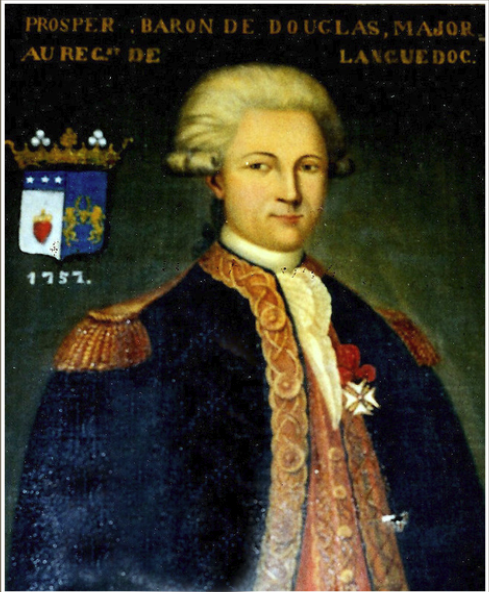 Francois-Prosper Douglas, Chevalier de Douglas, (21 Feb. 1725 - 26
April 1781) was an officer in the French regular troops. He was born
at Montréal, in Bugey (dept of Ain), France, the son of
Charles
Douglas, Comte de Douglas, syndic of the nobility of Bugey and
officer, and Marie-Anne de Lilia.
Francois-Prosper Douglas, Chevalier de Douglas, (21 Feb. 1725 - 26
April 1781) was an officer in the French regular troops. He was born
at Montréal, in Bugey (dept of Ain), France, the son of
Charles
Douglas, Comte de Douglas, syndic of the nobility of Bugey and
officer, and Marie-Anne de Lilia.
In keeping with family
tradition, François-Prosper Douglas took up a military career. In
1743 he was a second lieutenant in the Régiment du Languedoc, the
next year he was promoted lieutenant, and he subsequently took part
in several European campaigns. In 1746 he was made captain of a
company in the second battalion of his regiment, and he still held
this command when he arrived in Canada in 1755 with the French
troops under Dieskau*.
Douglas’s military record seems
undistinguished, although he participated in several actions during
the Seven Years’ War. He was at Lac Saint-Sacrement (Lake George) in
1755, at the capture of Oswego (Chouaguen) in 1756, and at Fort
Carillon (Ticonderoga, N.Y.) in 1758. According to the casualty list
he was wounded “very lightly” in the last battle. In his letters to
his family he did not mention the injury, complaining only of the
hardships he had endured since coming to Canada, where soldiers had
to be ready for action whenever the weather permitted. The wound
may nevertheless have been the reason for his being made a knight of
the order of Saint-Louis on 20 Oct. 1758.
During the siege of
Quebec the next year, Douglas was second in command of a party led
by Jean-Daniel Dumas which attempted to dislodge the British from
Pointe-Lévy (Lauzon) on the night of 12–13 July. The force consisted
of Indians, regulars, militia, townspeople, and some seminarians
whom a wag christened “the Royal Syntax.” It became separated in the
dark; its members mistook one another for the British, fired, and
retreated precipitately without having attacked the enemy. It is not
known whether Douglas was at all at fault in this fiasco. He appears
to have been in charge of the Samos battery, which fired on the
British fleet during the landing at Anse au Foulon on 13 September
but which was abandoned after being attacked by Wolfe’s men. A
ministerial note in the muster-roll of captains says that he “served
well. A good captain, without other talent.” His record in Canada
would seem to bear out that judgement.
Douglas was more
remarkable for having been one of the fewer than 20 regular officers
to marry Canadian women. Montcalm, who generally disapproved on the
grounds that the officers were marrying below their social class and
thereby jeopardizing their careers, approved of Douglas’s match.
Charlotte de La Corne, whom Douglas married on 13 April 1757, was of
noble descent through her father Louis, known as La Corne l’ainé,
and her mother Élisabeth de Ramezay. Montcalm described her as “a
woman of quality, with very good family connections in the colony
and a suitable fortune.” As a nobleman Douglas would in turn have
been considered a highly desirable match in Canada.
He
returned to France after the conquest, taking his wife and family
with him. Two sons had been born in Canada, Louis-Archambaud, later
made a knight of the order of Saint-Louis and imprisoned in 1794
during the Terror, and Charles-Luc (1). Another child was born in
Touraine (2), where Douglas stayed some time after his arrival in
France. In 1763 he embarked for Corsica; he remained there for six
years, during which he took part in several military operations. He
then retired and returned to France in 1769. Subsequently he wished
to come back to Canada to settle on the seigneury of Terrebonne,
which he had inherited from his father-in-law, but he was unable to
carry out the scheme before his death.
He died on 26 April
1781, at Nantua, France.
Translation:
Charles Joseph and Joseph-Marie Chevalier said Douglas belong to an ancient family of Scottish descent, came from Picardy and installed in the Bugey since the seventeenth century. Son of Charles Douglas, trustee of the nobility of Bugey and Marie Lilia, they were born in Montreal near Nantua, as is their brother François-Prosper Douglas. The three brothers served in the regiment of Languedoc. Joseph-Marie enters in 1739 as a cadet before moving to the bodyguards of Villeroy. The elder
Charles Joseph enters as a cadet in 1740, became a second lieutenant in 1742 and lieutenant in 1744. François-Prosper is a second lieutenant in 1743, lieutenant in 1744 and in 1746 became captain of a company in the 2nd battalion. Charles Joseph and Marie Joseph pursue their career in the Royal Scots, one as second captain in 1744 and the other as a lieutenant. Both were captured in 1746 after the Battle of Culloden. Charles-Joseph becomes captain of a company in 1748 when his brother became first mate the previous year. In 1751 Charles Joseph abandons his company to his brother who becomes captain, and was appointed Governor of Saint-Claude in 1751
Notes:
1. Charles-Luc may have become a priest and
may, during the massacres of September 1792, have been suspected of
loyalty to the King, and slain in Paris with several thousand
prisoners.
2. One source says the third son
was born in Corsica.
3. The Dictionary of French parliamentarians from 1789 to 1889 (Adolphe
Robert and Gaston Cougny) has a biography for a son,
Charles François
Xavier, Comte de Douglas.
See also:
Montreal Chateau
The Douglas family in France
Errors and Omissions
|
|
The Forum
|
|
What's new?
|
|
We are looking for your help to improve the accuracy of The Douglas
Archives.
If you spot errors, or omissions, then
please do let us know
Contributions
Many articles are stubs which would benefit from re-writing.
Can you help?
Copyright
You are not authorized to add this page or any images from this page
to Ancestry.com (or its subsidiaries) or other fee-paying sites
without our express permission and then, if given, only by including
our copyright and a URL link to the web site.
|
|
If you have met a brick wall
with your research, then posting a notice in the Douglas Archives
Forum may be the answer. Or, it may help you find the answer!
You may also be able to help others answer their queries.
Visit the
Douglas Archives Forum.
2 Minute Survey
To provide feedback on the website, please take a couple of
minutes to complete our
survey.
|
|
We try to keep everyone up to date with new entries, via our
What's New section on the
home page.
We also use
the Community
Network to keep researchers abreast of developments in the
Douglas Archives.
Help with costs
Maintaining the three sections of the site has its costs. Any
contribution the defray them is very welcome
Donate
Newsletter
If you would like to receive a very occasional newsletter -
Sign up!
Temporarily withdrawn.
|
|
|
|
|
|
|
|