   |
|
|
|
|
| ||||||
|
The Earls of Morton
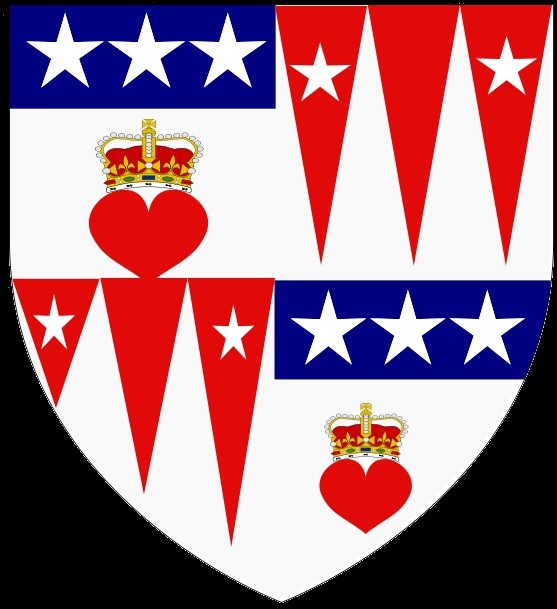 The Douglas
Earls of Morton family are descended from the second son of
Archibald of Douglas (fl 1198-1239), second Lord of Douglas, through
the Douglas families of Liddelsdale and Dalkeith. Sir James Douglas,
1st Lord Dalkeith, was granted a charter of the Barony of Morton
(Morton is a small holding in East Calder, West Lothian.) in
1381/1382 and his grandson, James Douglas (d c 1493), was created
Earl of Morton in 1457/1458. The Douglas
Earls of Morton family are descended from the second son of
Archibald of Douglas (fl 1198-1239), second Lord of Douglas, through
the Douglas families of Liddelsdale and Dalkeith. Sir James Douglas,
1st Lord Dalkeith, was granted a charter of the Barony of Morton
(Morton is a small holding in East Calder, West Lothian.) in
1381/1382 and his grandson, James Douglas (d c 1493), was created
Earl of Morton in 1457/1458. James Douglas married Joanna, daughter of James I (1394-1437), some time before 1459 and was succeeded by his eldest son, John Douglas. On the latter's death, sometime before September 1515, his son James Douglas (d c 1550) became 3rd Earl of Morton. James Douglas married Katherine Stewart, natural daughter of James IV (1473-1513), in 1507. In 1505 he was appointed procurator for the King and acted as bailie of the abbacy of Dunfermline in 1508 and 1509. James V (1512-1542) forced the Earl to resign his lands in 1540, nominally in favour of Robert Douglas of Lochleven, who was similarly compelled to resign the lands in favour of the King. A few months after the King's death in 1542 the Earl successfully brought an action before the Court of Session to nullify the resignation. He had no sons and was succeeded by his daughter's husband, James Douglas (c 1516-1581), second son of Sir George Douglas of Pittendreich. James Douglas served as Regent of Scotland, Lord Chancellor and Lord High Admiral until he was accused of complicity in the murder of Henry, Lord Darnley (1545-1567) and was beheaded in 1581. His estates were forfeited but the attainder was reversed in 1585/1586 and his nephew Archibald Douglas (d 1588) Earl of Angus became 5th Earl of Morton. On the latter's death the earldom devolved on the heir of entail to Sir William Douglas (1539-1606), of Lochleven, eldest son and heir of Sir Robert Douglas of Lochleven. Douglas was the custodian of Mary Queen of Scots (1542-1587) during her imprisonment at Lochleven Castle. He died in 1606 and was succeeded by his grandson William Douglas (1582-1648). Douglas was Lord High Treasurer of Scotland from 1630-1636 and advanced considerable sums for the support of the Royalist cause partly through the disposal of his property at Dalkeith. In recognition of this he was granted the jurisdiction of Orkney and Shetland in 1643 and he was also created Lord Aberdour in 1638. He was succeeded by his son Robert Douglas (d 1649) and grandson William Douglas (d 1681). The grant of Orkney and Shetland to the latter was disputed and they reverted to the Crown. Douglas, in 1672, resigned the Barony of Dalkeith. Sir James Douglas (d 1686) of Smithfield succeeded his nephew William and in 1669 James' son James Douglas (d 1715), 11th Earl of Morton, was granted Orkney and Shetland. James 11th Earl, died unmarried as did his brother Robert, 12th Earl. Their brother, George 13th Earl, was Vice Admiral of Scotland. The succession passed through this side of the family to James Douglas (1703-1768) 14th Earl of Morton who in 1742 obtained an Act of Parliament investing the Earldom of Orkney and Lordship of Zetland in himself and his heirs. In 1766 he sold the islands to Sir Laurence Dundas of Kerse in Stirling, descendant of the Dundas family of Fingask and ancestor of the Earls of Zetland. He was succeeded by his son Sholto Charles Douglas (1732-1774) and grandson George Douglas (1761-1827). The latter had no children and his cousin George Sholto Douglas (1789-1858) succeeded him. The succession then passed to George's eldest son Sholto John Douglas (1818-1884) and grandson Sholto George Douglas (1844-1935). The latter was succeeded by his grandson Sholto Charles John Hay Douglas (1907-1976), 20th Earl of Morton and Lord Aberdour, who in turn was succeeded by his cousin John Charles Sholto Douglas (b 1927), the 21st Earl of Morton. Lords of Dalkeith (1341) William Douglas, Lord of Liddesdale James Douglas, 1st Baron Dalkeith James Douglas, 2nd Baron Dalkeith James Douglas, 3rd Baron Dalkeith James Douglas, 4th Baron Dalkeith (created Earl of Morton 1458) Earls of Morton (1458) James Douglas, 1st Earl of Morton (d. 1493) John Douglas, 2nd Earl of Morton (d. 1513) James Douglas, 3rd Earl of Morton (d. 1548) ("abeyant" 1548) James Douglas, 4th Earl of Morton (c. 1516–1581) (abeyance terminated 1550, attainted 1580/81) John Maxwell, 8th Lord Maxwell (1552–1593), a grandson of the 3rd Earl, succeeded briefly as Earl of Morton. Archibald Douglas, 5th Earl of Morton (c. 1555–1588), also 8th Earl of Angus (attainder reversed 1586) William Douglas, 6th Earl of Morton (1540–1606) Robert Douglas, Master of Morton (d. 1585) William Douglas, 7th Earl of Morton (1582–1648) Robert Douglas, 8th Earl of Morton (d. 1649) William Douglas, 9th Earl of Morton (d. 1681) James Douglas, 10th Earl of Morton (d. 1686) James Douglas, 11th Earl of Morton (d. 1715) Robert Douglas, 12th Earl of Morton (d. 1730) George Douglas, 13th Earl of Morton (1662–1738) James Douglas, 14th Earl of Morton (c. 1703–1768) Sholto Charles Douglas, 15th Earl of Morton (1732–1774) George Douglas, 16th Earl of Morton (1761–1827) George Sholto Douglas, 17th Earl of Morton (1789–1858) Sholto John Douglas, 18th Earl of Morton (1818–1884) Sholto George Douglas, 19th Earl of Morton (1844–1935) Sholto Charles Douglas, Lord Aberdour (1878–1911) Sholto Charles John Hay Douglas, 20th Earl of Morton (1907–1976) John Charles Sholto Douglas, 21st Earl of Morton (1927-2016) John Stewart Sholto Douglas, 22nd Earl of Morton (b. 1952) The heir apparent is the present holder's son, John David Sholto Douglas, Lord Aberdour (b. 28 May 1986)
• Douglas Morton family tree - Please note that this is a large file and will take sometime to download -Chrome not recommended. • The Morton Succession

Any contributions will be gratefully accepteddiv class="article_seperator">
| ||||||||||||||||||||||||||||||||
|
The content of this website is a collection of materials gathered from a variety of sources, some of it unedited. The webmaster does not intend to claim authorship, but gives credit to the originators for their work. As work progresses, some of the content may be re-written and presented in a unique format, to which we would then be able to claim ownership. Discussion and contributions from those more knowledgeable is welcome. Last modified: Friday, 17 May 2024 |
