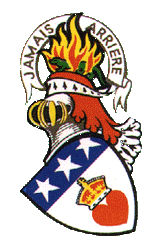
Douglas of Spott
This page is a stub - you can help
complete it
As far as I can deduce, the Douglases inherited Spott on the death
of George Home, whose daughter Anna married James Douglas in 1578.
I have been unable to trace any descendants beyond Alexander.
Sir James Douglas, lay
Prior of Pluscarden, knighted about 1607. He married Anna, only
daughter of George Home of Spott. He is mentioned in the Acts of
Parliament, 1592, and in the Privy Council Register,
1586-1613.
He had a son : —
Sir Archibald Douglas of Spott,
retoured to his father 1615. He is mentioned in the Great Seal
Register, 1620 (see below). His Will recorded Edinburgh 1647.
His son : —
Archibald Douglas of Spott, was retoured to his father 1647, and Sir
Robert Douglas of Makerstoune is named as his tutor, 1658 {Great
Seal Register).
His son : —
Alexander Douglas, was retoured to his father 1672.
Sir Robert Douglas of Spott (d.1629), master of
the horse to Prince Henry:
Douglas was the dedicatee of one of the many
lamentations for Prince Henry, viz."Great
Britaine all in Blacke" (London, 1612; STC (2nd ed.) / 23760), by
John Taylor, the "Water Poet" - Taylor's dedication to Douglas takes
the form of a sonnet.
Sir Robert Douglas, of Spott, in the county of Haddington, (son of
Malcolm Douglas, of Mains, in Dunbartonshire, descended from Nicol
Douglas, of the family of Morton,) was page of honour to Henry,
Prince of Wales, and afterwards his master of the horse. Upon the
lamented death of that prince, he was appointed one of the gentlemen
of the bedchamber to King James I., and continued in that office to
King Charles I., by whom he was also constituted master of the
household, and sworn a privy councillor. He was created a peer of
Scotland, by the title of
Viscount of Belhaven, in the county of Haddington, to himself
and the heirs male of his body, by patent, dated 24th June, 1633.
Robert Douglas of Spott, Viscount Belhaven (b c1573, dspl
14th
Jan1639), son of Matthew Douglas, 7th of Mains (abt 1549) and
Margaret Buchanan (dau of George Buchanan of that ilk), married m.
(may 1611) Nicolas Moray (d Nov 1612, dau of Robert Moray of
Abercairney).
Robert and Margaret are the assumed parents of:
John Douglas
Susanna Douglas (b c1617, d c1692), who married (2nd
Feb1635/6) Sir Robert Douglas of Blackerstone.
James Douglas of Spott -
an Ulster Undertaker
Sir James Douglas, of Spott; Haddington constabulary, 1612.
Commendator of Pluscardine, natural son of James, Earl of Morton,
had a charter, 31 Jan 1577/78 of the lands of Easter Spott, Co.
Edinburgh from George Home, Fiar of Spott
------------------------------------
(Jul. 26. ?1592/3)—An
Act is paffed ' in fauouris of The Erll Bothuill and his compliceis,'
viz. Dame Margaret Douglas Counteffe of Bothuill,2 James Douglas of
Spott, &c. Proclamation is ordered to be made, charging ' all his
hienes liegis, that nane of thame tak vpoun hand to fklander,
murmour, reproche or bakbyte the perfonis abouewrittin or thair
pairt-takaris, or onywayes moleft or perfew thame, in bodyis or
guidis, vpoun quhatfumeuir caus, cullour or cryme bigane.' And that
Letters be directed to relax them from the procefs of horn. (Aug.
8.)—Proclamation, relative to ' ane fchip of Preftoun laitlie
arryvit in this Firth, cum furth of England, quhairin ar lindrie
perfonis and guidis fufpect to be infectit with the peft.' The '
maifteris, fkipparis, marinaris,' &c. are charged ' to addrefle
thame felffis with the faid fchip and guidis being thairin to Sanct
Colmis Inche, and thair loife handle,3 and remane with the fame
fchip and guidis, vnto the tyme pruiff and tryale be had, giff thay
be foule or cleane of this difeafe,' &c. Charge is likewife given to
the liegis, to prevent communication with the fhip.
------------------------------------
It was proposed to
introduce Bothwell and his followers by a back passage, that lay
through the duke of Lennox' stables, who was immediately to seize
the gates, take the keys from the porters, and then to proceed to
the king's chamber, and secure him. As the king was totally
unprepared, and dreaming of no danger, there did not seem the least
risk of the enterprise failing, when the accession of James Douglas
of Spot, an accidental circumstance that should have rendered the
issue more certain, completely defeated it. A few days before,
George Hume of Spot, Douglas' father-in-law, was killed by some
Mersemen of the name of Home, and Sir George Hume, his nephew, the
king's equerry, suspecting Douglas, accused him of being author, or
accessory to the murder, from a dread lest his father-in-law should
bestow upon Sir George, some lands which Douglas claimed in right of
his wife. Upoh this accusation,, some of Douglas' servants were
taken into custody, and confined in the palace, on purpose to be
examined by torture ! The chancellor strenuously opposed this
infamous and unjust mode of procedure, but the king insisted, and
when Douglas, who also lodged in the palace, saw that there were no
means of preventing it, he joined the conspirators. At the hour
appointed, Bothwell and his followers were admitted by his
accomplices, and had already reached the inner court of the palace
without noise, when Douglas, eager to release his servants,
proceeded with a party to force the rooms where they were confined.
The noise of the hammers, in attempting to break open the doors,
gave the first alarm. The king, who was then in the queen's
apartments at supper, on hearing the noise, fled to the tower as a
place of safety. Bothwell, after directing one body of his men to
proceed to the chancellor's room, and secure him, went himself with
the rest to the queen's apartments, where be expected to find the
king; but the chancellor, with a few servants, resolutely defended
his chamber, and the door of the queen's being barricaded, while
Bothwell called for fire to burn them, Sir James Sandilands, one of
the gentlemen of the king's bedchamber, receiving information of the
king's danger, entered through the chapel, and drove the assailants
from the palace, the chief of whom, taking advantage of the
darkness, escaped by the same way by which they had entered. Nine of
the lower order were taken, and hanged next morning.
--------------------------------------------
June 4 1667:
Mr
William Douglas, son of the deceased Laird of Whittingham, was
tried for his concern in an unfortunate duel, in which Sir James
Home of Eccles was killed. The affair took its origin in a quarrel
in a tavern in Edinburgh, ‘after excessive drinking.’—Lam. We learn
from the evidence of a hackney-coachman, that being employed by four
gentlemen—namely, the two who have been mentioned, the Master of
Ramsay, and Archibald
Douglas of Spott—he drove them to a lonely spot on the shore
near Leith, where they all came out, and drawing their swords, ‘went
through other.’ He saw Sir James fall under the thrust of the
accused party. Another person saw the accused standing over Sir
James after he fell, and when the unfortunate gentleman was carried
into Leith, he beard the accused ask him forgivenness. A third
witness observed the Master of Ramsay with his foot on Spott’s neck,
and when he (the deponent) removed the Master, Spott got up, ran at
the Master, and called him ‘cullion!' It seems to have been a
barbarous quarrel barbarously wrought out; and when we see how the
men acted after they began fighting, we cannot but wonder that they
were able to come to the field in one vehicle. William Douglas was
sentenced to have his head stricken off his body three days after at
the Cross of Edinburgh.—
On the fourth of June 1667, Archibald Douglas of Spot, and Mr
William Douglas, " sone to umquhil Sir Robert Douglas of
Blackerstoune," were, as appears from the Criminal Record of
Edinburgh, " indytit and accusit for the slaughter of umquhill Sir
James Home of Eccles, Knight."—John Home of Eccles, son of the
deceased, is one of the pursuers—" My Lord Advocat insists primo
loco against Mr William; and continues the trial of the Laird of
Spott, to the first Wednesday of July next to come."—No
circumstances of the murder are detailed. The jury acquitted Mr
William of " the cryme of combatting, specified in the dittay," but
found him guilty, " airt and part," of the slaughter of Sir James.
Sentence—" To be tane upon Wednesday next, the 7th day of Junii,
instant, to the mercat croce of Edin: and ther, betuixt two and four
hours in the afternoone, to have his head stricken off from his
bodie, and all his moveable guids and geir to be escheet,"
June 11th 1667; Maister William Dowglas execute
Maister
Maister William Dowglas sone lau11 to the lady of Blaikorston was
Dowglaa beheided at the crosse of Edr and Baylly James Justice
received the execute. warrand for his executioun the wch warrand
could not be goten from him to regester
[Convicted of the
slaughter of Sir James Home of Eccles. The trial is described at
considerable length in Records of the Justiciary Court, vol. i.,
Scot. Hist. Socy., where it is stated that 'Mr. William Douglas a
litle before his Triall had almost escaped out of the Tolbooth,
having cutt the stenchers of the windows with aqua fortis. Being
ready to go away he was taken.']
------------------------------------------------------
Lady Isobella, wife of Sir Archibald Douglas of Spott,
By his deposition it appeared that Sir James Douglas of Spott
was ... Whereupon they were desired to pronounce Spott
excommunicated, as one that had made defection from the truth, and
was otherwise suspected of heinous crimes : but they ...
--------------
In 1678, a Captain Douglas of Spott commanded a company in
France, possibly in Lord George Douglas's regiment at Amiens.
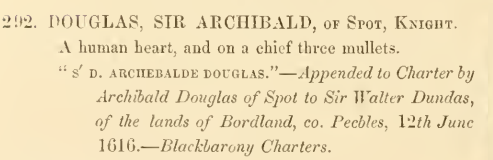
Probably the Archibald Douglas mentioned in the Great Seal register
of 1620. He was the son of Sir James Douglas, lay
Prior of Pluscarden,
Any contributions will be
gratefully accepted
Errors and Omissions
|
|
The Forum
|
|
What's new?
|
|
We are looking for your help to improve the accuracy of The Douglas
Archives.
If you spot errors, or omissions, then
please do let us know
Contributions
Many articles are stubs which would benefit from re-writing.
Can you help?
Copyright
You are not authorized to add this page or any images from this page
to Ancestry.com (or its subsidiaries) or other fee-paying sites
without our express permission and then, if given, only by including
our copyright and a URL link to the web site.
|
|
If you have met a brick wall
with your research, then posting a notice in the Douglas Archives
Forum may be the answer. Or, it may help you find the answer!
You may also be able to help others answer their queries.
Visit the
Douglas Archives Forum.
2 Minute Survey
To provide feedback on the website, please take a couple of
minutes to complete our
survey.
|
|
We try to keep everyone up to date with new entries, via our
What's New section on the
home page.
We also use
the Community
Network to keep researchers abreast of developments in the
Douglas Archives.
Help with costs
Maintaining the three sections of the site has its costs. Any
contribution the defray them is very welcome
Donate
Newsletter
If you would like to receive a very occasional newsletter -
Sign up!
|
|
|
|
|
|
|
|