|
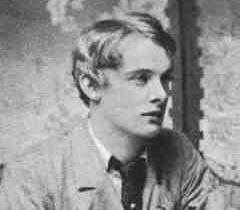
Lord Alfred Bruce Douglas (22 October 1870 – 20 March 1945) was
a poet, a translator and a prose writer, better known as the intimate
friend and lover of the writer Oscar Wilde. Much of his early poetry was
Uranian in theme, though he tended, later in life, to distance himself
from both Wilde's influence and his own role as a Uranian poet.
The third son of
John Douglas, 9th Marquess of Queensberry and his first wife, the
former Sibyl Montgomery, Douglas was born at Ham Hill House in
Worcestershire. He was his mother's favourite child; she called him
Bosie (a derivative of Boysie), a nickname which stuck for the rest of
his life.
Douglas was educated at Winchester College (1884–88) and at Magdalen
College, Oxford (1889–93), which he left without obtaining a degree. At
Oxford, Douglas edited an undergraduate journal The Spirit Lamp
(1892-3), an activity that intensified the ongoing conflict between him
and his father. Their relationship had always been a strained one and
during the Queensberry-Wilde feud, Douglas sided with Wilde, even
encouraging him to prosecute his own father for libel. In 1893, Douglas
had a brief affair with George Ives.
In 1891, Douglas met Oscar Wilde; they soon began an affair, though,
according to Douglas, they never engaged in sodomy. Though Douglas
consented to be the lover of the older Wilde, he shared Wilde's interest
in younger partners. Of the two, Douglas was known for preferring
schoolboys, while Wilde liked older teenagers and young men. When his
father, Lord Queensberry, suspected that their liaison may have been
more than a friendship, he began a public persecution of Wilde. In
addition to invading the playwright's home, Queensberry planned to throw
rotten vegetables at Wilde during the premiere of The Importance of
Being Earnest. In 1894, the Robert Hichens novel The Green
Carnation was published. Said to be based on the relationship of
Wilde and Douglas, it would be one of the texts used against Wilde
during his trials in 1895.
When Lord Drumlanrig (Douglas' eldest brother and the heir to the
marquessate of Queensberry) died in a suspicious hunting accident,
rumours circulated that Drumlanrig had been having a homosexual
relationship with the Prime Minister, Lord Rosebery. As a result, Lord
Queensberry began a crusade to save his youngest son. Queensberry
publicly insulted Wilde by leaving, at the latter's club, a calling card
on which he had written: "For Oscar Wilde posing as a somdomite" (a
misspelling of sodomite).
In response to this card, and with Douglas's avid support, but
against the advice of friends such as Robert Ross, Frank Harris, and
George Bernard Shaw, Wilde sued Queensberry for criminal libel. The case
went badly, since Queensberry had hired private detectives to document
Wilde's and Douglas's homosexual contacts. Several male prostitutes were
enlisted by the defence to give evidence against Wilde and, on advice
from his lawyer, he dropped the suit. However, based on evidence raised
during the case, Wilde was charged with committing acts of gross
indecency with other male persons, a charge which covered all homosexual
acts, public or private. Douglas's 1892 poem "Two Loves", which was used
against Wilde at the latter's trial, ends with the famous line that
refers to homosexuality as "the love that dare not speak its name".
After a retrial (the jury in his first trial having been unable to
reach a verdict), Wilde was convicted on 25 May 1895 and imprisoned at
hard labour for two years. Douglas was forced into exile in Europe.
Following Wilde's release (19 May 1897), although not immediately, the
two reunited in August at Rouen, but stayed together only a few months
owing to personal differences and the various pressures on them.
This meeting was disapproved of by the friends and families of both
men. During the later part of 1897, Wilde and Douglas lived together
near Naples, but for financial and other reasons, they separated. Wilde
lived the remainder of his life primarily in Paris, and Douglas returned
to England in late 1898.
The period when the two men lived in Naples would later become quite
controversial. Wilde claimed that Douglas had offered a home, but had no
funds or ideas. When Douglas eventually did gain funds from his late
father's estate, he refused to grant Wilde a permanent allowance,
although he did give him occasional handouts. When Wilde died in 1900,
he was relatively impoverished. Douglas served as chief mourner,
although there reportedly was an altercation at the gravesite between
him and Robert Ross. This struggle would preview the later litigations
between the two former lovers of Oscar Wilde.
After Wilde's death, Douglas established a close friendship with
Olive Eleanor Custance, an heiress and poet. They married on 4 March
1902 and had one son, Raymond Wilfred Sholto Douglas (Nov 17, 1902 - Oct
10, 1964). In 1911 Douglas embraced Catholicism.
Douglas started his "litigious and libellous career" (Murray p152) by
obtaining an apology and fifty guineas each from the Oxford and
Cambridge magazines The Isis and Cambridge for defamatory
references to him in an article on Wilde.
He was a plaintiff and defendant in several trials for civil or
criminal libel. In 1913 he accused Arthur Ransome of libelling him in
his book Oscar Wilde: A Critical Study. He saw this trial as a
weapon against his enemy Ross, not understanding that Ross would not be
called to give evidence in the trial. Similarly he did not appreciate
that when he urged Wilde to sue his father that his father’s character
was not relevant to the case. The court found in Ransome's favour.
In the most noted case, brought by Winston Churchill in 1923, Douglas
was found guilty of libelling Churchill and was sentenced to six months
in prison. Douglas had claimed that Churchill had been part of a Jewish
conspiracy to kill Lord Kitchener, the British Secretary of State for
War. Kitchener had died on June 5, 1916, while on a diplomatic mission
to Russia: the ship in which he was travelling, the armoured cruiser HMS
Hampshire, struck a German mine and sank west of the Orkney
Islands. Despite this conflict, in 1941 he wrote a sonnet in praise of
Churchill (Murray page 317).
In 1924 while in prison, Douglas, in an ironic echo of Wilde's
composition of De Profundis (Latin for "From the Depths") during
his incarceration, wrote his last major poetic work, In Excelsis
(literally, "in the highest"), which contains 17 cantos. Since the
prison authorities would not allow Douglas to take the manuscript with
him when he was released, he had to rewrite the entire work from memory.
Douglas maintained that his health never recovered from his harsh
prison ordeal, which included sleeping on a plank bed without a
mattress.
More than a decade after Wilde's death, with the release of
suppressed portions of Wilde's De Profundis letter in 1912,
Douglas turned against his former friend, whose homosexuality he grew to
condemn. In 1918, having been called as witness in Maud Allan's libel
suit against a newspaperman, he described his old lover as "the greatest
force for evil that has appeared in Europe during the last three hundred
and fifty years." Douglas added that he intensely regretted having met
Wilde, and having helped him with the translation of Salomé,
which he described as "a most pernicious and abominable piece of work."
Following his own incarceration in prison in 1924, Douglas' feelings
toward Oscar Wilde began to soften considerably. He said in Oscar
Wilde: A Summing Up that “Sometimes a sin is also a crime (for
example, a murder or theft) but this is not the case with homosexuality,
any more than with adultery” (Murray p309-310).
Throughout the 1930s and until his death, Douglas maintained
correspondences with many people, including Marie Stopes and George
Bernard Shaw. Anthony Wynn wrote the play Bernard and Bosie: A Most
Unlikely Friendship based on the letters between Shaw and Douglas.
One of Douglas's final public appearances was his well-received lecture
to the Royal Society of Literature on 2 September 1943, entitled The
Principles of Poetry, which was published in a limited edition of
1,000 copies. He attacked the poetry of T. S. Eliot, and the talk was
praised by Arthur Quiller-Couch and Augustus John (Murray pages
318-319).
Douglas's only child, Raymond, was diagnosed with schizoaffective
disorder in 1927 and entered St. Andrews Hospital, a mental institution.
He was decertified and released after five years, but suffered a
subsequent breakdown and returned to the hospital. In February 1944,
when Olive Douglas died of a cerebral haemorhage at the age of 67,
Raymond was able to attend his mother's funeral, and in June he was
again decertified and released. However, his conduct rapidly
deteriorated and he returned to St. Andrews in November where he stayed
until his death on 10 October 1964.
Douglas died of congestive heart failure on 20 March 1945 at the age
of 74. He was buried at the Franciscan Monastery, Crawley, West Sussex
on 23 March where he is interred alongside his mother, Sibyl,
Marchioness of Queensberry, who died in 1937 at the age of 91. A single
gravestone covers them both.
See also: The Curse of
the Queensberrys
|
|