Penrhyn Castle
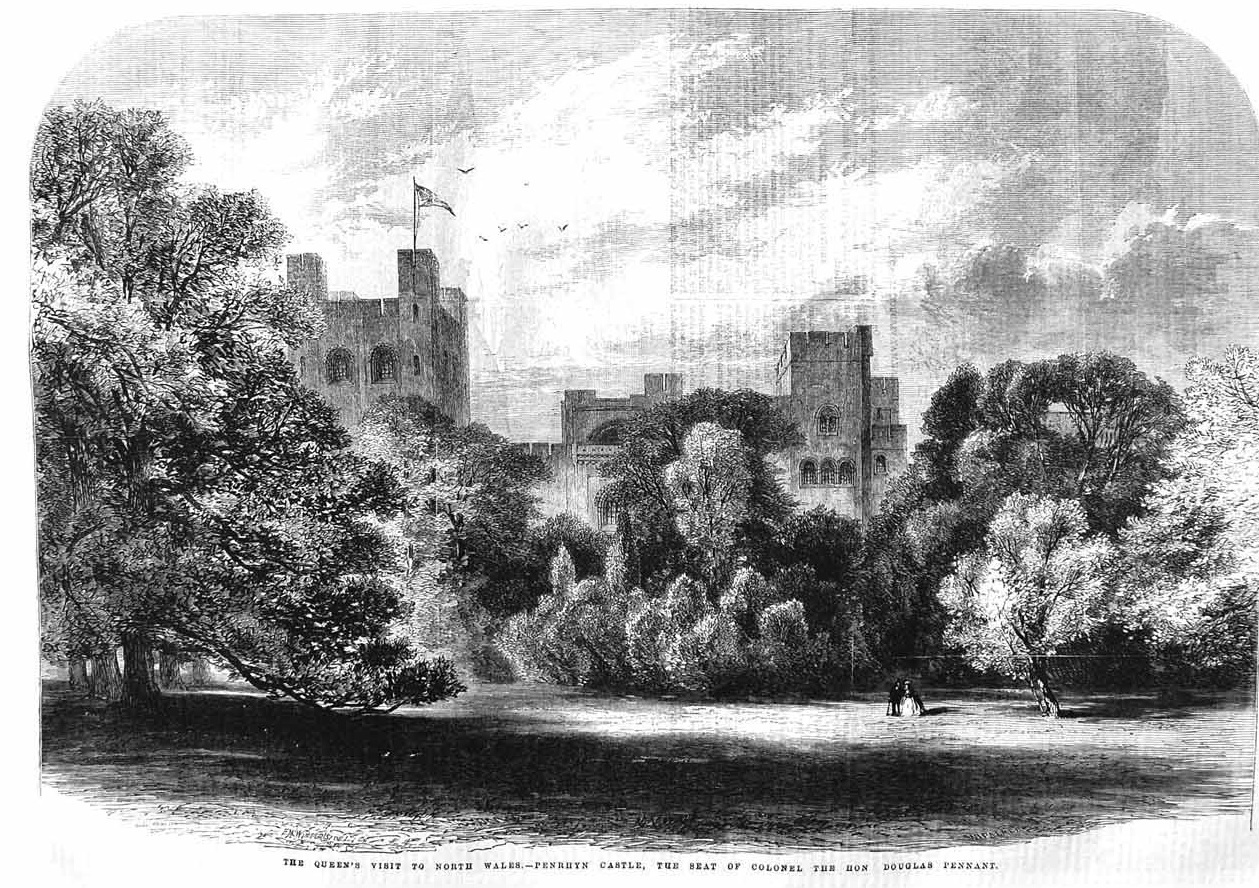 |
| The Queen's visit to North Wales - from the cover of the
Illustrated London News, 1859 |
Penrhyn Castle is a country house in Llandegai, Bangor, Gwynedd,
North Wales, in the form of a Norman castle. It was originally a
medieval fortified manor house, founded by Ednyfed Fychan. In 1438,
Ioan ap Gruffudd was granted a licence to crenellate and he founded
the stone castle and added a tower house. Samuel Wyatt reconstructed
the property in the 1780s.
The present building was created
between 1820 and 1840 to designs by Thomas Hopper, who expanded and
transformed the building beyond recognition. However a spiral
staircase from the original property can still be seen, and a
vaulted basement and other masonry were incorporated into the new
structure. Hopper's client was George Hay Dawkins-Pennant, who had
inherited the Penrhyn estate on the death of his second cousin,
Richard Pennant, who had made his fortune from Jamaican sugar and
local slate quarries. The eldest of George's two daughters, Juliana,
married Grenadier Guard, Edward Gordon Douglas, who, on inheriting
the estate on George's death in 1845, adopted the hyphenated surname
of Douglas-Pennant.
Penrhyn is one of the most admired of the
numerous mock castles built in the United Kingdom in the 19th
century; Christopher Hussey called it, "the outstanding instance of
Norman revival." The castle is a picturesque composition that
stretches over 600 feet from a tall donjon containing family rooms,
through the main block built around the earlier house, to the
service wing and the stables.
It is built in a sombre style
which allows it to possess something of the medieval fortress air
despite the ground-level drawing room windows. Hopper designed all
the principal interiors in a rich but restrained Norman style, with
much fine plasterwork and wood and stone carving. The castle also
has some specially designed Norman style furniture, including a one
ton slate state bed made for Queen Victoria when she visited in
1859.
The Castle was requisitioned at the start of the Second World War.
The National Gallery sent its collection of Old Masters to the
Castle, as it was one of the few buildings in Wales with doors large
enough to admit one of Van Dyck's huge equestrian portraits.
Eventually they were moved again to a slate mine to be certain of
protection from bombing. The Castle was then made the headquarters
of the Daimler Motor Company and also used by the BBC from where
they broadcast the sitcom 'It's That Man Again' (ITMA).
Hugh Napier Douglas-Pennant, 4th Lord Penrhyn, died in
1949, and the castle and estate passed to his niece, Lady Janet
Pelham, who, on inheritance, adopted the surname of Douglas-Pennant.
In 1951 the castle and 40,000 acres (160 km²) of land were accepted
by the Treasury in lieu of death duties from Lady Janet. It now
belongs to the National Trust and is open to the public.
Penrhyn's attractions include a formal walled garden, extensive
informal gardens, a dolls museum, an industrial railway museum, a
model railway museum and an adventure playground. Hanging on its
walls is one of the finest art collections in North Wales, with
works by artists such as Rembrandt, Canalletto, Richard Wilson and
Palma Vecchio. The family began collecting paintings from the early
years of the 19th century; this significant collection was
catalogued by the 2nd Lord Penrhyn's daughter Alice Douglas-Pennant.
The castle has views over the Snowdonia mountains.
In
2008/09 it was the National Trust's thirteenth most visited
paid-entry property, with 156,575 visitors.
See also:
The Douglas-Pennant Family
•
The
Penrhyn Art Collection
Any contributions will be
gratefully accepted
Errors and Omissions
|
|
The Forum
|
|
What's new?
|
|
We are looking for your help to improve the accuracy of The Douglas
Archives.
If you spot errors, or omissions, then
please do let us know
Contributions
Many articles are stubs which would benefit from re-writing.
Can you help?
Copyright
You are not authorized to add this page or any images from this page
to Ancestry.com (or its subsidiaries) or other fee-paying sites
without our express permission and then, if given, only by including
our copyright and a URL link to the web site.
|
|
If you have met a brick wall
with your research, then posting a notice in the Douglas Archives
Forum may be the answer. Or, it may help you find the answer!
You may also be able to help others answer their queries.
Visit the
Douglas Archives Forum.
2 Minute Survey
To provide feedback on the website, please take a couple of
minutes to complete our
survey.
|
|
We try to keep everyone up to date with new entries, via our
What's New section on the
home page.
We also use
the Community
Network to keep researchers abreast of developments in the
Douglas Archives.
Help with costs
Maintaining the three sections of the site has its costs. Any
contribution the defray them is very welcome
Donate
Newsletter
If you would like to receive a very occasional newsletter -
Sign up!
Temporarily withdrawn.
|
|
|
|
|
|
|
|