|
In 1346 the greater part
of the English army of Edward III were away at war fighting against the French
with the assistance of among others Thomas Hatfield, the Bishop of Durham who
took along his own private army. The French were desperate for the English to be
diverted and called upon King David II of Scotland to attack the English
northern border. King David gladly obliged and sallied forth into England with
20,000 men who wrecked and plundered parts of Cumberland and Northumberland
before entering Durham where they made camp at Bearpark to the west of the city.
The Scots were comprised of three factions under the respective commands of King
David, the Earl of Moray and Sir William Douglas.
On the 17th October the
men of Sir William Douglas went on a rampage throughout Durham straying as far
south as Ferryhill where to their surprise they encountered part of an English
army of some 15,000 which pursued them north. Under the leadership of Sir Ralph
Neville and supported by the men of Thomas Rokeby and Lord Percy, the English
were successful in this initial encounter and a number of Scots lost their
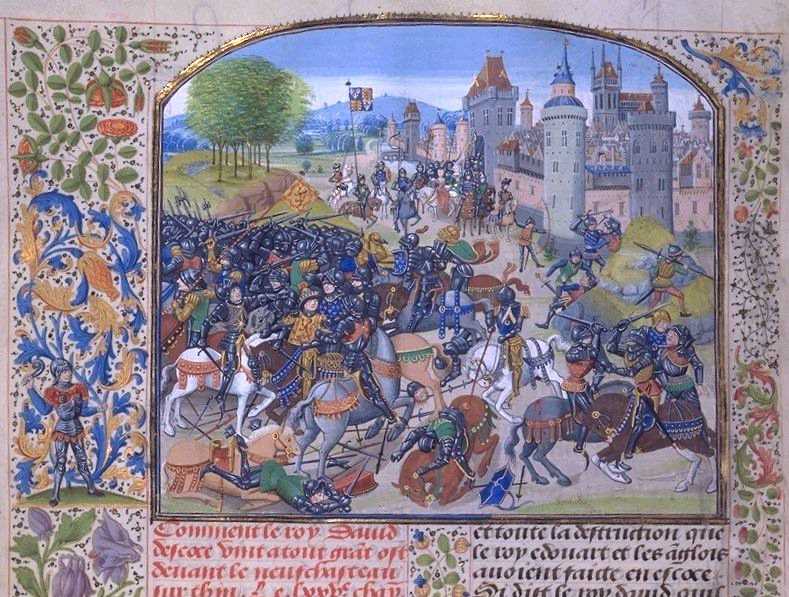
lives. Moving north the real battle took place on the Red Hills in the vicinity
of a stone cross called Neville's Cross (which existed before the battle). Arrows
were fired, axes began hacking, swords were thrusted and as the bloodbath
continued the indication was that the Scots were going to lose. David, the
Scottish king fled from the scene.In the far distance praying monks spectated
from the Cathedral’s central tower while nearby on a hill called the
Maiden's Bower atCrossgate Moor other monks watched at closer quarters. Here
they held high the holy cloth of St Cuthbert, which was a call for the support
of God in this battle.
The call seemed on this
occasion to be answered as the Scots were easily defeated. Meanwhile in the
vicinity of Aldin Grange where the road from Crossgate to Bearpark crosses a
tributary of the Wear called the River Brownley, a Northumbrian soldier by the
name of Copeland came across a rather exciting discovery, for there beneath the
arch of Aldin Grange Bridge lay hiding none other than David King of the Scots
who was badly injured from two spears that had pierced his body. Copeland
quickly captured the Scottish monarch and for a time the English held on to him
for ransom.
Eventually a fee was
agreed for the return of King David to Scotland and he was released. The canny
Scots never paid the fee !. The Victory at Neville's Cross was long commemorated
in Durham City folklore by local children. Boys of the city traditionally
claimed that if you walked nine times around the Neville's Cross and then put
your head to the ground you could hear the sound of battle and the clash of
arms. Attempted today it is more likely to distract motorists and result in the
sound of clashing cars.
|
|