 The
Jacobite Risings and the Battle of Culloden (16 April 1746) The
Jacobite Risings and the Battle of Culloden (16 April 1746)
The vote for union had been close, especially if
one discounts the votes of self-seeking nobles (such as Argyll, it must
be said), even though the economic benefits of union were to prove
beneficial for Scotland overall.
The Scots loved their country. But why would they support the Stuarts,
who had been so cruel to them? Most of them didn't. Truthfully, whether
they were happy with the union or not, there was no love lost between
protestant Scotland and the Stuart dynasty.
The highlands were a different story. Here, many of
the clans were still Catholic and supported a Catholic dynasty,
particularly one with its roots in Scotland. Another factor was the
highland loathing for the Campbells. Staunchly Protestant from the
beginning, the Campbells, for many reasons, were extremely unpopular in
the highlands. The chiefs' tendencies were always to oppose the
Campbells, in whatever way they could.
Even so, only about half the Highland clans
participated in the risings. They would have been no threat at all, had
the Highlanders not been such feared and fearsome warriors. In any case,
the Highlands were always seen as the best "jumping off" point in any
affort to restore the Stuart dynasty.
The first rising, in 1715, was poorly planned and
executed and failed very quickly. James Francis Edward Stuart seemed
himself rather ambivalent about the throne, not ill content in exile.
This rising had no French backing and, therefore, no money. James turned
around and left practically on the heels of his arrival. Argyll defeated
the Jacobite troops under Mar at Sheriffmuir on November 13 and that was
about it. James retired from Scotland and continued his life on the
continent.
The '45 Rising was instigated by James' son, Prince
Charles Edward Stuart, the young Pretender. He was much more brash and
ambitious than his father, arriving on the west coast with seven men and
refusing to leave. Finally, Cameron of Lochiel was persuaded to back him
and quickly other clans followed suit.
Initially, this attempt had great success, with a defeat of General Cope
at Prestonpans. Pressing on into England was a mistake, and the army
ended up in a slow retreat back to the north of Scotland, though meeting
attack with victory along the way (Falkirk). Nevertheless, the lengthy
retreat, with no money and little food, sapped their strength.
Half-starved and weary men were forced to battle at Culloden, falling in
droves to Cumberland's artillery.
After a year of playing hide-n-seek with the Brits,
Charles made his escape and returned to exile. He was fortunate.
Cumberland "the Butcher" pursued and killed the highlanders without
mercy. Worse, the government in London, having come near to panic when
Charles first entered England, now passed a series of extreme measures
bent on destroying the clan system and the highland way of life.
Bagpipes and tartans were outlawed. Guns were outlawed. The military
bonds between tenants and clan chiefs were outlawed. All powers were
stripped from the chiefs over their tenants. Missionaries came to force
Presbyterianism, roads was pushed through the glens and mountains, the
entire area was policed.
And so passed the end of an age. From the landing
of the Dalriada Scots in 501 AD, the clan chiefs had led, succored, and
guided their people. Now, few could even afford to keep their lands. The
years following would produce the horrifying Highland Clearances,
forcing thousands of highlanders to emigrate or move to lowland cities.
Thousands of men, unable to wear their clan tartans, would chose to wear
the tartans of the Scots regiments, where at least they could enter
battle under the prompting of the pipes.
The moor of Culloden is littered with large stone
markers, each engraved simply with the name of the clan whose men lie in
mass graves beneath. Legend says they come out and fight on the
anniversary of the great battle. Perhaps they rest a little easier now
that the Stone of Destiny has resumed its proper place.
Following the battle of Falkirk the Duke of Cumberland arrived in
Edinburgh on 30th January 1746. The next day the royal army marched
north. The final encounter took place on Culloden Moor. The royal army
had on 15th April 1746 celebrated the Duke’s birthday in its camp
outside Nairn.
The Battle
On that day the highlanders attempted a surprise approach but
failed, falling back to Culloden. On 16th April the royal army followed
the rebels. The royal troops came upon the highland army in a state of
exhaustion and hunger and the two sides took up positions on the moor
outside Culloden House.
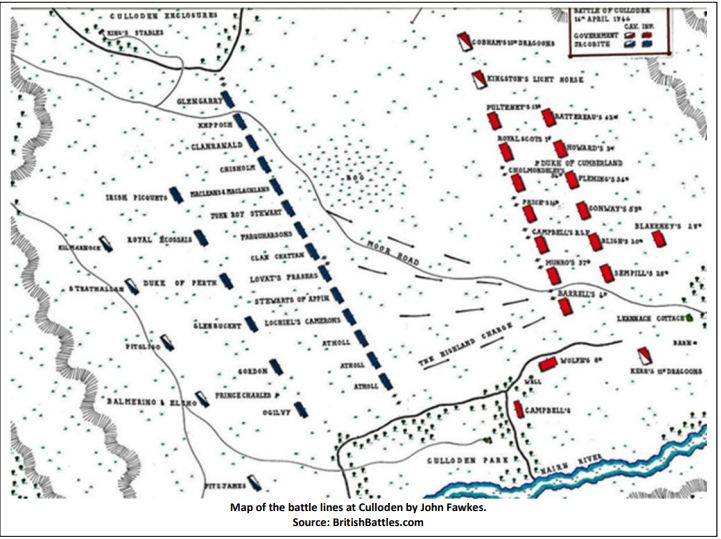
The armies formed facing each other and the battle began with an
artillery exchange. The Jacobite artillery was poorly served. By
contrast the Duke had ensured that he had a full artillery train
properly manned by gunners and officers of experience. The royal fire
told heavily on the highlanders.
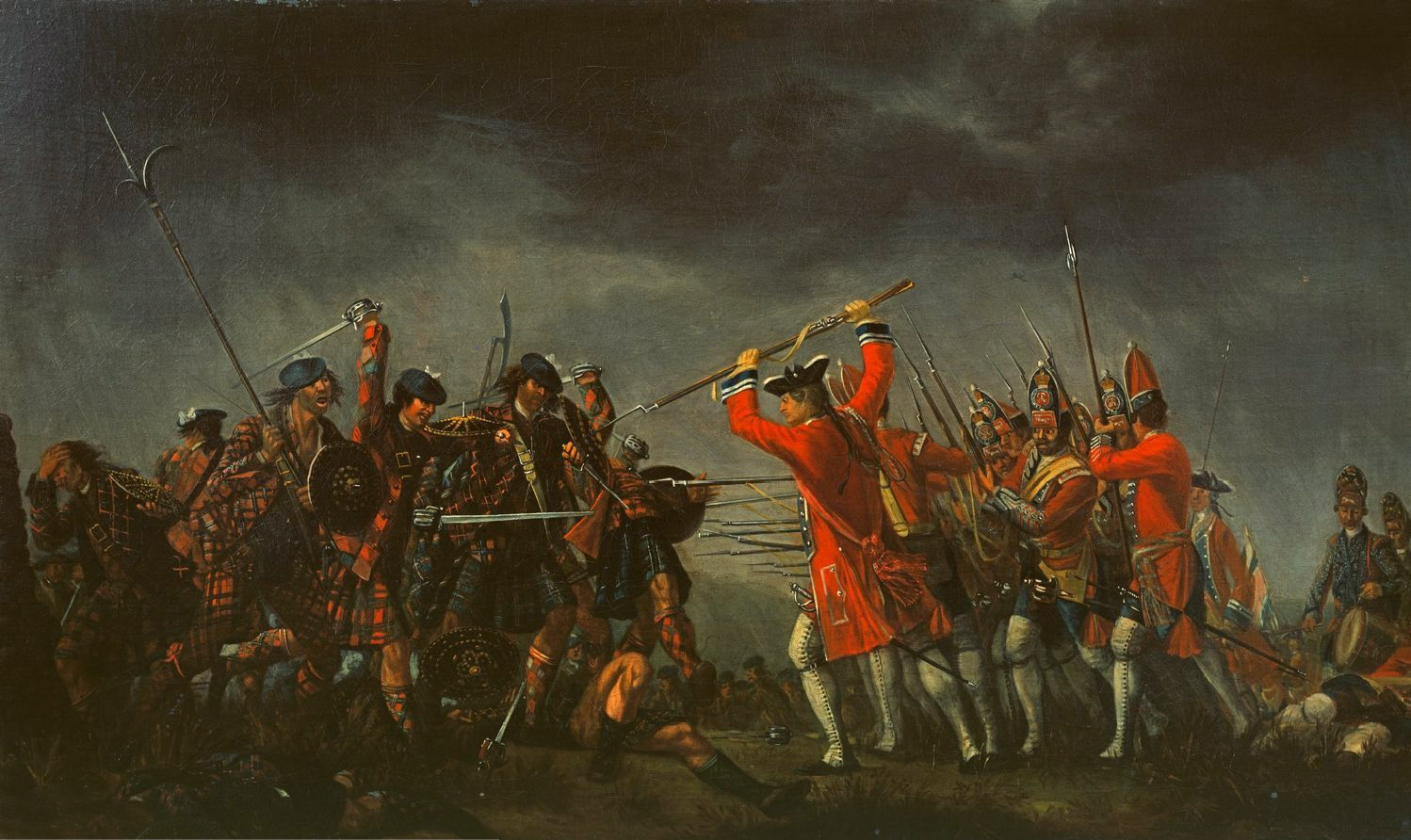
Eventually there was a charge by the Atholl Brigade, the Camerons, Appin
Stewarts, Frasers and Mackintoshes largely against the royal left. There
was time for a single volley into the highlanders followed by savage
hand to hand fighting. The highlanders veered to their right away from
the fire of Campbell’s and Price’s and the attack fell on Barrel’s and
Munro’s on the royal left (as the casualties indicate).
It is said that at this battle the musket and bayonet had the better of
the highland broadsword. The old spirit had largely left the rebel army
and only part of their line charged. The highlanders were overcome and
the Jacobite army left the field pursued by dragoons and royal foot. The
battle took around 45 minutes.
Clans who fought for the prince at Culloden: Cameron, Campbell of
Glenlyon (not Argyll), Chisholm, Drummond, Farquarson, Forbes of
Pitsligo, Fraser, Gordon, Grant, MacBean, MacDonald, MacGillivray,
MacGregor, MacIntosh, MacKenzie, MacLachlan, MacLaren, MacLean, MacLeod,
MacNeil, MacPherson, Menzies, Murray, Ogilvie, Robertson, Stuart. And
many smaller clans and septs.
Few Douglases were involved. We are researching those who were present,
and will add details in due course. Details of one who made good his escape are emerging (March 2005) in
our
Forum.
It is an intriguing tale!
The Muster Roll of the Jacobite Army that was compiled after the battle of Culloden by the Hanoverian Army under the command of the Duke of Cumberland, and it records just seven (7) Douglas names. Three (3) served with the Ecossais Royale, two (2) with the Atholl Brigade, one (1) with John Roy Stuarts Coy Edinburgh, and lastly one (1) with Stewarts Coy which "I think" refers to the Appin Stewart Regiment.
James Douglas served in Stewart's Company of the Duke of Perth's Regiment and Thomas Kerrow Douglas was in the Atholl Brigade.
Sir William of Glenbervie. First son of former Sir William. Married
Had one daughter, Isabel Douglas. Was a supporter of Prince Charlie and
a Jacobite. After Culloden fled to Caithness, and took refuge with his
kinsmen, the Douglas's of Thurso or Wick. Was subject to the Act which
confiscated all estates and titles Of Jacobires. Died at Wick and was
buried at Lysbter Cemetery.
There is a good story from
Sunderland of one survivor.
There are two versions of the tale of Alexander Douglas(s):
a. Alexander Douglass was a Scottish soldier who served in the British Army during the mid-18th century. He was born around 1722 in Ardclach Parish, Nairn, which is located in the northern part of Scotland. Not much is known about his early life, but he is recorded as having fought in several significant battles, including the Battle of Culloden in 1746. After his military service, he settled in Virginia and became a prominent landowner and politician. He died in 1792 and is buried in what is now known as the Douglass Cemetery in Winchester, Virginia.
b. Alexander Douglass, was born about 1722 in Ardclach Parish, Nairn, Scotland. He married Christian Grant, daughter of Alexander Grant and Janet Rose, on July 31, 1751. Eight children were born to them in or near Lynmore, Ardclach. The family emigrated to Boston, Massachusetts, sailing from Inverness, Scotland, and arrived around the time of the Boston Tea Party (1773). Five of their eight children died at sea during the journey. It is believed that Alexander and Christian lived in the Albany, NY area and that they are buried near Lake George (formerly called Caldwell), NY, but no records have been found for them in that area. The family story is that Alexander and his son, John, both fought in the Revolutionary War against England. Of their three surviving children, James returned to Edinburgh, Scotland, Catherine married John Simpson, a fellow immigrant, and John married Patience Taylor.
The following account cannot be correct:
Some of the Berry family fled to the north of Ireland to escape the persecutions, and one of them married Eleanor Douglas, daughter of the "Black Douglas", who had fought the English under the banner of Charles Edward Stewart, "The Young Pretender", in the Battle of Culloden Moor, in 1776. The English were victorious, and Douglas with his daughter Eleanor fled to Ireland.
Meanwhile,
further contributions to the is article would be very welcome.
See also: Prisoners of the '45
|
|