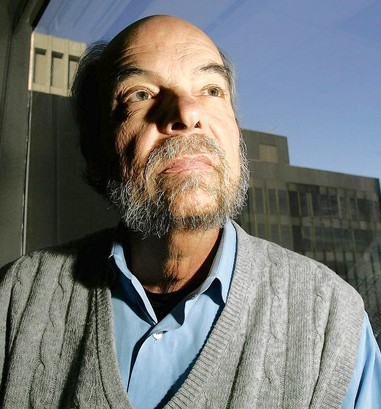
 Peter M. Douglas (1942-2012) was for more than a quarter-century was
executive director of the California Coastal Commission, the powerful
regulatory agency he helped create.
Peter M. Douglas (1942-2012) was for more than a quarter-century was
executive director of the California Coastal Commission, the powerful
regulatory agency he helped create.Born into a Jewish family in Berlin on 22nd August 1942, Douglas fled the Nazis with his family when he was a child and settled in Southern California, having immigrated to the United States in 1950.
As a child crossing the English Channel with his family to immigrate to America, Peter M. Douglas was mesmerized by the churning seas and his first sighting of a whale, an experience that he said forged an "intangible, unbreakable, lifelong bond" with the ocean that deepened as he grew up in Southern California.
That fondness for the ocean would later lead him to become one of the fiercest and most controversial guardians of the state's 1,100-mile-long coastline who battled to preserve its natural beauty and public access to its beaches.
He was the main author of California's landmark coastal protection law and for more than a quarter-century was executive director of the California Coastal Commission, the powerful regulatory agency he helped create.
Douglas, 69, who died Sunday at his sister's home in La Quinta, relinquished his day-to-day duties at the commission last June after a cancer diagnosis and retired in November.
He was a seminal figure in conservation as the principal author of Proposition 20, a grass-roots initiative approved by voters in 1972 that created the California Coastal Commission and gave it control over development along the state's coast. He later helped write the 1976 Coastal Act, a landmark law that became a model for other states and countries and made the commission a permanent body with an unusual degree of autonomy.
As executive director since 1985, Douglas guided the 12-member commission on many contentious issues, including blocking offshore oil drilling and leasing, sharply restricting coastal construction and expanding public access to the beach. He and his staff settled a number of complex disputes involving coastal resources, including an unprecedented expansion plan for the ports of Los Angeles and Long Beach that added 500 acres of landfills and cargo terminals while compensating for the loss of marine habitats.
"Peter maintained public access to the coast so that it wasn't just something that belonged to the rich," said Warner Chabot, former executive director of the California League of Conservation Voters. "Probably his greatest achievement wasn't what you see," he added, "but rather a political achievement .… He created a commission that enabled citizens to take direct action to protect their coast and be seen as equals with the very rich and powerful landowners along the coast."
In the process, Douglas made many enemies. Both Democrats and Republicans tried to remove him from his post and slashed the commission budget. Developers campaigned strenuously to reduce his and the commission's influence, persuading the U.S. Supreme Court in 1987 to limit the panel's power to carve public access ways into private ocean-front property in exchange for granting building permits to the property owner.
The most fundamental challenge came in 2002, when critics led by the conservative Pacific Legal Foundation won lower-court rulings that found the method for selecting commission members unconstitutional, which threatened to overturn hundreds of commission decisions. The conflict was settled by the California Supreme Court, which rejected the critics' arguments.
"The goals and objectives of the Coastal Act are to better the environment, give due-process rights and protect the liberties of property owners. Unfortunately Peter Douglas and the Coastal Commission ignored the protections that are guaranteed in the act," said attorney Ronald Zumbrun, a frequent adversary who led the unsuccessful constitutional challenge.
At the same time Zumbrun acknowledged that Douglas brought formidable skills to his leadership of the agency. "Peter has been such a dominant person and so effective in his maneuvering and political instincts, I doubt anyone can match that," Zumbrun said.
Bearded and fond of wearing Birkenstock sandals to the office, Douglas described himself as a "radical pagan heretic," who often spoke of his deep spiritual bond with nature.
He was initially diagnosed with throat cancer in 2004 and was declared cancer-free in 2010 before discovering a month later that he had advanced lung cancer.
As his cancer progressed, he wrote of his beliefs about life and death in lengthy, highly philosophical emails to friends. He halted mainstream Western medical treatment in favor of Eastern therapies, abandoned his strict vegan diet and wound up outliving his doctors' dismal prognoses by many months, applying the same drive and optimism to his personal fight as he had to his job as chief steward of California's coast.
"Part of the reason for his success is he was not the typical bureaucrat," said Melvin L. Nutter, who was commission chairman when Douglas was promoted to executive director. "He was a poetic visionary. His vision … helped sustain the coastal program as well as his career."
Douglas was born in the German capital of Berlin on Aug. 22, 1942. When he was 2, Allied bombers destroyed his home, causing him to flee with his family to a friend's farm near the Polish border and eventually to an area in Bavaria controlled by American forces. In 1950, he immigrated to the United States.
As a youth in Southern California, he surfed off Redondo Beach and camped in the desert and mountains.
In 1965 he earned an undergraduate degree in psychology at UCLA. After studying for a year in Germany, he entered UCLA's law school, where he plunged into antiwar and social justice movements and co-founded a law collective. After completing his law degree in 1969, he and his German-born wife, Rotraut, moved abroad for a few years. Environmentalism was not yet on his radar.
He returned to the U.S. in 1971 and accepted a job in Sacramento on the staff of then-Assemblyman Alan Sieroty, a Democrat from Los Angeles, who put him in charge of writing laws to protect the state's coastline. The challenge "quickly grabbed me and never let me go," Douglas recalled in a personal blog last year.
In the late 1960s and early 1970s, oil spills off Santa Barbara and waterfront developments in enclaves such as Malibu had created a sense of urgency about threats to the state's scenic shoreline. The coast, Douglas told The Times in 1996, "was in a very precarious state. It was clear that unless something drastic was done, it would be irretrievably lost or compromised."
Despite fierce and well-financed opposition by coastal landowners, developers and oil companies, the Coastal Commission was created in 1972 when voters passed Proposition 20. Douglas then helped craft the Coastal Act, which was adopted in 1976 with bipartisan support. In 1977 Douglas joined the commission staff as deputy director. Eight years later, he was narrowly approved as executive director.
He counted among the commission's most significant achievements defeating a proposed toll road skirting San Onofre State Beach, a liquefied natural gas terminal off the Ventura County coast and the development of Hearst Ranch. He considered the decision to allow housing subdivisions along the Bolsa Chica wetlands one of its worst failures.
During his tenure he weathered about a dozen attempts to oust him, the most serious of which came in 1996, when the commission was dominated by Republican appointees. The effort failed after hundreds of Douglas' supporters packed the commission meeting in protest, many of them chastising members for what they considered a blatantly political move. Douglas attributed the attack on him to his opposition to the Bolsa Chica housing project and Southern California Edison's efforts to renege on a promise to mitigate environmental impacts caused by the San Onofre nuclear plant in northern San Diego County.
"The coast," Douglas told The Times in 2001, "is never saved. It's always being saved. The job of environmental stewardship of the coast is never done. It's never dull, and it's never done."
Family
Peter M. Douglas was born into a Jewish family in 1942 in Berlin. The family eventually fled to live with relatives in Southern California.
Douglas, who had homes in the Marin County city of Larkspur and on the Smith River in the state's northernmost Del Norte County, was divorced from his wife Rotraut Douglas, of Petaluma, and is survived by her and their two sons, Vanja Douglas, of Redwood City, and Sascha Douglas of Larkspur; a sister, Christina Douglas, of La Quinta; a brother, Dieter Claren, of Australia; and two grandchildren, Charlie and Madelina Douglas, of Redwood City.