Sir James Douglas
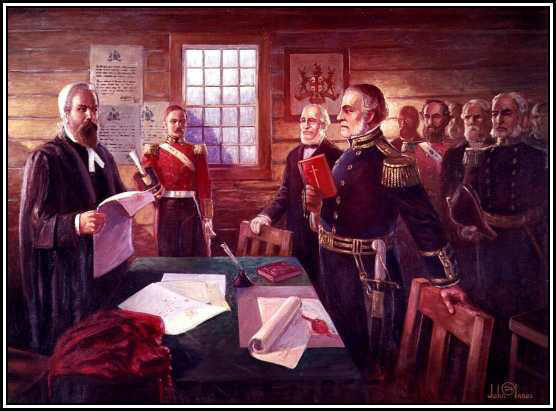
John Innes' paintinJohn Innes' painting of the inauguration of the Crown
Colony of British Columbia. The event took place in the Big
House at Fort Langley on November 19, 1858, when Sir Matthew
Baillie Begbie, the newly appointed Chief Justice, swore in
James Douglas as the first Governor of the Crown Colony of
British Columbia.
Lieutenant Governor, Vancouver
Island: 1 Sep 1851 - 25 Mar 1864
Governor, British
Columbia: 22 Mar 1838 - Oct 1839 and Nov 1845 - 11 Mar 1850
Lieutenant Governor, British Columbia: 19 Nov 1858 - 20 Apr
1864
Sir James Douglas 1803–77, Canadian fur
trader and colonial governor, b. British Guiana (now
Guyana). As a young man, he went to Canada in the service of
the North West Company; soon after its merger (1821) with
the Hudson's Bay Company, he accompanied the noted John
McLoughlin to the Columbia River country. Rising eventually
to chief factor, he succeeded (1846) McLoughlin in command
of the Hudson's Bay Company territory W of the Rockies. On
Vancouver Island, on the site of the present Victoria, he
built (1843) Fort Camosun (later Fort Victoria), which
became (1849) the western headquarters for the company. In
1851 he was appointed governor of Vancouver Island, and in
1858 he also became governor of the new colony of British
Columbia on the mainland. At this time Douglas severed his
long association with the Hudson's Bay Company. His
governorship, which extended until 1864, was marked by a
firm control of the colonies' affairs, made particularly
turbulent by the gold rushes to the Fraser River and to the
Cariboo region. Shortly before his retirement he was
knighted (1863).
Source: AllRef.com
======================
It was in 1857 that the British and American governments decided
to do the actual survey to establish the boundary between the United
States and British Columbia. Survey gangs working east had no problems
other than mosquito plagues. Problems did arise with those working west.
According to the Oregon Boundary Treaty of 1846 the line was to
follow the 49th parallel to the middle of the channel
separating Vancouver Island from the mainland. From there it was to
follow the middle of the channel southward about Vancouver Island to the
Pacific Ocean. The initial treaty totally ignored the many islands
between the two which were naturally claimed by both sides. This blunder
almost brought the United States and Britain into a war. Governor
Douglas was in favour of going to war against the Americans and went so
far as to have Moody's engineers taken away from their many projects and
placed on standby in case of an attack. The British government
discouraged any hostilities because Britain was involved in wars in
other parts of the world.
It took Governor Douglas until February 4,
1859 to issue the first Pre-emption Act whereby land could be purchased
at the upset price of ten shillings per acre, half cash and the balance
in two years. A second one passed on January 4, 1860, provided for
pre-emption of rectangular blocks, of which the shorter should be at
least two-thirds the length of the longer side. The settler had to
stake out the four corners of his property and pay a registration fee of
eight shillings to the nearest magistrate. These acts were amended from
time to time over the next couple of years. The first man to pre-empt
land in Langley was Kenneth Morrison. He pre-empted 160 acres just
upriver from the fort. He called his home Barvis, in honour of his
birthplace, and operated it as a stopping house for the miners. His
friend John McIver also pre-empted on the south side of the river. He
took up land west of the fort opposite the Katzie Indian Reserve.
Both Morrison and McIver were present at the Crown Colony of
British Columbia's birth. As the boats came up the river with the
dignitaries the pair posted themselves in the fort's bastions and (44)
fired salutes of welcome. Later McIver, like so many others, left to
prospect in the Kamloops area. He mined at Cherry Creek, just outside
Kamloops, where he lived with an Indian girl and fathered her child.
When the 'Chilcotin War' broke out in 1864 he joined a punitive party
headed by Donald McLean, ex-Chief Trader at Kamloops, to go after the
Indians accused of murdering the Alfred Waddington road building party.
McLean, upon leaving the company had built the Hat Creek Stopping House
on the Cariboo Road out of Ashcroft. McLean, upon going into battle,
always wore a bullet-proof steel-plated breastplate for protection.
Unfortunately for him he bragged to one too many Indians about it. A Chilcotin
Indian killed him with a bullet in the back. McIver was closest to him
at the time of the shooting. Upon returning to Langley, McIver learned
that his original pre-emption had previously been a potato patch
belonging to Chief Michel of Katzie. The Royal Engineers had
investigated the dispute and issued McIver a piece of land on the
opposite side of the river while he was away.
--------------------------
James Douglas is a legendary figure in
British Columbia, from his fur trade days at Fort St. James to his dual
governorship of Vancouver Island and British Columbia.
In his
official capacities as a Chief Factor with the Hudson’s Bay Company and
as governor, Douglas earned a reputation for discipline and sternness.
Old Square Toes was a most appropriate nickname if the dour, haughty
expression we see in his photographs was how he appeared in everyday
life.
As important as his public contributions were, Douglas
is also of great interest to historians for his personal life. He was
born in 1803, the illegitimate son of a Scottish sugar planter and a
“free coloured woman”, in British Guiana. His mother was probably a
descendant of a black, slave woman and a European man stationed in the
West Indies. James Douglas lived in the planter and slave society in
British Guiana until the age of nine. In 1812, his father sent him to
Scotland to attend school. There he met many of his father’s extended
family, members of the well-to-do planter and merchant class in Glasgow.
But it was the fur trade that attracted young James and so he headed for
Canada at age sixteen not to return to Scotland for 45 years.
After several years in the fur trade, Douglas was posted to Fort St
James, B.C. This northern outpost became his centre of activities during
his first years in British Columbia. At Fort St James, he met Amelia
Connolly, the daughter of Irish-born Chief Factor William Connolly and
Suzanne, a Cree woman of the Fort Churchill area of Hudson Bay. In the
absence of clergy they were married “in the custom of the country” and
together had 13 children, of whom only 6 lived to adulthood.
Through the 1830s and ’40s the Douglas family resided at Fort Vancouver,
then they moved to Fort Victoria. In Victoria they built a large home at
James Bay where domestic life was kept quite separate from the routine
of the fort. The marriages of their daughters and the arrival of many
grandchildren occupied the home life of Sir James and Lady Amelia
through the 1860s. Douglas experienced grave disappointment over his son
James, who was a sickly lad and did not do well in school. Each of the
children’s families add fascinating new stories to the Douglas family
history. For example, Cecilia Douglas married Dr J.S. Helmcken through
whose reminiscences and descendants we have learned a great deal about
the Douglas family and days in early British Columbia.
Upon
his retirement in 1864 Sir James took a year-long holiday to Britain and
continental Europe where he visited relatives and saw the grand sights.
When death came in 1877, Douglas was buried in the large family vault at
Ross Bay Cemetery where his bones still lie surrounded by those of other
family members.r>Copyright 1999 Royal British Columbia Museum
====================================
Scholars who have sScholars who have studied his life do not agree on the exact date of
his birth. Two different dates are the most likely: June 5th and August
15th. So, we know that he was born in the summer of 1805. The second
point of contention is the place of his birth. It is known, from one of
his daughters, that he was born in Lanarkshire, Scotland, but no one
believed an old lady named Agnes Douglas Bushby when she related that
fact. Agnes died in 1928, after giving that information to Professor
Walter Sage, one of Douglas' many biographers. From the papers of old
friends and colleagues of Douglas during his days in the Hudson Bay
Company's fur trade, it is quite definite that he was born in the
tropical colonies of the British West Indies, in either Jamaica or
British Guyana. From what remains of his father's mention in history,
most scholars agree today that James Douglas was horn in Demerara,
Guyana, where his father ran a sugar plantation and other family
business interests. It is positive that James Douglas had a brother and
sister who were born there also.
His father left Guyana in 1809, with
the children, and settled in Glasgow. There he married a Scotswoman,
Miss Jessie Hamilton. Therefore, James and his brother and sister were
probably illegitimate. This led to the last item of discussion about his
origins: the identity of his mother. No one knows who she was. A friend
and colleague of Douglas wrote that she was a Creole. More than that is
not known. Any reader familiar with the history of the West Indies at
the time of James Douglas' birth will, however, feel an urge to conclude
that she was a Black slave.conclusion woulThe conclusion would not be farfetched. James Douglas was
"remarkably dark of complexion, a matter often commented on", says one
of his biographers, M. Derek Pethick. And he goes on to point out that
in a letter written by Letitia Hargrave, "someone familiar with much
personal detail about important officials of the Hudson's Bay Company"
while Douglas "was still in the early years of his career" referred to
him as a "mulatto".
On May 7th, 1819, James Douglas, not yet 16, embarked at
Liverpool to enter the service of the North West Company.une, 1858, almoIn June, 1858, almost 40 years later, he was Governor of the
Colony of vancouver Island, and without ever having to reach for it, he
was well on his way to immortality. Indeed, Douglas started in lower
Canada with the North West Company, moving westward gradually, following
orders. The North West Company was eventually absorbed by the Hudson's
Hay Company, but nothing changed in Douglas' life; he remained a loyal
officer of the fur trade. In 1842, the company felt that new
headquarters were needed on the Pacific Coast; it was clear then that
what are now the territories of the states of Oregon and Washington
would in time fall under American jurisdiction. Douglas was asked to
find a site in the south of Vancouver Island. The headquarters were
effectively moved there in 1849, the year Vancouver Island became
officially a Crown Colony. In 1851, Douglas, while remaining the Chief
Factor of the Hudson's Bay Company, became Governor, He would have
remained an obscure autocrat leading a forgotten and remote land, had
not gold been Found in 1857. The California goldfields had not lived up
to the dreams of thousands who rushed there a few years before. Those
disenchanted miners were more than ready to try their luck again, up
north. In the Spring of 1858, the small community of Fort Victoria
numbered some 500 souls, but their village was the gateway to the gold
of the Fraser River. During that Spring, the small community of Fort
Victoria was overrun by the arrival of a few thousand goldseekers in
transit.
Among them were a fear Black families, who were bona fide
settlers, raking refuge in the British colony from years of persecution
in California. The goldseekers were of all nationalities, but most of
them were Americans and ready to ask the annexation of these
territories. some of them were rowdy, and soon there was a public outcry
calling for a policing force.
In June of 1858, James Douglas, Governor of the Colony of
Vancouver Island, appointed the colony's first policemen. "In a striking
move" he chose all Black men. Jamaican. British subjects! "strikingThis "striking move" marks for the historian, the beinning of a
series of decisions, reversals, hesitations and silences that cloud any
possible assessment of Douglas' attitude and personal feelings towards
the Black community. It is clear, however, that the Black pioneers were
welcome and that the settlement helped Douglas and the interests of the
British Empire. The Blacks, persecuted in San Francisco, were unable to
identify with the American expansionism; they just enlarged the
population on which the Governor could count to maintain the legitimacy
of the British rule on the lands lying north of the Juan de Fuca
passage.
Douglas' life has been studied at length; he has been viewed as
the "sealant of two empires", an autocrat, a "coureur des bois" who got
lucky in big-time politics, and again as an efficient public accountant
who also took care to have his daughters marry "well" – considering the
times, the place and the breadth of the territory under his
jurisdiction, it is peculiar that he never emerged as the first modern
master-statesman in British Columbia's history.
Source: http://www.multinova.com/canroots/blackframes/Douglas.htm ---------------------------------------------------------------------------------------------------------
Frederick James Douglas was born on either June 5 or August 15,
1803 in British Guiana. A "Scotch West Indian," as he was known in the
fur trade, James Douglas was the son of John Douglas. John Douglas and
his three brothers, merchants in Glasgow, held interests in sugar
plantations in British Guiana. Placed at an early age in a preparatory
school in Scotland, James Douglas learned "to fight [his] own way with
all sorts of boys, and to get on by dint of whip and spur." He received
a good education at Lanark, and probably further training from a French
Huguenot tutor at Chester, England. During his early years in the fur
trade he was singled out for having a sound knowledge of the French
language and "possessing a clear and distinct pronunciation."At the age
of sixteen James Douglas and his brother Alexander were apprenticed to
the North West Company. After sailing on May 7,1819 on the brig Matthews
from Liverpool, bound for Quebec, James Douglas proceeded to Fort
William, arriving on August 6. That winter he applied himself to
accounting, learning business methods, and studying the Indian
character. It is not unlikely that he already displayed those
characteristics for which he became noted: industry, punctuality,
observance of the smallest detail, and a determination amidst the most
pressing business to acquire knowledge of literature and history,
politics and public affairs.
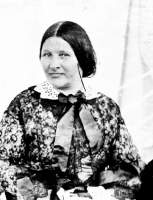
Lady Amelia Douglas
Of their
13 children, only 6 survived childhood:
| name |
born |
married |
| Cecilia |
1834 |
Dr. John Sebastian Helmcken7
in December 1852. Cecelia's life was cut short. She died at the age of
31, leaving behind young children for her husband to raise by himself.
They had seven children altogether, though only four of them survived. |
| Jane |
1839 |
A.G. Dallas in March 1858, who succeeded Douglas as head of the
Western Department of the Hudson's Bay Company. After the death of her
first child in 1860, Jane and her husband left Victoria for Rupert's
Land, where A.G. Dallas had been appointed Governor. |
| Agnes |
1841 |
Arthur Thomas BushbArthur Thomas Bushby May 1862. She was
engaged for three years to Arthur Bushby, an Englishmen serving as
private secretary and clerk of the court to Judge Begbie. In 1862 her
husband was promoted to Registrar General of British Columbia. The
couple lived in New Westminster. |
| Alice | 1844 |
Charles Good in Canada August 31,
1861, and in the US just prior to August 31, 1861. They later
divorced and remarried.
Alice caused a scandal in Victoria
when at the age of seventeen she eloped with Douglas' private
secretary Charles Good. Douglas sent a government agent after them,
but it was too late. The couple had been married by an American
Justice of the Peace at Port Townsend.
When they returned the next day,
Douglas insisted they go through a second marriage ceremony, as he was
uncertain about the validity of it, so on August 31, 1861, they
re-exchanged their vows in Victoria. The marriage was not a happy one,
however, and eventually obtained a divorce, and later remarried.
"Had she trusted her Father
more, and put less faith in God, how different, and how much more
happy would her lot in life have been"
-James Douglas |
| James William |
1851 |
Mary Elliott in 187Mary Elliott in 1877. He was sent to
school in England. It had been Douglas' aspirations that he graduate
from a respected university and pursue law, but his health was never
good enough to fulfil his fathers aspirations for him. His father felt
that he lacked application, and moved him from one school to the next.
In 1870, James came home for a holiday and never came back, though his
health somewhat improved. James studied law for a time with the first
premier of BC, J.F. McCreight. He was eventually elected to the
Provincial Legislature, serving as a junior member for Victoria from
1876 to 1878. The year of his fathers death, James wed Mary Elliott,
the daughter of BC's Attorney General A.C. Elliot. James died at the
age of thirty two. |
| Marthe |
1854 | Dennis Harris in 1878.
Between 1872 and 1874, Martha was sent to school in England to, as
her father says ". . . get rid of the cobwebs of colonial
training and give you a proper finish." He would write he a few
lines to her almost daily, and send them in a letter once composed.
These "Letters to Martha" are available in the British
Columbia Archives (BCARS EB 124A 1866-1869), and provide fascinating
insight into the Victorian era and the Colonies early civic and
provincial development.
Martha married Mr. Dennis Harris in 1878, a grand affair in high
Victorian style. |
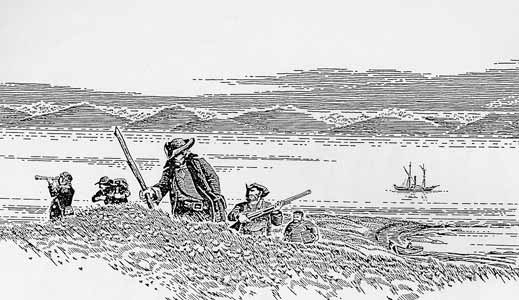
When Hudson’s Bay Company Chief Factor James Douglas landed on
Clover Point (Victoria, British Columbia) in 1842, he named it for the acres of tall red clover growing
“most luxuriantly.” Douglas reported to John McLoughlin on July 12,
1842:
"In two places particularly, we saw several acres of clover
growing with a luxuriance and compactness more resembling the close
sward of a well-managed lea than the produce of an uncultivated waste."
(“The Founding of Victoria,” The Beaver, Outfit 273, March, 1943, p. 6)
Douglas wrote to his friend James Hargrave: “I was...delighted in
ranging over fields knee deep in clover, tall grasses and ferns reaching
above our heads, at these unequivocal proofs of fertility.” (James
Douglas to James Hargrave, February 5, 1843, G. P. de T. Glazebrook, ed.
The Hargrave Correspondence, p. 421)
The most likely clover
species referred to by Douglas is Springbank Clover (Trifolium
wormskjoldii), according to botanist Dr. T. Christopher Brayshaw. Local
First Nations people cared for and managed the land for centuries in
order to harvest edible plants such as camas and clover.
Historical accounts describe James Douglas, Capt. Grant and other
Hudson’s Bay Company employees landing at Clover Point and walking
through Beacon Hill Park to reach Fort Victoria. Their canoe crews took
an alternate river route inland from Ross Bay, following a stream which
emerged where the Empress Hotel now stands. "Lost Streams of Victoria,”
a map with commentary by Jennifer Sutherst, describes that route:
The stream that the Empress hotel was built upon was unnamed and
flowed from a wetland in the vicinity of Cook and Moss streets. This
wetland was connected to another creek which ran into Ross Bay thus
linking the bay with Victoria's inner harbour. Oral history indicates
that the First Nations would use this waterway as an alternate route
during heavy winter storms. During wet winter periods when the tides
were high they would be able to paddle from Ross Bay to the inner
harbour thereby avoiding the heavy weather on the outer coast. (Jennifer
Sutherst, "Lost Streams of Victoria," May, 2003. South Islands Aquatic
Stewardship Society, Fisheries and Oceans Canada.)
 |
|
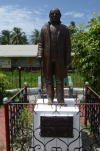
A statue of James Douglas sits outside Fort Langley, where he was proclaimed the first Governor of the Colony of British Columbia in 1858. (Christian Amundson/CBC News) |
| |
|
|
 |
|
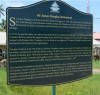
Location: Mahaica District, East Coast Demerara
Built: 2008
Sir James Douglas was born in
British Guiana on August 15, 1803. He was the son of
Scottish man, Mr. John Douglas and Barbadian mulatto
woman, Ms. Martha Ann Telfer. During his early years, he
lived on his father’s plantation named Belmont in the
Mahaica District along with his two other siblings; his
parents were never formally married. In 1812, he and his
father travelled to Scotland where he continued his
education. In 1819, he moved to Canada where he started
his apprenticeship at the North West Company. In 1821,
after the company was merged with Hudson Bay Company, he
was hired as an employee. Sir James Douglas would go on
to become the chief trader for the organisation.
Douglas is hailed as the ‘The Father of British
Colombia’ which is now a part of Canada’s sovereignty
for his many contributions made to the then British
colony. He held a number of titles such as the first
Governor of British Colombia from 1858 and Governor of
the colony of Vancouver Island from 1851. Douglas was
married to Amelia Connolly and together they produced
ten children. He remained Governor for both Vancouver
Island and British Columbia until 1864, when he retired.
He died on August 2, 1877.
The Guyanese-Canadian
Association of British Columbia, in close collaboration
with the National Trust of Guyana, erected a statue of
Sir James Douglas in honour of his contributions to
Canada and to pay homage to his place of birth. It was
unveiled on August 27, 2008, by Prime Minister Samuel
Hinds in the presence of numerous patrons including
Canadian High Commissioner Mr. Charles Court and
President of the Guyanese-Canadian Association of
British Columbia, Mr. Clyde Duncan.
|
See also:
• Douglas family
of Druimfin, Isle of Mull
• Chief
Douglas' Daughter (poem)
Any contributions will be
gratefully accepted
Errors and Omissions
|
|
The Forum
|
|
What's new?
|
|
We are looking for your help to improve the accuracy of The Douglas
Archives.
If you spot errors, or omissions, then
please do let us know
Contributions
Many articles are stubs which would benefit from re-writing.
Can you help?
Copyright
You are not authorized to add this page or any images from this page
to Ancestry.com (or its subsidiaries) or other fee-paying sites
without our express permission and then, if given, only by including
our copyright and a URL link to the web site.
|
|
If you have met a brick wall
with your research, then posting a notice in the Douglas Archives
Forum may be the answer. Or, it may help you find the answer!
You may also be able to help others answer their queries.
Visit the
Douglas Archives Forum.
2 Minute Survey
To provide feedback on the website, please take a couple of
minutes to complete our
survey.
|
|
We try to keep everyone up to date with new entries, via our
What's New section on the
home page.
We also use
the Community
Network to keep researchers abreast of developments in the
Douglas Archives.
Help with costs
Maintaining the three sections of the site has its costs. Any
contribution the defray them is very welcome
Donate
Newsletter
If you would like to receive a very occasional newsletter -
Sign up!
|
|
|
|
|
|
|
|
|