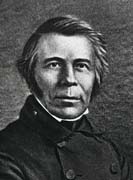
 David
Bates Douglass was born in Pompton, N.J., on March 21, 1790, the youngest
son of Deacon Nathaniel Douglass and Sarah Bates of Newark. Raised in an
iron-mining district, he developed an interest in the natural sciences and
technology from very early in life, encouraged, perhaps, by his mother who
provided his early education. As a teenager, Douglass developed into an avid
and capable student under the tutelage of Rev. Samuel Whelpley, and was
advanced enough to enter Yale as a sophomore with the class of 1813, where
he hoped to prepare himself for a career in civil engineering. He soon
became restless and frustrated, however, with Yale's hide bound curriculum
and its limited course offerings in the natural sciences. Fortunately, the
military afforded opportunities that the university did not. With the War of
1812 providing suitable training and employment for large numbers of
engineers, Douglass secured a commission as second lieutenant of engineers,
and reported for duty at West Point in October, 1813. David
Bates Douglass was born in Pompton, N.J., on March 21, 1790, the youngest
son of Deacon Nathaniel Douglass and Sarah Bates of Newark. Raised in an
iron-mining district, he developed an interest in the natural sciences and
technology from very early in life, encouraged, perhaps, by his mother who
provided his early education. As a teenager, Douglass developed into an avid
and capable student under the tutelage of Rev. Samuel Whelpley, and was
advanced enough to enter Yale as a sophomore with the class of 1813, where
he hoped to prepare himself for a career in civil engineering. He soon
became restless and frustrated, however, with Yale's hide bound curriculum
and its limited course offerings in the natural sciences. Fortunately, the
military afforded opportunities that the university did not. With the War of
1812 providing suitable training and employment for large numbers of
engineers, Douglass secured a commission as second lieutenant of engineers,
and reported for duty at West Point in October, 1813.
Douglass'
distinguished service in the Niagara Campaign of 1814, at the Battle of
Lundy's Lane, and at the siege of Fort Erie earned him a promotion to first
lieutenant and a brevet captaincy in September, 1814. Douglass' personal
courage while in command of an artillery battery at Fort Erie was singled
out for commendation, and credited with helping to ensure victory for the
American forces during the British assault in mid-August, 1814. After
demobilization, the army was reluctant to lose such a promising young
officer to civilian life, and as a result, on January 1, 1815, Douglass was
offered the opportunity to become assistant professor of natural philosophy
at the Military Academy, the only school at the time to offer formal
training in engineering and therefore an outstanding opportunity for an
aspiring young scientist. Throughout his career, Douglass aggressively
sought out every chance to improve his professional standing, pursuing his
interests both in the government service and as a private consultant,
accepting seemingly any project that offered intellectual challenge,
professional betterment, or financial reward. During his first few years at
West Point, he organized the survey of defenses along the southern coast of
New England (1815) and at the eastern end of Long Island Sound (1817), and
he accompanied the commission to determine the Canadian boundary from
Niagara to Detroit in 1819 as an astronomical surveyor. Inadvertently,
surely, even his personal life fed his professional ambitions. In December,
1815, he married Ann Eliza Ellicott (1792-1873), daughter of Andrew
Ellicott, one of America's leading surveyors and long-time Professor of
Mathematics at West Point.
During these years, Douglass became active
in every aspect of life at the Academy, from admissions to teaching and
discipline. He was an important figure in generating enthusiasm among the
cadets and faculty at the Academy for the study of natural history, and at
the same time, he developed an extensive correspondence with scientists
around the country, with museums, other universities and private
individuals, forming a broad network that facilitated the exchange of ideas
and specimens. It was largely through Douglass' efforts that the natural
history collections at West Point were established, and in turn, he became
an important source of specimens for scientists such as Benjamin Silliman,
Parker Cleaveland, and John Torrey.
Among the many projects that
occupied Douglass' time at West Point, he is perhaps best remembered as an
engineer assigned to the Lewis Cass Expedition of 1820, which surveyed the
north-western regions of the Michigan Territory and reported on the economic
potential of its natural resources. From first hearing of the expedition,
Douglass relished the thought of accompanying Cass, and when his old friend,
Col. William A. Trimble, recommended his appointment to Secretary of War
Calhoun, he did not hesitate. Douglass played an important role in surveying
and mapping and in collecting specimens, and after his return, he assumed
the major responsibility of coordinating publication of the survey's
results, working with Cass and Schoolcraft to obtain official permission to
make the results public. Dividing the writing chores among Torrey (botany),
Daniel H. Barnes (conchology), Schoolcraft (geology and mineralogy), Cass
(Native Americans), and himself (geography), Douglass successfully saw the
massive task to completion. At the same time, he arranged with Silliman,
editor of America's most prestigious scientific journal, the American
Journal of Science, to publish a series of miscellaneous articles resulting
from the expedition, including Schoolcraft's important contribution on the
copper deposits of the Upper Peninsula of Michigan.
The death of
Andrew Ellicott in August, 1820, left the chair in mathematics at West Point
vacant, and Douglass stepped in to fill the void. Three years later,
however, he was transferred again, when a position even closer to his
interests came open, the professorship of civil engineering. The move was
timely. With the first fruits of success from the Erie Canal being felt by
politicians and the public, engineering was beginning to garner more and
more attention, and more and more money was becoming available for the
development of a viable infrastructure for communications and transport. By
1823-24, Douglass' interests in internal improvements, and in canals in
particular, was sharpening. Between sessions at West Point, partly out of
financial necessity, he began to take on consulting work, and in 1825,
DeWitt Clinton offered him the plum job of supervising construction of the
difficult western section of the Erie Canal. From this beginning, Douglass
rapidly became one of the nation's leading experts in canal engineering,
consulting widely on projects in New York, Pennsylvania, and New Jersey, and
on the project to link the Ohio River with the Potomac. He was offered a
position as chief engineer for the State of Georgia and the superintendence
of internal improvements in Pennsylvania, but declined both.
After
years of splitting his time between military service and work on public
projects, the War Department accepted Douglass' resignation from the Corps
of Engineers, effective March 1, 1831, allowing Douglass to accept a
position as chief engineer on the Morris & Essex Canal in New Jersey. The
potential lucre of private employment had finally convinced Douglass to
leave the lower pay, but greater security of military life, and he removed
to Brooklyn to begin life as a civilian. Within a year, he landed an
appointment as professor of natural philosophy at New York University, but
relinquished the chair in 1833 when he found that his instructional duties
interfered with his engineering, and instead moved into the professorship of
civil engineering and architecture, with the understanding that no duties
would be required except those that he chose for himself. In actuality,
Douglass lectured only one year, 1836-37, devoting most of his time to
designing the University's new collegiate building in Washington Square.
Douglass' participation in several high profile engineering projects
during the 1830s brought him considerable public acclaim. In 1833, he
surveyed the railroad route from Brooklyn to Jamaica, N.Y., capitalizing on
the growing national enthusiasm for rail travel, and he solved a
long-standing public health problem for the residents of New York City with
his design of the Croton Aqueduct (1833-36), which supplied pure drinking
water to Manhattan for many years. Perhaps his greatest fame, however, was
reserved for his design of Greenwood Cemetery (1838-39) in Brooklyn, one of
the most fashionable and progressive cemeteries in the nation. The Greenwood
ideal of the cemetery as a place of bucolic serenity, artfully laid out to
mimic a natural landscape, dominated cemetery design for the remainder of
the century and had an important influence on the larger culture. Douglass
remained in charge of the development of Greenwood until 1841.
Despite his professional success, Douglass' personal finances remained
shaky, and after the financial panic of 1837, his luck took a turn for the
worse. In 1840, he wrote that his financial affairs were "greatly deranged,"
and that he felt himself "labouring under accumulated embarrassments" (1840
May or June). As a result, he once again sought out the security of a
position with the government, hoping for a post on the Northeastern Boundary
Survey, but this time was passed over. At bidding of Charles Petit McIlvaine,
Douglass accepted the presidency of Kenyon College, beginning March, 1841,
and was also named professor of intellectual and moral philosophy, logic,
and rhetoric. His stay there was less than successful, however, and by
February, 1844, with the college failing to prosper as McIlvaine wished,
Douglass was dismissed.
Returning to engineering and consulting work,
Douglass laid out the Albany Rural Cemetery in 1845-46 and the Protestant
cemetery in Quebec, 1848, both in the style of Greenwood. In August, 1848,
he moved to Geneva College (now Hobart) to become professor of mathematics
and natural philosophy, but not long after moving, he suffered a fall and
paralytic stroke that left him incapacitated, and that ultimately resulted
in his death on October 21, 1849.
 Image
depreciated Image
depreciated |
“Captain
David Bates Douglass acquired this quilled leather pouch in 1820 while
serving as a surveyor for the Lewis Cass expedition to the headwaters of the
Mississippi River. This blackened deerskin pouch is decorated with
quill-embroidered Thunderers, supernatural beings that fly through the sky,
hidden by dark clouds. Thunderers are extremely powerful: thunder booms from
their flapping wings, and when they blink, lightning shoots from their eyes.
The two fish, probably lake sturgeon, may represent the owner’s clan
affiliation. Holes in the upper corners of the pouch suggest a now-missing
shoulder strap. It was probably used to hold herbal medicines, hunting
charms, or tobacco.”
Made of deerskin, porcupine quills, tin cones,
porcelain beads, horse hair, sinew in the late 17th – mid 18th century, it
is held in the Peabody Essex Museum
Note:
I have been informed by the Museum that this is not the pouch
donated in 1822 by Captain Douglas. It would be good to receive a
photograph of the correct item.
Send
image>>> |
Family
Youngest son of Deacon Nathaniel Douglass and Sarah Bates
of Newark
Spouse:
Ann Eliza Ellicott Douglass (1792 - 1873)
Ann Douglass survived her husband along with four sons and
four daughters. Two of the sons graduated from Kenyon College in 1837 and
1838, a third from Trinity College in 1846, and the youngest, Henry, from
West Point, 1852. The first and third sons became clergymen.
Children:
Rev. Charles Edward Douglass (1818 - 1934)
Andrew Ellicott Douglass b1819
Malcolm Douglass b: 19 JUL 1825 in West Point, Orange Co., NY
Col. Henry
Douglass (1827 - 1892)
Emily Douglass b: 10 DEC 1828 in West Point,
Orange Co., NY
Mary Louisa Douglass (1832 - 1906)
The David Bates Douglass Papers, held in William L. Clements Library,
University of Michigan, contain 1,191 letters, documents, and manuscripts
relating to many aspects of Douglass's family and professional life between
approximately 1812 and 1873. The collection is broad, encompassing incoming
letters from scientific and military associates of Douglass, with drafts and
retained copies of some his responses; long love letters to his future wife,
Ann Ellicott (later Douglass); letters between Ann and Douglass; letters
between Ann, Douglass, and the children; correspondence to and from a larger
extended family; and several letters pertaining to the scandal at Kenyon
College. Douglass's interests in internal improvements, natural history,
systems and theories of academic scientific exchange, the education of his
daughters and sons, the complex and numerous relationships and family
connections through which early nineteenth-century American communities were
built, and the Military Academy at West Point are very well-documented.
David Bates Douglass was not the first Douglass in Gambier, nor the last.
Douglass' son, Charles Edward Douglass, graduated from Kenyon in 1837, prior
to his father's appointment to the presidency, while Douglass' great great
grandson, Richard Rickard, worked with Kenyon's School-College Articulation
Program (SCAP) from 1979-1990 and served as director of the program from
1980-1983.
Note:
David Douglass, born 1715 in Hanover Neck, Bergen Co., NJ and died about
1765 married as his second wife, Esther Reed.
One of his
children was Deacon Nathaniel Douglass b. 1760 in
Hanover Neck. He was a resident of Pompton, NJ and a member of the firm of
Vanderpoel and Douglass, leather manufacturers of Newark. In 1813 he removed
to Caldwell, New Jersey and died there in 1824. His wife, Sarah, b. 1762 d. 1816 was
the daughter of David Bates. Their son was Major David Bates Douglass.
|
|