Catherine
Douglas, later Catherine "Kate" spelled Katherine)
was a historical figure involved in the assassination of
King James I of Scotland on February
20, 1437. She was a lady-in-waiting to his queen, Joan Beaufort.
Legend has it that during the King's stay at a Dominican
chapterhouse in Perth, a group of men led by Sir Robert Graham came
to the door searching for the King in order to kill him. The King's
Chamberlain, Robert Stuart, aware of the plot against his life, had
taken the precaution of removing the bolt from the door of the room
in which James and his queen were staying.
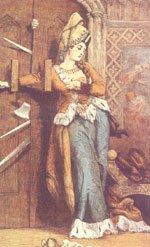
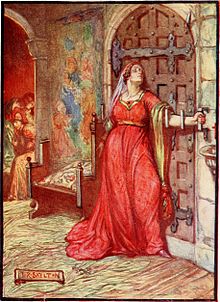
Catherine sprang
to the door and placed her arm through the staples to bar the
assassins' entrance. However, they forced the door open anyway,
breaking Catherine's arm, and discovered and killed the King. From
that point on, according to the story, Catherine took the surname of
"Barlass".
Dante Gabriel Rossetti recounted the story of
Catherine Douglas in verse in 1881, under the title "The King's
Tragedy". This poem contains the line "Catherine, keep the door!" -
possibly the origin of the idiomatic phrase "Katy, bar the door!" (a
warning of the approach of trouble). There are over 800 verses, so I
have not included them here!
Catherine married to Alexander Lovell, and lived at the castle of
Ballumbie.
Note:
The following is extracted
from an unidentified source:
The account re: Elizabeth Douglas, sister of
Sir James Douglas of Ralston (1), discusses her part in defending
King James I during his assassination at Perth in Feb 1436/7. It
also states,
' She afterwards married Richard Lovel of
Ballumby, with whom, on 24 August 1438, she had a charter from
Alexander Lindsay, second Earl of Crawford, of the lands of
Muirhouse, co. Inverness.
In this charter she is styled neptis
of the Earl, which shows that the commonly accepted marriage of her
father to a daughter of Sir David Lindsay, first Earl of Crawford,
is correct. '
[SP VI:366[1], cites Reg. Mag. Sig., 29 October
1463]
The event was commemorated in Dante Gabriel Rossetti's poem The
King’s Tragedy, 1881. The full poem is 173 stanzas, but this
selection shows the possible links with Katy bar the door:
Then the Queen cried, "Catherine, keep the door,
And I to this
will suffice!"
At her word I rose all dazed to my feet,
And
my heart was fire and ice.
...
Like iron felt my arm, as
through
The staple I made it pass:-
Alack! it was flesh and
bone - no more!
'Twas Catherine Douglas sprang to the door,
But I fell back Kate Barlass.
Notes:
1. Sir James Douglas of Ralston was the
son of Sir William Douglas of Lochleven, who was killed In Battle 1421,
possibly Bauge,
in France.
James was one of the protagonists in the famous
Stirling tournament.