Cranshaws Tower
 |
| Photo
by Lisa Jarvis |
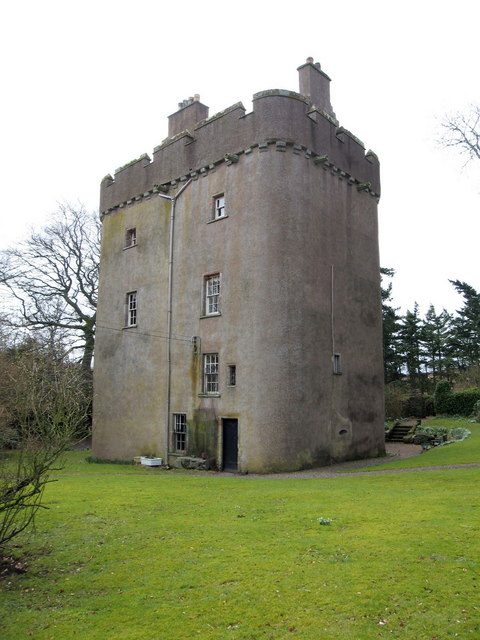
Cranshaws Castle is a well preserved, inhabited peel tower
thought to date from the later 14th century. Rectangular in
plan, it measures 40ft by 26ft and is 65ft high. The rounded
corners are particularly interesting, being reminiscent of other
late 14th century towers such as Drum or
Neidpath.
Built by
the Swinton family, resident in Cranshaws until the early
18th century, the tower became the stronghold of the Douglases
and subsequently, the Douglas Earls of Morton. It was they who
were responsible for alterations to the tower during the 18th
and 19th centuries. With no indication that there was a kitchen
in the main block, it is assumed that ancillary buildings,
enclosed by a barmkin, would originally have surrounded the
5-storey structure.
The
13th Earl of Morton
(1738-68) is said to have removed the ground floor vault so as
to increase the space within, and it is possible he also removed
the ancillary buildings, leaving the tower as a replanned,
re-fenestrated self-contained block.
|
1884 description: The fine old peel tower called Cranshaws
Castle, standing towards the centre of the northern section,
measures 40 by 24 feet, and is 65 feet high ; a former
stronghold of tie Douglases, and the haunt of a drudging
brownie, it now is the seat of the eldest son of the Earl of
Morton, Sholto-George-Watson Douglas, Lord Aberdour (b. 1844),
who, holding 2551 acres in the shire, valued at £1050 per annum,
divides this parish with 2 other landowners. It is in the
presbytery of Dunse and synod of Merse and Teviotdale.
|
Andrew Smith, an Edinburgh
brewer, purchased Cranshaws estate from Lord Aberdour, eldest
son of the Earl of Morton in the late 19th century, and work on
the tower's parapet is thought to date from this period.
Robert Hurd & Partners were commissioned to refurbish the
structure in 1978, and little appears to have changed since
then. Well detailed both inside and out, there are numerous
features which, although not necessarily 14th century,
contribute greatly to the whole.
The sundial and well
within the grounds are inscribed 'A S', 'I F S' and 'A S', 'I F
L' respectively, referring to Andrew Smith and Mrs Ida Frances
Landale (later Smith). Both their initials can be seen on the
nearby gateway to Cranshaws Farm stable courtyard. Swinton
burial ground, thought to date from the 16th century, is set to
the SW of the tower.
See also:
• Dunbars Vs Douglas

Any contributions to this item will be
gratefully accepted
Errors and Omissions
|
|
The Forum
|
|
What's new?
|
|
We are looking for your help to improve the accuracy of The Douglas
Archives.
If you spot errors, or omissions, then
please do let us know
Contributions
Many articles are stubs which would benefit from re-writing.
Can you help?
Copyright
You are not authorized to add this page or any images from this page
to Ancestry.com (or its subsidiaries) or other fee-paying sites
without our express permission and then, if given, only by including
our copyright and a URL link to the web site.
|
|
If you have met a brick wall
with your research, then posting a notice in the Douglas Archives
Forum may be the answer. Or, it may help you find the answer!
You may also be able to help others answer their queries.
Visit the
Douglas Archives Forum.
2 Minute Survey
To provide feedback on the website, please take a couple of
minutes to complete our
survey.
|
|
We try to keep everyone up to date with new entries, via our
What's New section on the
home page.
We also use
the Community
Network to keep researchers abreast of developments in the
Douglas Archives.
Help with costs
Maintaining the three sections of the site has its costs. Any
contribution the defray them is very welcome
Donate
Newsletter
If you would like to receive a very occasional newsletter -
Sign up!
|
|
|
|
|
|
|
|