Battle of Worcester, 1651
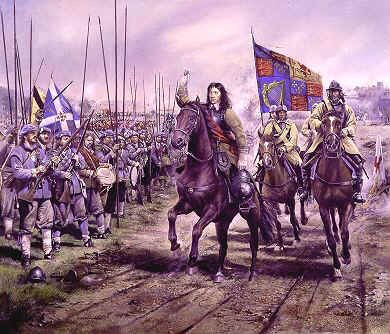
The Battle of Worcester was the final conflict in the
interminable English Civil War. The king in exile, Charles II,
aided by Scottish allies under Sir David Leslie, attempted to
regain the throne lost at his father's death. While Leslie
argued that they should make a stand in Scotland, where support
for the royalist cause was strongest, Charles iunsisted on
carrying the fight into his homeland. He marched his men south
into England, and they came up against Parliamentary forces
under Oliver Cromwell at Worcester.
Charles entered the
city on August 23, and there he paused to allow his men to rest
and gather supplies. Cromwell divided his men into two groups,
and it is likely that all told Cromwell's men outnumbered the
royalists by two to one. Cromwell began a bombardment of the
city and attempted to cross the Severn from the south, but his
men were beaten back. Charles sallied out to attack, but he,
too, was unsuccessful and returned without taking any of
Cromwelll's guns.
Cromwell constructed a boat bridge across
the river, and led his men across. They pushed back the royal
troops, allowing the main Parliamentary army to cross. The
Scottish troops broke and fled, turning the royal retreat into a
rout.
Charles quickly launched a counterattack, pushing
his opponents back in the east. Cromwell was forced to recross
the river to support his men, and after 3 hours of hard fighting
they pushed the royalists back into Worcester.
The city
was surrounded, and troops attempting to flee were quickly
captured by Cromwell's men. Charles left his bodyguard to hold
off pursuit, and fled the field. In a story that has been told
and retold over the years since, he hid from his pursuers in the
leafy branches of an oak tree, before eventually making his way
to the coast and eventual safety in France.
It is
estimated that of the 16,000 strong Scots Army, 3,000 were
killed on the battlefield, between 7 to 10 thousand captured on
the battlefield, and most of the remainder shortly thereafter as
they fled. An estimated 2 to 6 thousand prisoners were deported
to Colonial possessions in the New World, to work as forced
labour.
The following were amongst those taken prisoner:
Col George Douglas - Colonel of Foot, possibly
Sir William of Kirkness's successor following his death at
Dunbar.
Lieutenant of Horse Hugh
DouglasLieutenant of Foot Robert Douglas - listed amongst
prisoners taken to Liverpool, 8 Sep 1651Cornet of Horse
David Douglas - listed amongst prisoners taken to Liverpool, 8
Sep 1651James Douglas,
1st lord Mordington
A (Sir?) John Douglas, of
Hewelsfield in the Forest of Dean was killed in the battle. This
could be Sir John Douglas, one time Field Marshall to the state of
Venice, born in about 1600, whose daughter, Anne, wife of William Gough,
was possibly born there in about 1630, and who was buried on 4 Jan 1669
at Hewelsfield, Gloucestershire, England.
See also:
Prisoners from the Battles of Dunbar (1650) and Worcester (1651)
Any contributions will be
gratefully accepted
Errors and Omissions
|
|
The Forum
|
|
What's new?
|
|
We are looking for your help to improve the accuracy of The Douglas
Archives.
If you spot errors, or omissions, then
please do let us know
Contributions
Many articles are stubs which would benefit from re-writing.
Can you help?
Copyright
You are not authorized to add this page or any images from this page
to Ancestry.com (or its subsidiaries) or other fee-paying sites
without our express permission and then, if given, only by including
our copyright and a URL link to the web site.
|
|
If you have met a brick wall
with your research, then posting a notice in the Douglas Archives
Forum may be the answer. Or, it may help you find the answer!
You may also be able to help others answer their queries.
Visit the
Douglas Archives Forum.
2 Minute Survey
To provide feedback on the website, please take a couple of
minutes to complete our
survey.
|
|
We try to keep everyone up to date with new entries, via our
What's New section on the
home page.
We also use
the Community
Network to keep researchers abreast of developments in the
Douglas Archives.
Help with costs
Maintaining the three sections of the site has its costs. Any
contribution the defray them is very welcome
Donate
Newsletter
If you would like to receive a very occasional newsletter -
Sign up!
|
|
|
|
|
|
|
|
|